Department of Psychiatry and Psychotherapy, University of Lübeck, Ratzeburger Allee 160, D-23562 Lübeck, Germany.
Department of Psychiatry and Psychotherapy, Christian-Albrechts-University of Kiel, Niemannsweg 147, D-24105 Kiel, Germany.
Psychol Med. 2022 Oct;52(14):2899-2916. doi: 10.1017/S0033291722002458. Epub 2022 Aug 18.
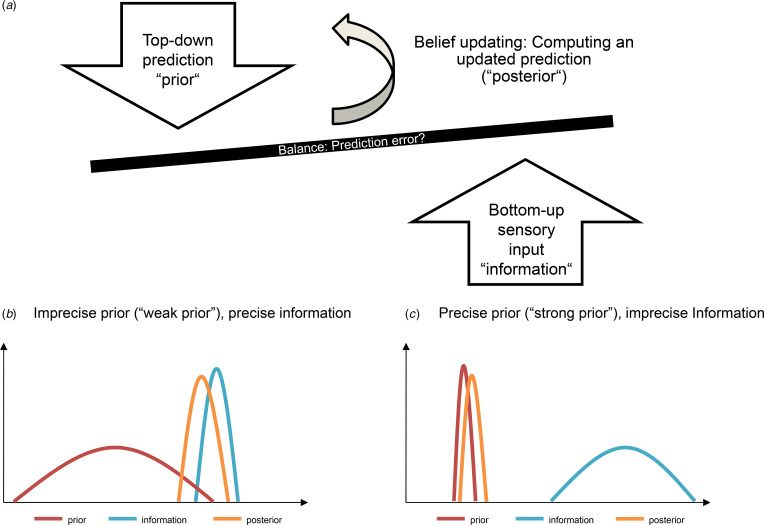
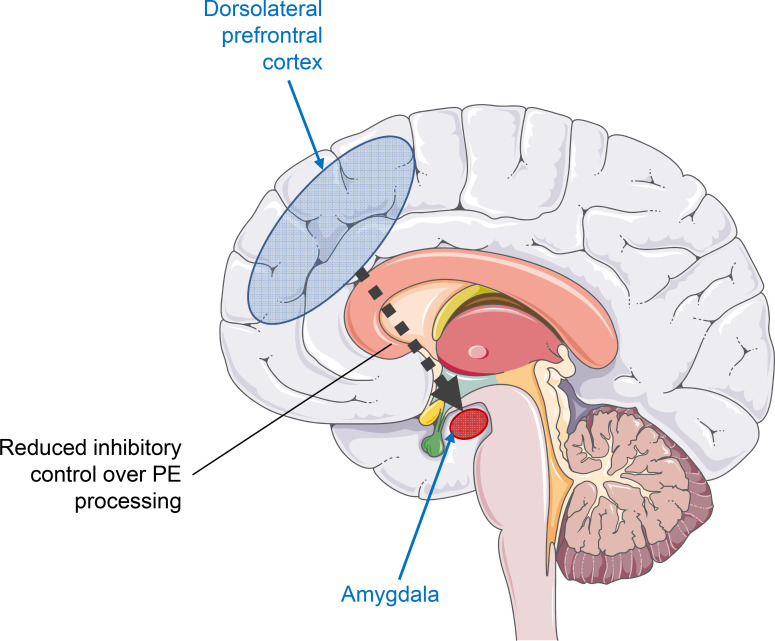
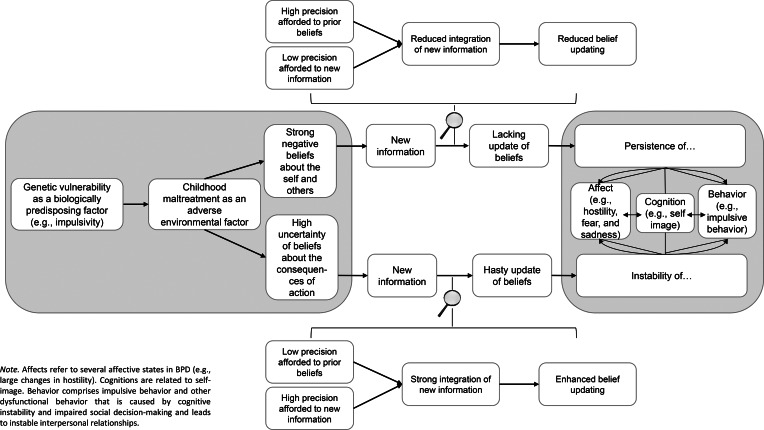
Borderline personality disorder (BPD) is a severe mental disorder, comprised of heterogeneous psychological and neurobiological pathologies. Here, we propose a predictive processing (PP) account of BPD to integrate these seemingly unrelated pathologies. In particular, we argue that the experience of childhood maltreatment, which is highly prevalent in BPD, leaves a developmental legacy with two facets: first, a coarse-grained, alexithymic model of self and others - leading to a rigidity and inflexibility concerning beliefs about self and others. Second, this developmental legacy leads to a loss of confidence or precision afforded beliefs about the consequences of social behavior. This results in an over reliance on sensory evidence and social feedback, with concomitant lability, impulsivity and hypersensitivity. In terms of PP, people with BPD show a distorted belief updating in response to new information with two opposing manifestations: rapid changes in beliefs and a lack of belief updating despite disconfirmatory evidence. This account of distorted information processing has the potential to explain both the instability (of affect, self-image, and interpersonal relationships) and the rigidity (of beliefs about self and others) which is typical of BPD. At the neurobiological level, we propose that enhanced levels of dopamine are associated with the increased integration of negative social feedback, and we also discuss the hypothesis of an impaired inhibitory control of the prefrontal cortex in the processing of negative social information. Our account may provide a new understanding not only of the clinical aspects of BPD, but also a unifying theory of the corresponding neurobiological pathologies. We conclude by outlining some directions for future research on the behavioral, neurobiological, and computational underpinnings of this model, and point to some clinical implications of it.
边缘型人格障碍(BPD)是一种严重的精神障碍,包括异质的心理和神经生物学病理学。在这里,我们提出了一个边缘型人格障碍的预测加工(PP)理论来整合这些看似无关的病理学。具体来说,我们认为童年期虐待的经历,在 BPD 中非常普遍,会留下两个方面的发展遗产:第一,一个粗糙的、缺乏感受力的自我和他人模型——导致对自我和他人的信念僵化和缺乏灵活性。第二,这种发展遗产导致对社会行为后果的信念失去信心或准确性。这导致对感官证据和社会反馈的过度依赖,同时伴随着不稳定性、冲动性和过度敏感性。从预测加工的角度来看,BPD 患者在新信息出现时会表现出扭曲的信念更新,有两种相反的表现:信念的快速变化和尽管有否定证据但缺乏信念更新。这种对扭曲信息处理的解释有可能解释 BPD 患者的不稳定性(情感、自我形象和人际关系)和僵化(对自我和他人的信念)。在神经生物学水平上,我们提出多巴胺水平的升高与对负面社会反馈的增强整合有关,我们还讨论了前额叶皮层对负面社会信息处理的抑制控制受损的假设。我们的解释不仅可能为 BPD 的临床方面提供新的理解,而且还为相应的神经生物学病理学提供了一个统一的理论。最后,我们概述了该模型的行为、神经生物学和计算基础的一些未来研究方向,并指出了其一些临床意义。