From the Laureate Institute for Brain Research, Tulsa, OK, USA (Smith, Kirlic, Stewart, Touthang, Kuplicki, Khalsa, Feinstein, Paulus, Aupperle); and the Oxley College of Health Sciences, University of Tulsa, Tulsa, OK, USA (Stewart, Khalsa, Paulus, Aupperle).
J Psychiatry Neurosci. 2021 Jan 4;46(1):E74-E87. doi: 10.1503/jpn.200032.
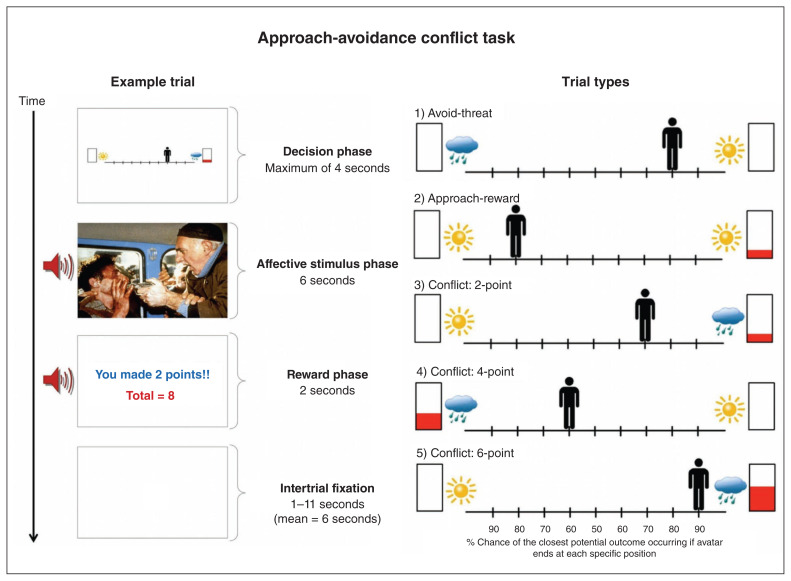
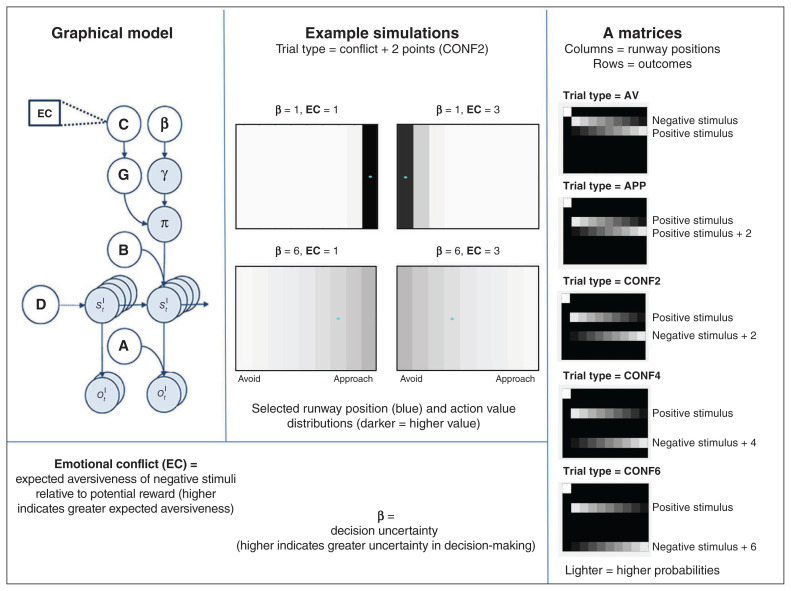
Imbalances in approach-avoidance conflict (AAC) decision-making (e.g., sacrificing rewards to avoid negative outcomes) are considered central to multiple psychiatric disorders. We used computational modelling to examine 2 factors that are often not distinguished in descriptive analyses of AAC: decision uncertainty and sensitivity to negative outcomes versus rewards (emotional conflict).
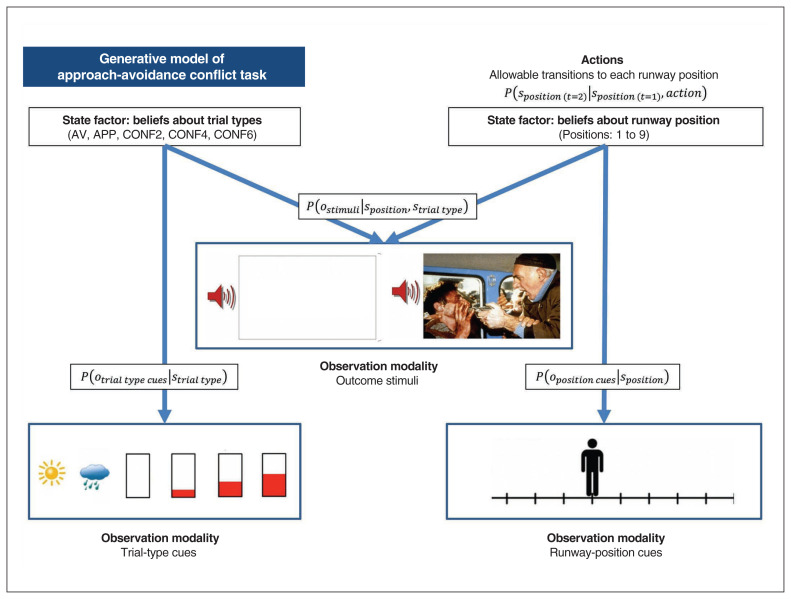
A previously validated AAC task was completed by 478 participants, including healthy controls ( = 59), people with substance use disorders ( = 159) and people with depression and/or anxiety disorders who did not have substance use disorders ( = 260). Using an active inference model, we estimated individual-level values for a model parameter that reflected decision uncertainty and another that reflected emotional conflict. We also repeated analyses in a subsample (59 healthy controls, 161 people with depression and/or anxiety disorders, 56 people with substance use disorders) that was propensity-matched for age and general intelligence.
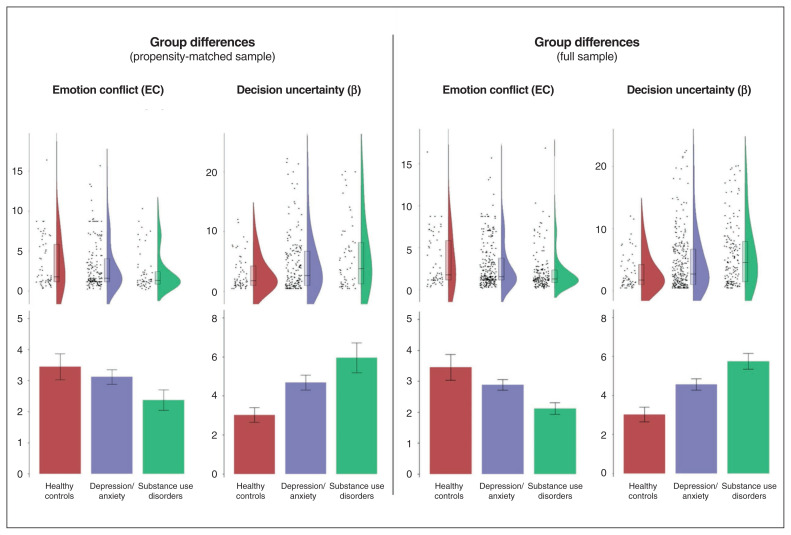
The model showed high accuracy (72%). As further validation, parameters correlated with reaction times and self-reported task motivations in expected directions. The emotional conflict parameter further correlated with self-reported anxiety during the task ( = 0.32, < 0.001), and the decision uncertainty parameter correlated with self-reported difficulty making decisions ( = 0.45, < 0.001). Compared to healthy controls, people with depression and/or anxiety disorders and people with substance use disorders showed higher decision uncertainty in the propensity-matched sample ( = 2.16, = 0.03, and = 2.88, = 0.005, respectively), with analogous results in the full sample; people with substance use disorders also showed lower emotional conflict in the full sample ( = 3.17, = 0.002).
This study was limited by heterogeneity of the clinical sample and an inability to examine learning.
These results suggest that reduced confidence in how to act, rather than increased emotional conflict, may explain maladaptive approach-avoidance behaviours in people with psychiatric disorders.
在趋近-回避冲突(AAC)决策中(例如,为了避免负面结果而牺牲奖励)的失衡被认为是多种精神疾病的核心。我们使用计算模型来研究在描述性 AAC 分析中通常无法区分的两个因素:决策不确定性和对负面结果与奖励的敏感性(情绪冲突)。
478 名参与者(包括健康对照组[59 人]、物质使用障碍组[159 人]和没有物质使用障碍的抑郁和/或焦虑障碍组[260 人])完成了一个以前经过验证的 AAC 任务。我们使用主动推理模型,估计了一个反映决策不确定性的模型参数和另一个反映情绪冲突的模型参数的个体水平值。我们还在年龄和一般智力上进行倾向匹配的子样本(59 名健康对照组、161 名抑郁和/或焦虑障碍组、56 名物质使用障碍组)中重复了分析。
该模型具有很高的准确性(72%)。作为进一步的验证,参数与反应时间和自我报告的任务动机呈预期方向相关。情绪冲突参数进一步与任务期间的自我报告焦虑相关( = 0.32,<0.001),决策不确定性参数与自我报告的决策困难相关( = 0.45,<0.001)。与健康对照组相比,在倾向匹配的样本中,有抑郁和/或焦虑障碍的人和有物质使用障碍的人表现出更高的决策不确定性( = 2.16, = 0.03,和 = 2.88, = 0.005,分别),在全样本中也有类似的结果;在全样本中,物质使用障碍组也表现出较低的情绪冲突( = 3.17, = 0.002)。
本研究受到临床样本异质性的限制,且无法检查学习情况。
这些结果表明,在有精神疾病的人群中,对如何行动的信心降低,而不是情绪冲突增加,可能解释了适应性不良的趋近-回避行为。