Department of Psychology, Columbia University, New York, New York; Department of Psychology, Yale University, New Haven, Connecticut.
Department of Psychiatry, University of Oxford, Warneford Hospital, Oxford, United Kingdom; Oxford Health National Health Service Foundation Trust, Warneford Hospital, Oxford, United Kingdom.
Biol Psychiatry Cogn Neurosci Neuroimaging. 2020 Dec;5(12):1134-1141. doi: 10.1016/j.bpsc.2020.07.013. Epub 2020 Jul 29.
Borderline personality disorder (BPD) is a serious mental disorder characterized by marked interpersonal disturbances, including difficulties trusting others and volatile impressions of others' moral character, often resulting in premature relationship termination. We tested a hypothesis that moral character inference is disrupted in BPD and sensitive to democratic therapeutic community (DTC) treatment.
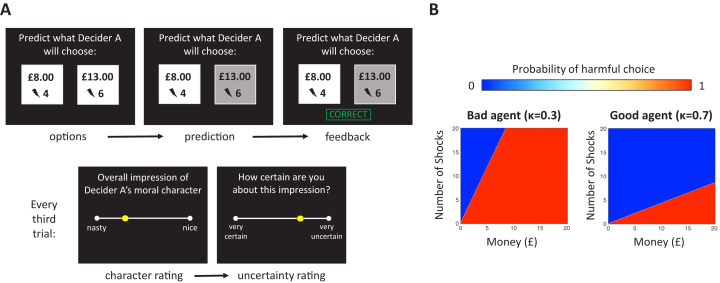
Participants with BPD (n = 43; 20 untreated and 23 DTC-treated) and control participants without BPD (n = 106) completed a moral inference task where they predicted the decisions of 2 agents with distinct moral preferences: the "bad" agent was more willing than the "good" agent to harm others for money. Periodically, participants rated their subjective impressions of the agent's moral character and the certainty of those impressions. We fit a hierarchical Bayesian learning model to participants' trialwise predictions to describe how beliefs about the morality of the agents were updated by new information.
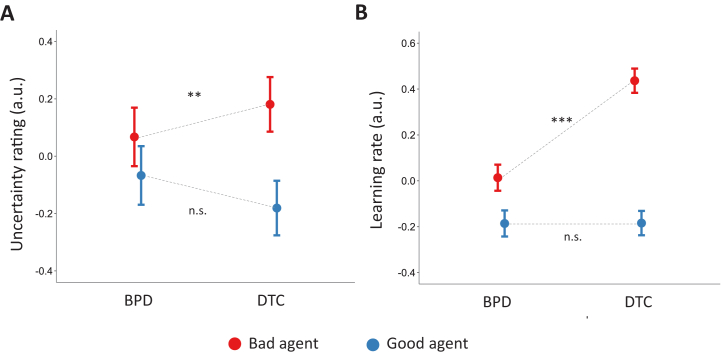
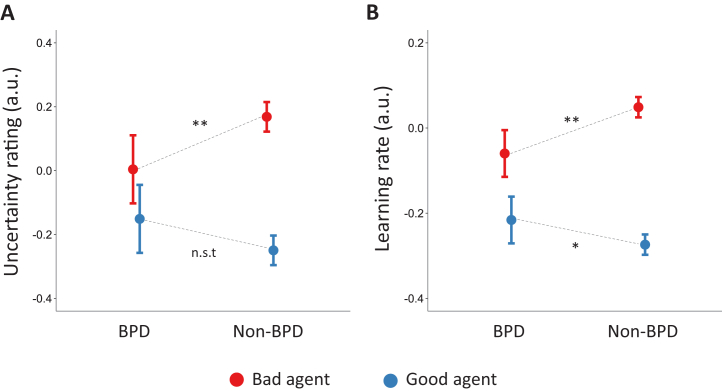
The computational mechanisms of moral inference differed for patients with untreated BPD relative to matched control participants and patients with DTC-treated BPD. In patients with BPD, beliefs about harmful agents were more certain and less amenable to updating relative to both control participants and participants who were treated with DTC.
The findings suggest that DTC may help the maintenance of social relationships in BPD by increasing patients' openness to learning about adverse interaction partners. The results provide mechanistic insights into social deficits in BPD and demonstrate the potential for combining objective behavioral paradigms with computational modeling as a tool for assessing BPD pathology and treatment outcomes.
边缘型人格障碍(BPD)是一种严重的精神障碍,其特征为明显的人际关系障碍,包括难以信任他人以及对他人道德品质的不稳定印象,这通常导致关系过早结束。我们提出了一个假设,即道德品质推断在 BPD 中受到干扰,并且对民主治疗社区(DTC)治疗敏感。
有 BPD 的参与者(n=43;20 名未治疗和 23 名 DTC 治疗)和无 BPD 的对照组参与者(n=106)完成了一项道德推断任务,在该任务中,他们预测了 2 名具有不同道德偏好的代理的决策:“坏”代理比“好”代理更愿意为了钱伤害他人。定期,参与者对代理的道德品质的主观印象及其印象的确定性进行评分。我们拟合了一个分层贝叶斯学习模型来描述参与者对代理道德的信念如何根据新信息进行更新。
与匹配的对照组参与者和接受 DTC 治疗的 BPD 患者相比,未经治疗的 BPD 患者的道德推断计算机制不同。在 BPD 患者中,与对照组参与者和接受 DTC 治疗的参与者相比,对有害代理的信念更确定且不易更新。
这些发现表明,DTC 通过增加患者对不良互动伙伴的学习开放度,可能有助于维持 BPD 中的社会关系。结果为 BPD 中的社交缺陷提供了机制上的见解,并证明了将客观行为范式与计算模型相结合作为评估 BPD 病理和治疗结果的工具的潜力。