College of Life Science, Nanjing Normal University, Nanjing, China.
Wildlife Ecology and Conservation Group, Wageningen University, Wageningen, The Netherlands.
PLoS Comput Biol. 2022 Aug 18;18(8):e1009577. doi: 10.1371/journal.pcbi.1009577. eCollection 2022 Aug.
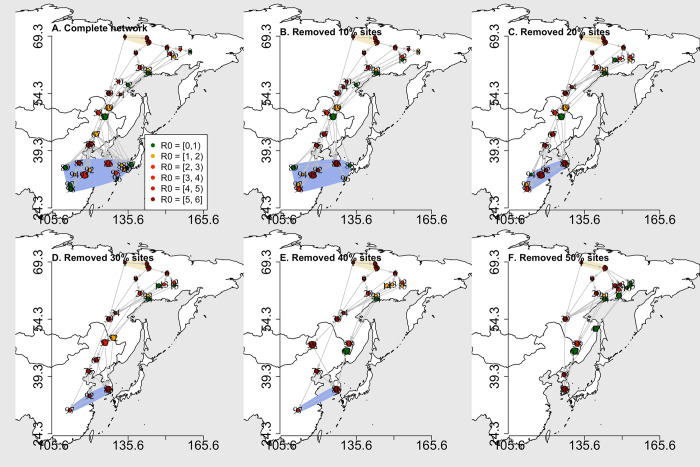
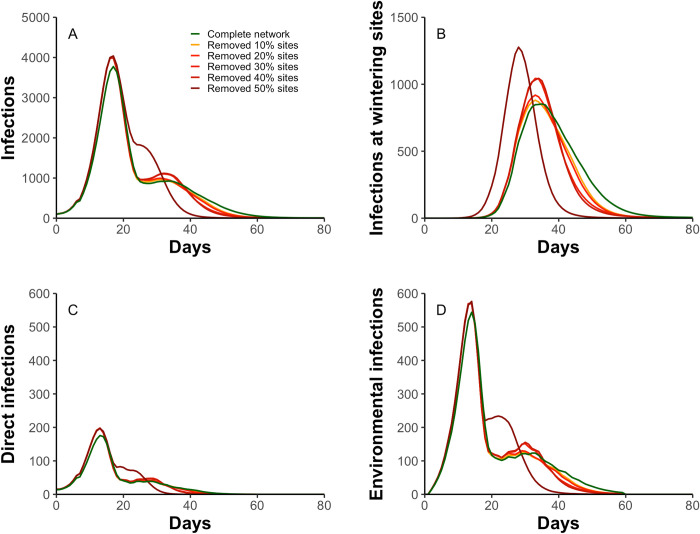
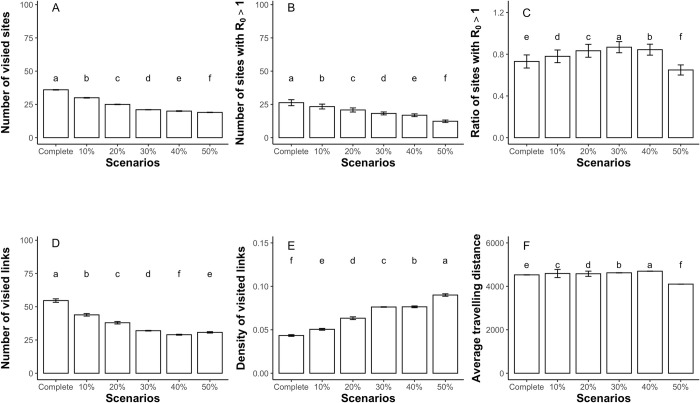
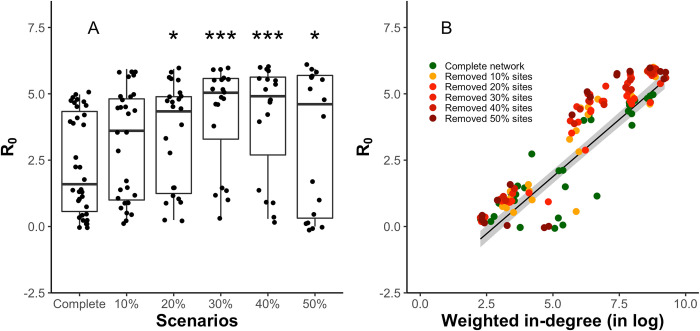
Habitat availability determines the distribution of migratory waterfowl along their flyway, which further influences the transmission and spatial spread of avian influenza viruses (AIVs). The extensive habitat loss in the East Asian-Australasian Flyway (EAAF) may have potentially altered the virus spread and transmission, but those consequences are rarely studied. We constructed 6 fall migration networks that differed in their level of habitat loss, wherein an increase in habitat loss resulted in smaller networks with fewer sites and links. We integrated an agent-based model and a susceptible-infected-recovered model to simulate waterfowl migration and AIV transmission. We found that extensive habitat loss in the EAAF can 1) relocate the outbreaks northwards, responding to the distribution changes of wintering waterfowl geese, 2) increase the outbreak risk in remaining sites due to larger goose congregations, and 3) facilitate AIV transmission in the migratory population. In addition, our modeling output was in line with the predictions from the concept of "migratory escape", i.e., the migration allows the geese to "escape" from the location where infection risk is high, affecting the pattern of infection prevalence in the waterfowl population. Our modeling shed light on the potential consequences of habitat loss in spreading and transmitting AIV at the flyway scale and suggested the driving mechanisms behind these effects, indicating the importance of conservation in changing spatial and temporal patterns of AIV outbreaks.
生境可利用性决定了沿迁徙路线迁徙水禽的分布,这进一步影响了禽流感病毒(AIV)的传播和空间扩散。东亚-澳大利西亚迁徙路线(EAAF)广泛的生境丧失可能已经潜在地改变了病毒的传播和扩散,但这些后果很少被研究。我们构建了 6 个秋季迁徙网络,这些网络在生境丧失程度上存在差异,生境丧失的增加导致网络中站点和连接变少。我们整合了基于主体的模型和易感-感染-恢复模型来模拟水禽迁徙和 AIV 传播。我们发现,EAAF 广泛的生境丧失可以 1)使疫情向北转移,以响应越冬水禽鹅的分布变化,2)由于鹅群数量的增加,使剩余站点的疫情爆发风险增加,3)促进迁徙种群中 AIV 的传播。此外,我们的模型输出与“迁徙逃逸”概念的预测一致,即迁徙使鹅能够“逃离”感染风险高的地点,影响水禽种群中感染流行率的模式。我们的模型揭示了生境丧失在迁徙路线尺度上传播和传播 AIV 的潜在后果,并提出了这些影响背后的驱动机制,表明在改变 AIV 爆发的时空模式时保护的重要性。