Zhongshan School of Medicine, 74644Sun Yat-sen University, Guangzhou, People's Republic of China.
Department of Clinical Research, 107652The First Affiliated Hospital of Jinan University, Guangzhou, People's Republic of China.
Cancer Control. 2022 Jan-Dec;29:10732748221121226. doi: 10.1177/10732748221121226.
Clear-cell renal cell carcinoma (ccRCC) is one of the most common malignant tumors worldwide whose poor prognosis results in a serious disease burden on patients. The changing trend of the long-term relative survival rates (RSRs) of patients with ccRCC was analyzed in this study to evaluate their treatment results over a 15-year period.
This study is a retrospective study, which assessed and predicted the 1-, 3-, and 5-year survival rates of patients with ccRCC during 2001-2005, 2006-2010, 2011-2015, and 2016-2020 using data extracted from the Surveillance, Epidemiology, and End Results (SEER) database. Period analysis was used in this study to analyze the data from the SEER database and to assess survival differences according to age, sex, race, and socioeconomic status (SES) during the 15-year study period by comparing Kaplan-Meier curves.
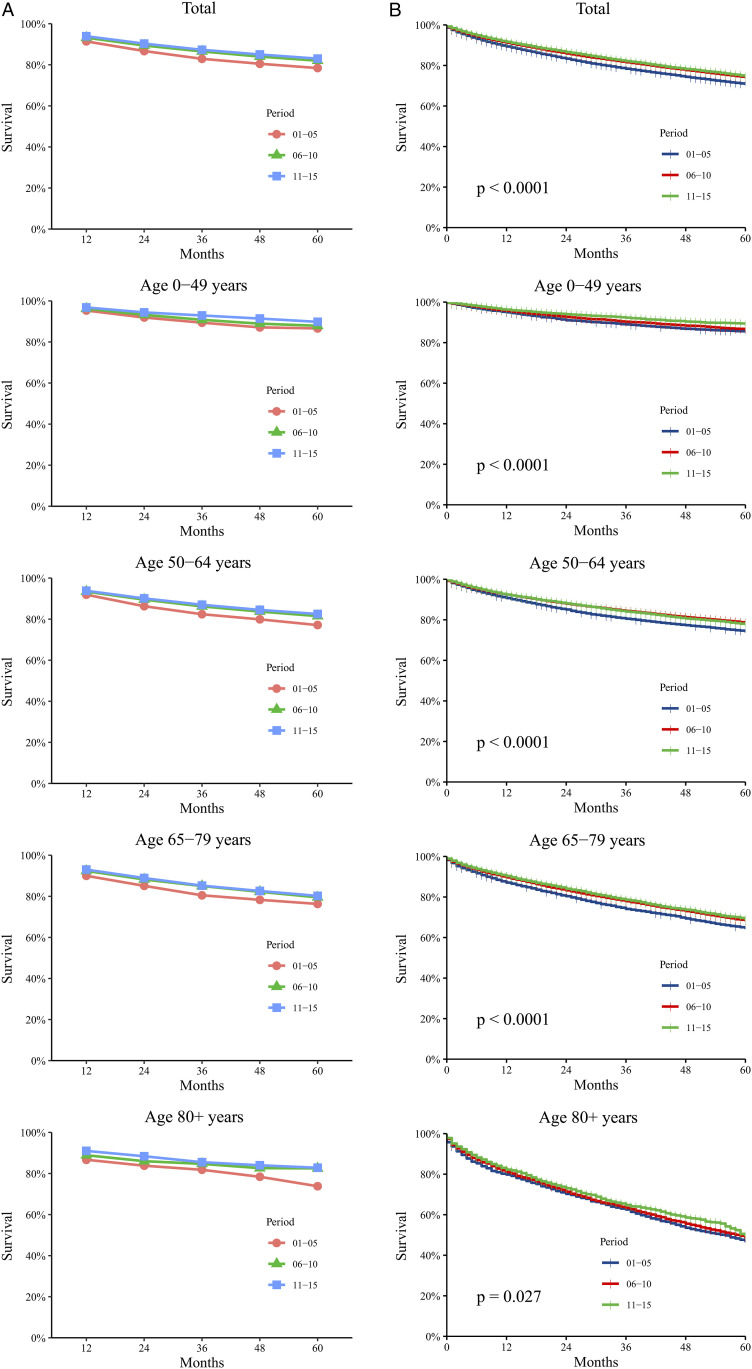
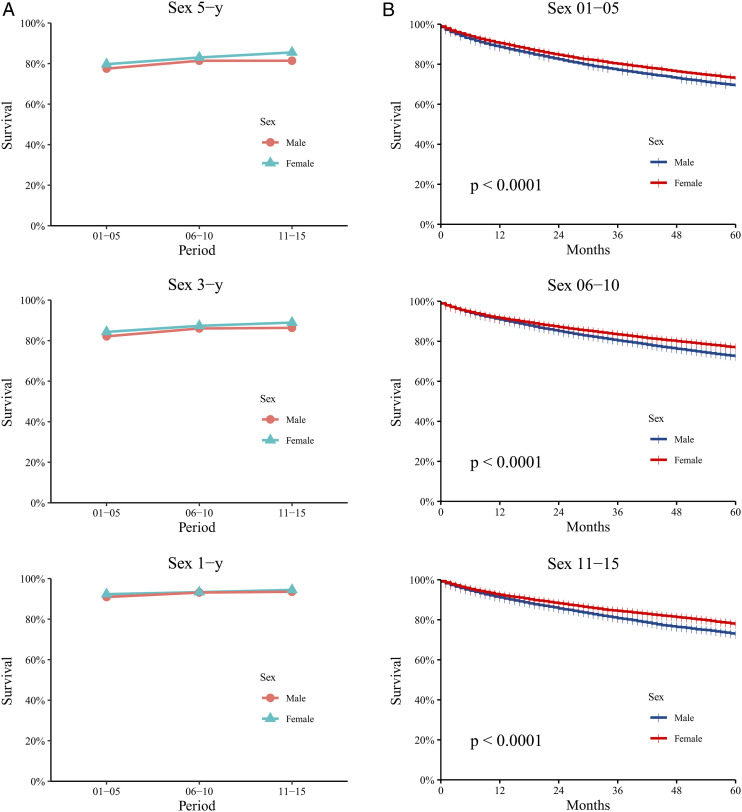
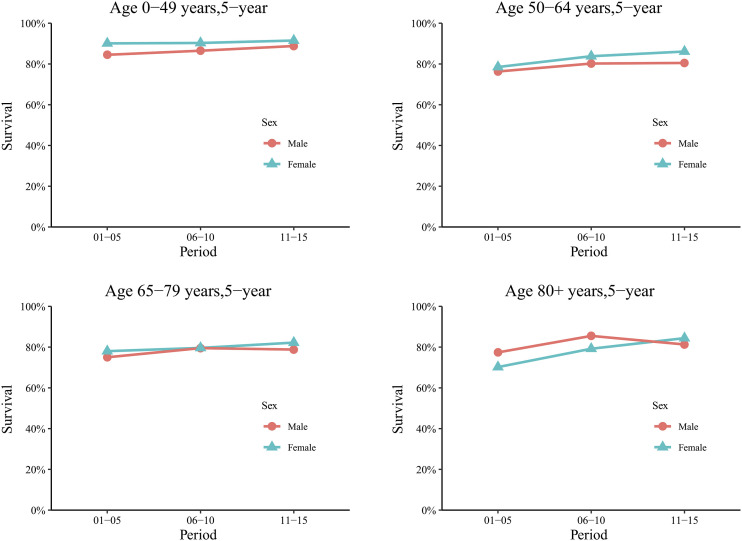
During 2001-2015, the 5-year RSR of patients with ccRCC increased from 78.4% to 83.0%, and the generalized linear model predicted that the 5-year RSR increased to 85.7% during 2016-2020. The RSR of patients with ccRCC differed significantly with SES, race, sex, and age. Compared with male patients, the survival advantage of female patients decreased as their age increased. The RSR of all patients with ccRCC was also lower in patients with a lower SES and of black race.
This study found an improvement in the RSR of patients with ccRCC during 2001-2020. Understanding the change trend of the survival rate of patients with ccRCC is helpful to improve the design of clinical trials. It also provides basic data and a scientific basis for evaluating the harm of ccRCC on the health of affected patients and the effect of cancer prevention, and developing cancer prevention plans.
透明细胞肾细胞癌(ccRCC)是全球最常见的恶性肿瘤之一,其预后不良导致患者疾病负担沉重。本研究旨在分析 15 年来 ccRCC 患者长期相对生存率(RSR)的变化趋势,以评估其治疗效果。
本研究为回顾性研究,利用 Surveillance, Epidemiology, and End Results(SEER)数据库中的数据,评估和预测 2001-2005 年、2006-2010 年、2011-2015 年和 2016-2020 年 ccRCC 患者的 1、3 和 5 年生存率。本研究采用时期分析方法,对 SEER 数据库中的数据进行分析,并通过比较 Kaplan-Meier 曲线,根据年龄、性别、种族和社会经济状况(SES)评估 15 年研究期间的生存差异。
2001-2015 年,ccRCC 患者 5 年 RSR 从 78.4%上升至 83.0%,广义线性模型预测 2016-2020 年 5 年 RSR 将上升至 85.7%。ccRCC 患者的 RSR 与 SES、种族、性别和年龄显著相关。与男性患者相比,女性患者的生存优势随着年龄的增长而降低。SES 较低和黑种人患者的所有 ccRCC 患者的 RSR 也较低。
本研究发现 2001-2020 年 ccRCC 患者的 RSR 有所提高。了解 ccRCC 患者生存率的变化趋势有助于改进临床试验设计。它还为评估 ccRCC 对患者健康的危害以及癌症预防的效果、制定癌症预防计划提供了基本数据和科学依据。