Department of Archaeology, Fitzwilliam Street, University of Cambridge, Cambridge, CB2 1QH, UK.
Department of Anthropology, University of Zurich, 8057, Zurich, Switzerland.
Sci Rep. 2022 Aug 18;12(1):14119. doi: 10.1038/s41598-022-18275-9.
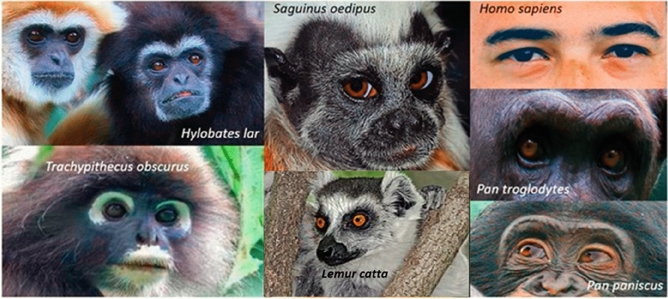
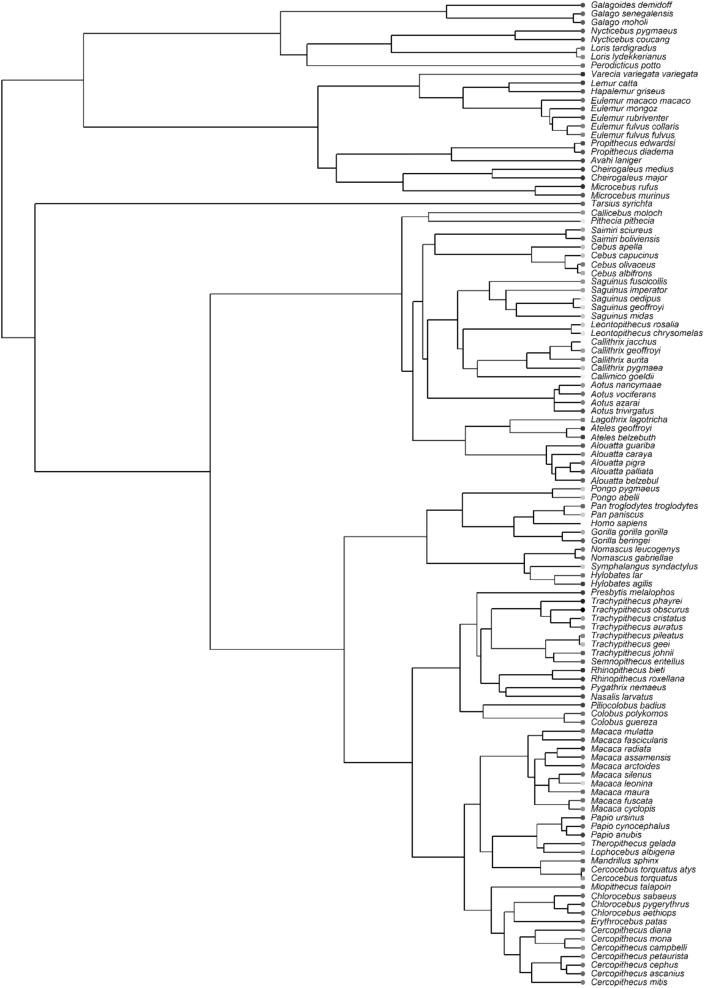
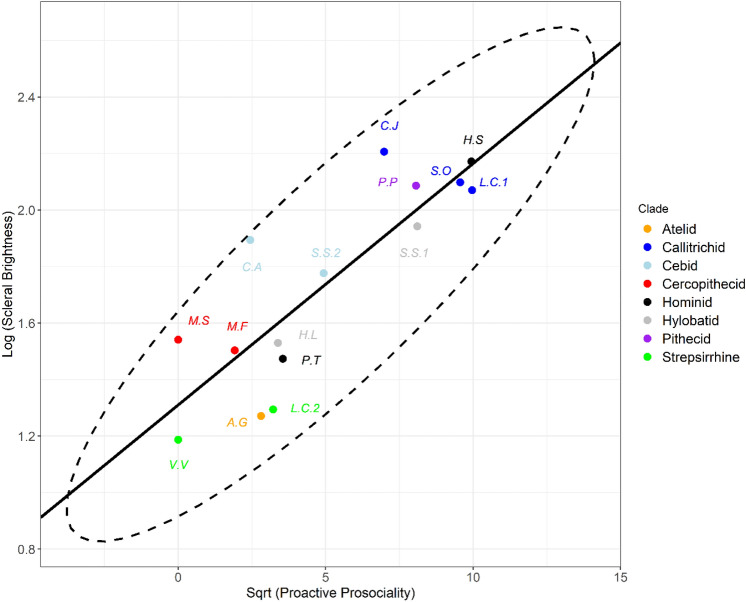
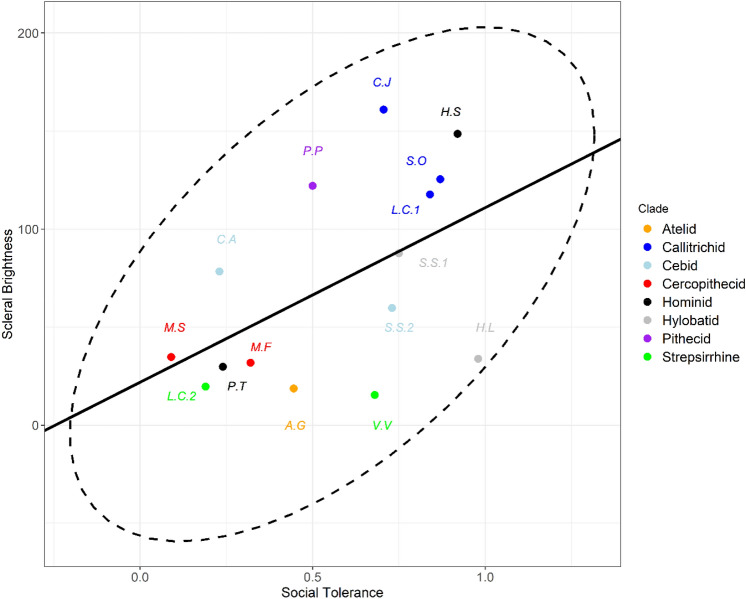
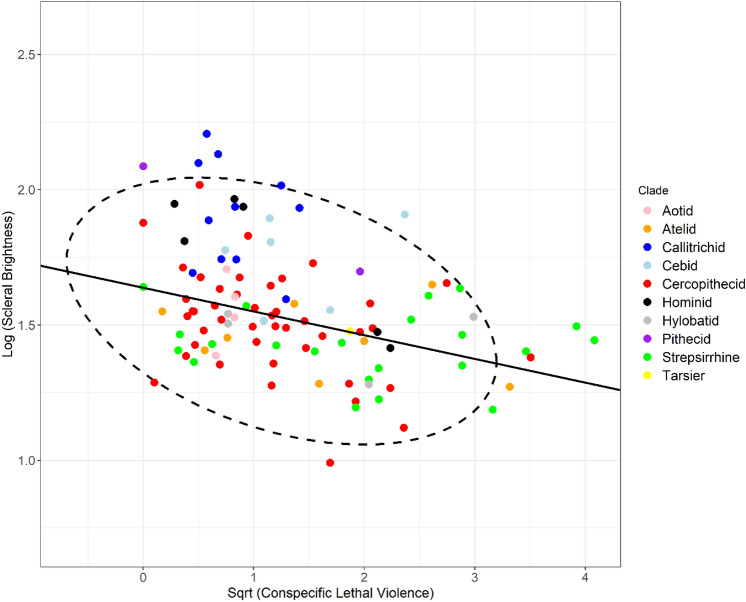
The drivers of divergent scleral morphologies in primates are currently unclear, though white sclerae are often assumed to underlie human hyper-cooperative behaviours. Humans are unusual in possessing depigmented sclerae whereas many other extant primates, including the closely-related chimpanzee, possess dark scleral pigment. Here, we use phylogenetic generalized least squares (PGLS) analyses with previously generated species-level scores of proactive prosociality, social tolerance (both n = 15 primate species), and conspecific lethal aggression (n = 108 primate species) to provide the first quantitative, comparative test of three existing hypotheses. The 'self-domestication' and 'cooperative eye' explanations predict white sclerae to be associated with cooperative, rather than competitive, environments. The 'gaze camouflage' hypothesis predicts that dark scleral pigment functions as gaze direction camouflage in competitive social environments. Notably, the experimental evidence that non-human primates draw social information from conspecific eye movements is unclear, with the latter two hypotheses having recently been challenged. Here, we show that white sclerae in primates are associated with increased cooperative behaviours whereas dark sclerae are associated with reduced cooperative behaviours and increased conspecific lethal violence. These results are consistent with all three hypotheses of scleral evolution, suggesting that primate scleral morphologies evolve in relation to variation in social environment.
灵长类动物巩膜形态差异的驱动因素目前尚不清楚,尽管人们通常认为白色巩膜是人类高度合作行为的基础。人类的巩膜没有色素沉着,这很不寻常,而许多其他现存的灵长类动物,包括密切相关的黑猩猩,都有深色的巩膜色素。在这里,我们使用已生成的物种水平的亲社会主动性、社会容忍度(均为 n = 15 种灵长类动物)和同种致死攻击性(n = 108 种灵长类动物)的系统发育广义最小二乘法(PGLS)分析,首次对三个现有假说进行了定量比较检验。“自我驯化”和“合作眼”假说预测白色巩膜与合作环境有关,而不是竞争环境。“凝视伪装”假说预测深色巩膜色素在竞争的社会环境中作为凝视方向的伪装。值得注意的是,关于非人类灵长类动物从同种动物的眼球运动中获取社交信息的实验证据尚不清楚,后两个假说最近也受到了挑战。在这里,我们表明,灵长类动物的白色巩膜与合作行为的增加有关,而深色巩膜与合作行为的减少和同种致死暴力的增加有关。这些结果与巩膜进化的三个假说一致,表明灵长类动物巩膜形态的进化与社会环境的变化有关。