Department of Biosciences, Durham University, Durham, DH1 3LE, UK.
Sci Rep. 2024 May 7;14(1):10491. doi: 10.1038/s41598-024-61110-6.
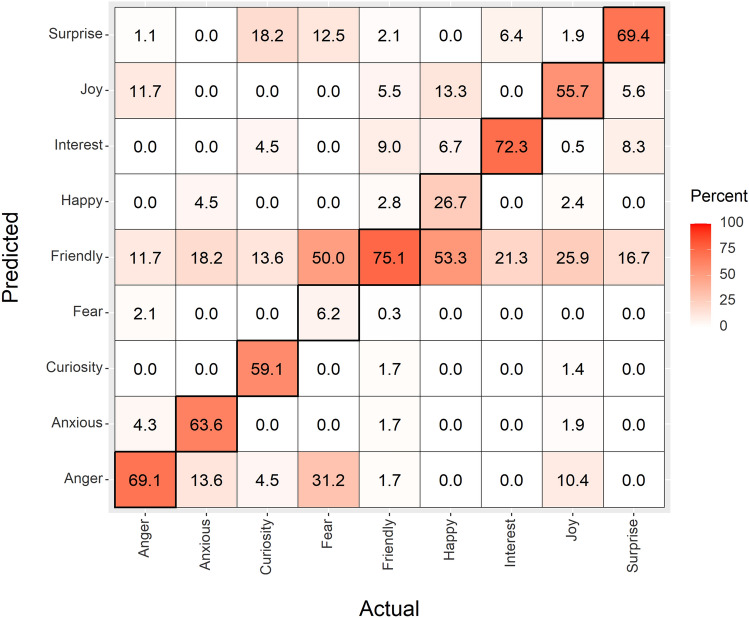
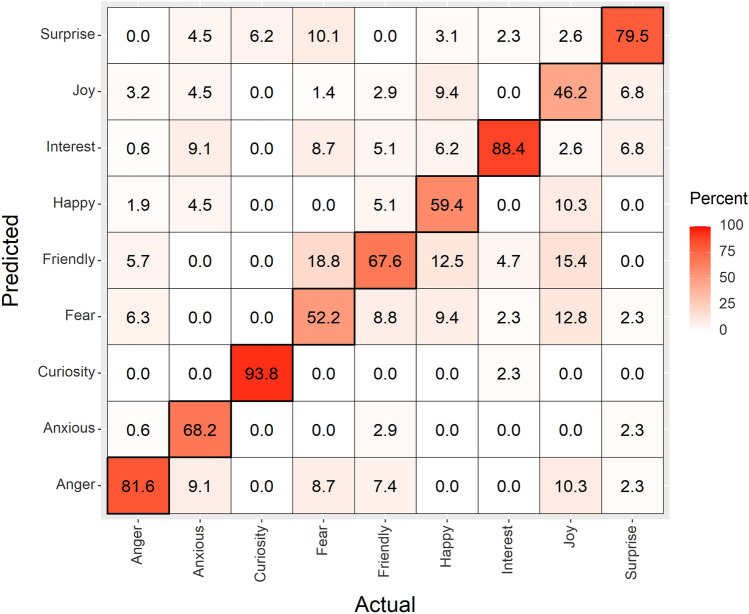
Dogs (Canis lupus familiaris) are the domestically bred descendant of wolves (Canis lupus). However, selective breeding has profoundly altered facial morphologies of dogs compared to their wolf ancestors. We demonstrate that these morphological differences limit the abilities of dogs to successfully produce the same affective facial expressions as wolves. We decoded facial movements of captive wolves during social interactions involving nine separate affective states. We used linear discriminant analyses to predict affective states based on combinations of facial movements. The resulting confusion matrix demonstrates that specific combinations of facial movements predict nine distinct affective states in wolves; the first assessment of this many affective facial expressions in wolves. However, comparative analyses with kennelled rescue dogs revealed reduced ability to predict affective states. Critically, there was a very low predictive power for specific affective states, with confusion occurring between negative and positive states, such as Friendly and Fear. We show that the varying facial morphologies of dogs (specifically non-wolf-like morphologies) limit their ability to produce the same range of affective facial expressions as wolves. Confusion among positive and negative states could be detrimental to human-dog interactions, although our analyses also suggest dogs likely use vocalisations to compensate for limitations in facial communication.
狗(Canis lupus familiaris)是狼(Canis lupus)的家养后代。然而,与狼的祖先相比,选择性繁殖极大地改变了狗的面部形态。我们证明了这些形态差异限制了狗成功产生与狼相同的情感面部表情的能力。我们解码了圈养狼在涉及九个不同情感状态的社交互动中面部运动。我们使用线性判别分析基于面部运动的组合来预测情感状态。由此产生的混淆矩阵表明,特定的面部运动组合可以预测狼的九个不同的情感状态;这是对狼的如此多的情感面部表情的首次评估。然而,与犬舍救援犬的比较分析显示出预测情感状态的能力降低。关键的是,对于特定的情感状态,预测能力非常低,在友好和恐惧等负面和正面状态之间会出现混淆。我们表明,狗的不同面部形态(特别是非狼形态)限制了它们产生与狼相同范围的情感面部表情的能力。积极和消极状态之间的混淆可能对人与狗的互动有害,尽管我们的分析还表明,狗可能会使用声音来弥补面部交流的局限性。