Goa Institute of Management, Poriem, Sattari, Goa, India, 403505.
National Health Authority, Ministry of Health and Family Welfare, Government of India, New Delhi, India.
BMC Health Serv Res. 2022 Aug 18;22(1):1056. doi: 10.1186/s12913-022-08407-2.
The Pradhan Mantri Jan Arogya Yojana (PMJAY), a publicly funded health insurance scheme for the poor in India, was launched in 2018. Early experiences of states with various purchasing arrangements can provide valuable insights for its future performance. We sought to understand the institutional agencies and performance of the trust and insurance models of purchasing with respect to; a) Provider contracting b) Claim management c) Implementation costs.
A mixed methods case study design was adopted. Two states, Uttar Pradesh (representing a trust model) and Jharkhand (representing the insurance model) were purposively selected. Data sources included document reviews, key informant interviews, quantitative scheme data from the provider empanelment and claims database, and primary data on costs. Descriptive statistics were reported for quantitative data, content analysis was used for thematic reporting of qualitative data.
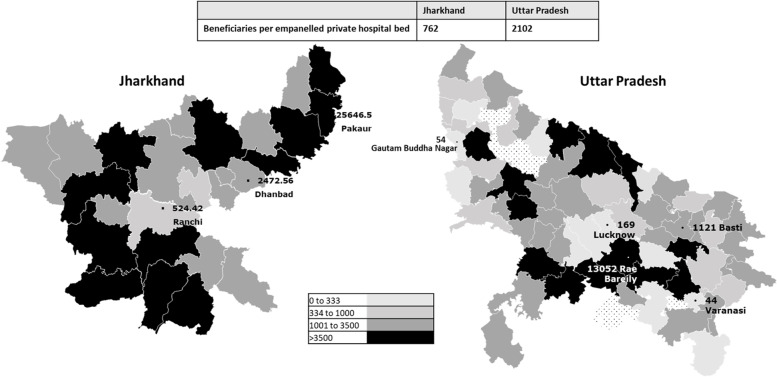
In both models, the state was the final authority on empanelment decisions, with no significant influence of the insurance company. Private hospitals constituted the majority of empanelled providers, with wide variations in district-wise distribution of bed capacities in both states. The urgency of completing empanelment in the early days of the scheme created the need for both states to re-review hospitals and de-empanel those not meeting requirements. Very few quality- accredited private hospitals were empaneled. The trust displayed more oversight of support agencies for claim management, longer processing times, a higher claim rejection rate and numbers of queries raised, as compared to the insurance model. Support agencies in both states faced challenges in assessing the clinical decisions of hospitals. Cost-effectiveness showed mixed results; the trust cost less than the insurance model per beneficiary enrolled, but more per claim generated.
Efforts are required to enable a better distribution and ensure quality of care in empanelled hospitals. The adoption of standard treatment guidelines is needed to support hospitals and implementing agencies in better claim management. The oversight of agencies through enforcement of contracts remains vital in both models. Assessing the comparative performance of trusts and insurance companies in more states at later stages of scheme implementation, would be further useful to determine their cost-effectiveness as purchasers.
印度的 Pradhan Mantri Jan Arogya Yojana(PMJAY)是一项为贫困人群提供的公共资助医疗保险计划,于 2018 年启动。各州在各种采购安排方面的早期经验可以为其未来的表现提供有价值的见解。我们试图了解信托和保险采购模式在以下方面的机构代理和绩效:a)供应商合同 b)理赔管理 c)实施成本。
采用混合方法案例研究设计。选择了两个邦,北方邦(代表信托模式)和恰尔康得邦(代表保险模式),这两个邦是根据目的入选的。数据来源包括文件审查、关键知情人访谈、来自供应商入围和理赔数据库的定量计划数据,以及关于成本的主要数据。对定量数据进行描述性统计,对定性数据进行内容分析。
在这两种模式下,州都是入围决策的最终权威,保险公司没有太大的影响力。私立医院构成了入围供应商的大多数,两个邦的床位容量在地区分布上差异很大。在计划早期完成入围工作的紧迫性使得两个邦都需要重新审查医院,并取消不符合要求的医院的入围资格。入围的合格私立医院很少。与保险模式相比,信托模式对理赔管理的支持机构进行了更多的监督,处理时间更长,理赔拒绝率更高,提出的问题也更多。两个邦的支持机构在评估医院的临床决策方面都面临挑战。成本效益结果参差不齐;每招收一名受益人,信托的成本低于保险模式,但每产生一笔理赔,成本就高于保险模式。
需要努力使入围医院的服务更好地分配,并确保其医疗质量。需要采用标准治疗指南,以支持医院和执行机构更好地进行理赔管理。在这两种模式下,通过执行合同对机构进行监督仍然至关重要。在计划实施的后期阶段,在更多的邦评估信托和保险公司的相对绩效,将有助于确定它们作为采购方的成本效益。