Petermann Jana S, Gossner Martin M
Department of Environment and Biodiversity University of Salzburg Salzburg Austria.
Forest Entomology Swiss Federal Research Institute WSL Birmensdorf Switzerland.
Ecol Evol. 2022 Aug 12;12(8):e9206. doi: 10.1002/ece3.9206. eCollection 2022 Aug.
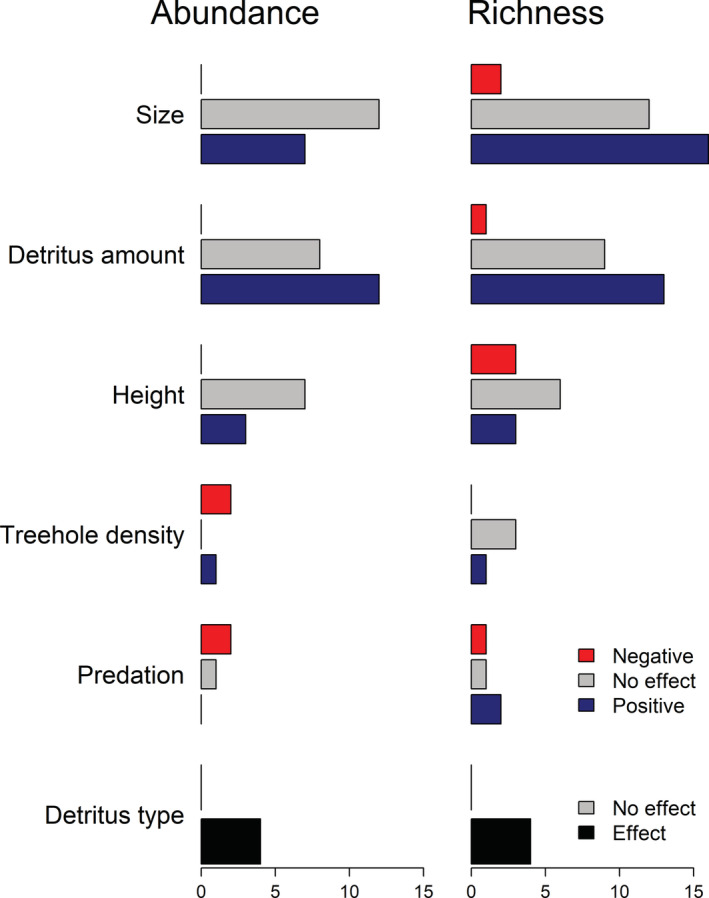
Water-filled tree holes are unique ecosystems that may occur high up in tree crowns and are essentially aquatic islands in the sky. Insect larvae, mesofauna, and other organisms colonize the waterbodies and feed on the accumulating detritus. Water-filled tree holes are not only important habitats for these species but have been used as model systems in ecology. Here, we review more than 100 years of research on tree-hole inhabiting organisms and show that most studies focus on selected or even single species (most of which are mosquitoes), whereas only few studies examine groups other than insects, especially in the tropics. Using a vote counting of results and a meta-analysis of community studies, we show that the effects of tree-hole size and resources on abundance and richness were investigated most frequently. Both were found to have a positive effect, but effect sizes were modulated by site-specific environmental variables such as temperature or precipitation. We also show that parameters such as the height of the tree holes above ground, tree-hole density, predation, and detritus type can be important drivers of organism abundance or richness but are less often tested. We identify several important research gaps and potential avenues for future research. Specifically, future studies should investigate the structure, functions, and temporal dynamics of tree-hole food webs and their cross-system interactions, for example, with terrestrial predators that act as a connection to their terrestrial surroundings in meta-ecosystems. Global observational or experimental tree-hole studies could contribute pivotal information on spatial variation of community structure and environmental drivers of community assembly. With a better understanding of these unique aquatic habitats in terrestrial ecosystems, natural and artificial tree holes can not only serve as model systems for addressing fundamental ecological questions but also serve as indicator systems of the impacts of environmental change on ecosystems.
充满水的树洞是独特的生态系统,可能出现在树冠高处,本质上是天空中的水生岛屿。昆虫幼虫、中型动物和其他生物在这些水体中栖息,并以积累的碎屑为食。充满水的树洞不仅是这些物种的重要栖息地,还被用作生态学的模型系统。在这里,我们回顾了100多年来对栖息在树洞中生物的研究,发现大多数研究集中在特定的甚至单一的物种上(其中大多数是蚊子),而只有少数研究考察了昆虫以外的类群,特别是在热带地区。通过对研究结果的投票计数和群落研究的荟萃分析,我们表明树洞大小和资源对丰度和丰富度的影响研究最为频繁。两者都被发现有积极影响,但效应大小受到特定地点环境变量的调节,如温度或降水。我们还表明,诸如树洞离地高度、树洞密度、捕食和碎屑类型等参数可能是生物丰度或丰富度的重要驱动因素,但较少被测试。我们确定了几个重要的研究空白和未来研究的潜在途径。具体而言,未来的研究应调查树洞食物网的结构、功能和时间动态及其跨系统相互作用,例如与陆地捕食者的相互作用,这些捕食者在元生态系统中作为与陆地环境的连接。全球范围内的树洞观测或实验研究可以提供关于群落结构空间变异和群落组装环境驱动因素的关键信息。通过更好地理解陆地生态系统中这些独特的水生生境,天然和人工树洞不仅可以作为解决基本生态问题的模型系统,还可以作为环境变化对生态系统影响的指示系统。