Wang Na, Zhang Hong, Yin Yihua, Xu Xiaogang, Xiao Li, Liu Yang
Institute of Antibiotics, Huashan Hospital, Fudan University, Shanghai, 200040, People's Republic of China.
Department of Medical Oncology, Shanghai Cancer Center, Fudan University, Shanghai, 200032, People's Republic of China.
Infect Drug Resist. 2022 Aug 11;15:4443-4452. doi: 10.2147/IDR.S370126. eCollection 2022.
The current study investigated the recent genetic characteristics and antimicrobial susceptibility profiles of () in Shanghai, becoming a clinical reference for treating infection in Shanghai.
Clinical strains were isolated from nasopharyngeal aspirates of the pediatric patients in Shanghai from 2017 to 2019. Nine antimicrobial agents of three antimicrobial classes macrolides, fluoroquinolones and tetracyclines, against isolates were investigated using the broth microdilution method. The mechanism of macrolide resistance was analyzed by evaluating the sequences of the 23S rRNA gene and the ribosomal protein genes L4 and L22. Molecular genotyping was undergone to classify the P1 subtypes and the multi-locus variable-number tandem-repeat analysis (MLVA) types.
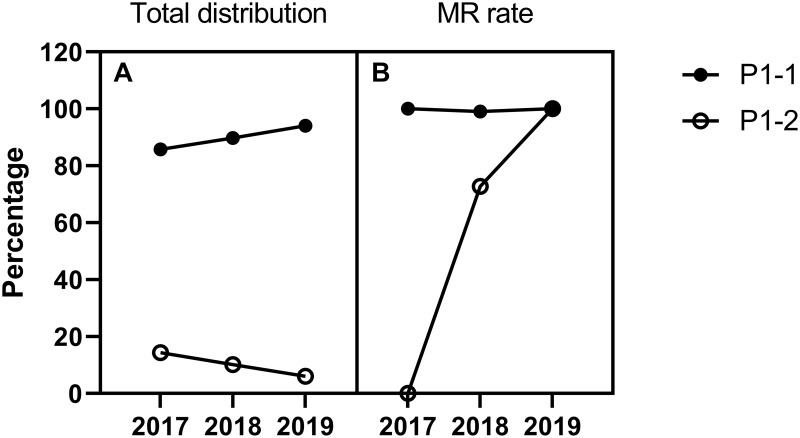
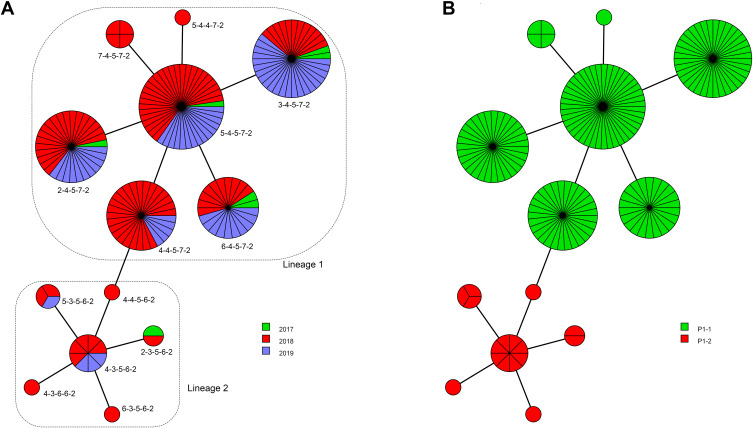
A total of 72 isolates were resistant to macrolides (MICs > 64 mg/L for erythromycin) based on the A2063G mutation in the 23S rRNA gene. These strains were susceptible to tetracyclines and fluoroquinolones. P1 type 1 (166/182, 91.2%) and MLVA type 4-5-7-2 (165/182, 90.7%) were the dominant subtypes. MLVA type was associated with the P1 subtypes. The distribution of the P1 subtypes and MLVA types did not change over time. The macrolide-resistant rate in P1 type 2 and MLVA type 3-5-6-2 strains were increased during the three-year study. The 5-loci MLVA typing scheme revealed the clonal expansion of MLVA type 3-4-5-7-2 strains which are macrolide-resistant in 2019.
Macrolide resistance in in Shanghai is very high and is evolving among certain subtypes. Cautions should be taken for the possible clonal spreading of macrolide-resistant genotypes within this populated region.
本研究调查了上海地区()的近期遗传特征及抗菌药物敏感性概况,为上海地区()感染的治疗提供临床参考。
从2017年至2019年上海地区儿科患者的鼻咽抽吸物中分离临床菌株。采用肉汤微量稀释法研究了大环内酯类、氟喹诺酮类和四环素类三类抗菌药物中的九种抗菌药物对()分离株的抗菌活性。通过评估23S rRNA基因以及核糖体蛋白基因L4和L22的序列,分析大环内酯类耐药机制。进行分子基因分型以对P1亚型和多位点可变数目串联重复分析(MLVA)类型进行分类。
基于23S rRNA基因中的A2063G突变,共有72株分离株对大环内酯类耐药(红霉素MICs>64mg/L)。这些菌株对四环素类和氟喹诺酮类敏感。P1型1(166/182,91.2%)和MLVA型4-5-7-2(165/182,90.7%)是主要亚型。MLVA类型与P1亚型相关。P1亚型和MLVA类型的分布随时间未发生变化。在为期三年的研究中,P1型2和MLVA型3-5-6-2菌株中的大环内酯类耐药率有所增加。5位点MLVA分型方案揭示了2019年大环内酯类耐药的MLVA型3-4-5-7-2菌株的克隆扩增。
上海地区()的大环内酯类耐药率很高,且在某些亚型中不断演变。对于该人口密集地区大环内酯类耐药基因型可能的克隆传播应予以关注。