Swinya Dalia L, Martín-Yerga Daniel, Walker Marc, Unwin Patrick R
Department of Chemistry, University of Warwick, Coventry CV4 7AL, United Kingdom.
Department of Physics, University of Warwick, Coventry CV4 7AL, United Kingdom.
J Phys Chem C Nanomater Interfaces. 2022 Aug 11;126(31):13399-13408. doi: 10.1021/acs.jpcc.2c02801. Epub 2022 Jul 29.
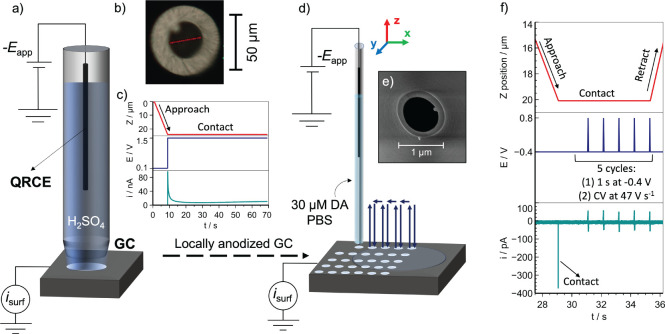
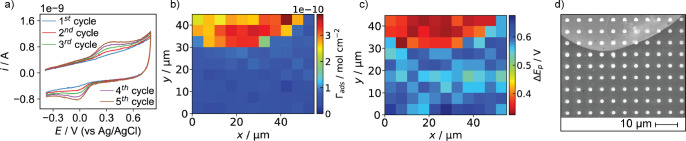
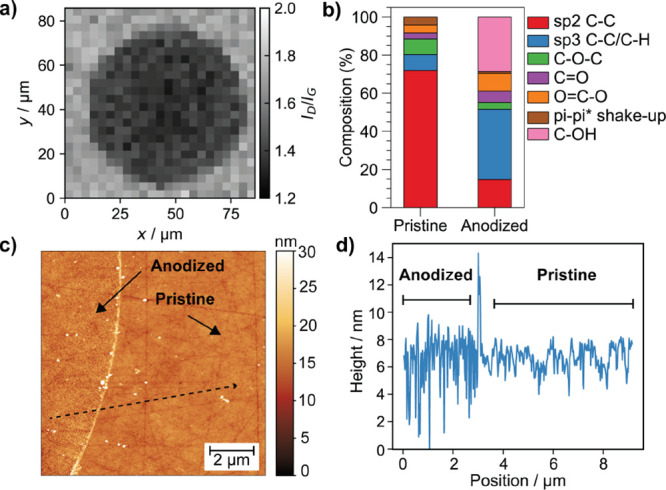
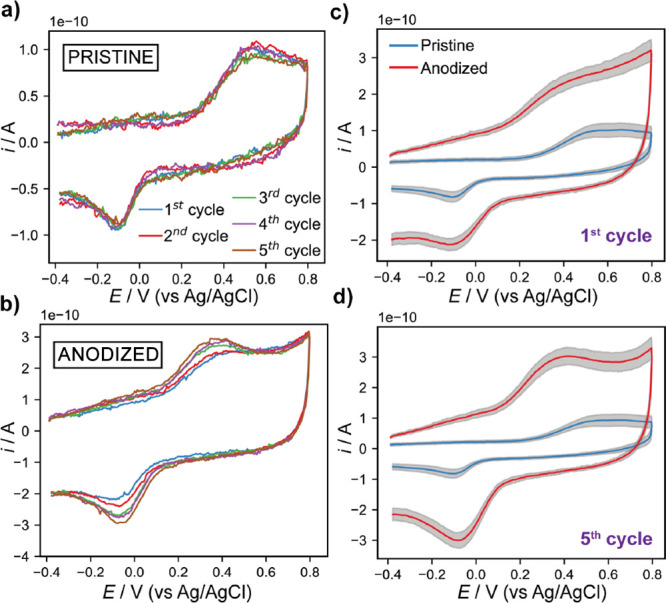
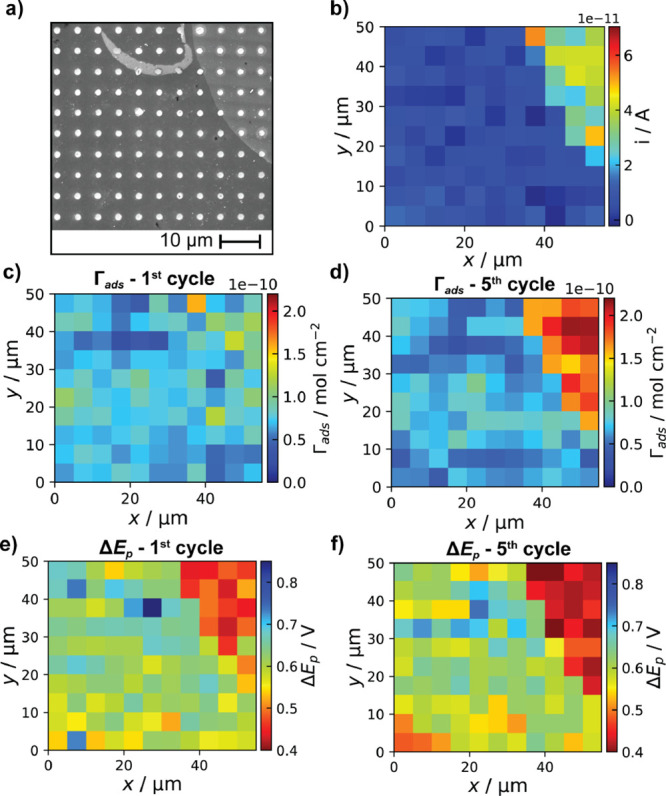
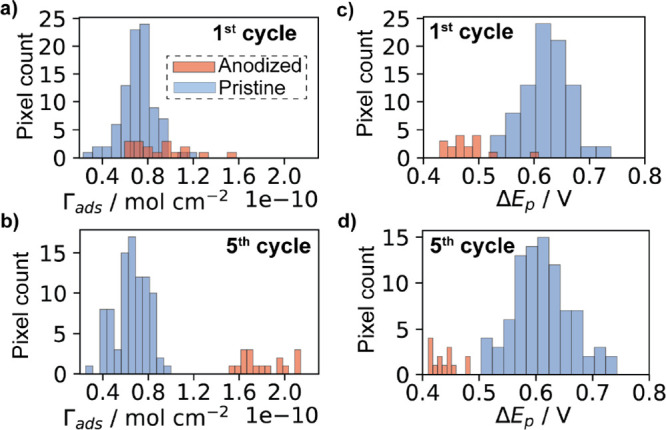
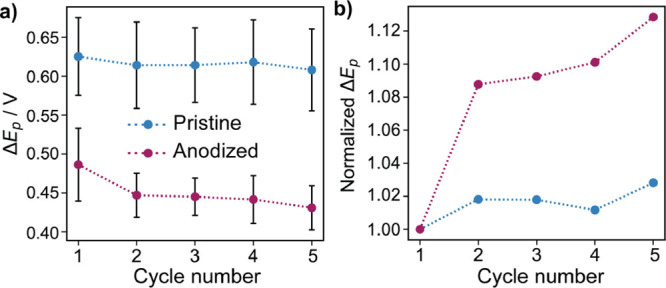
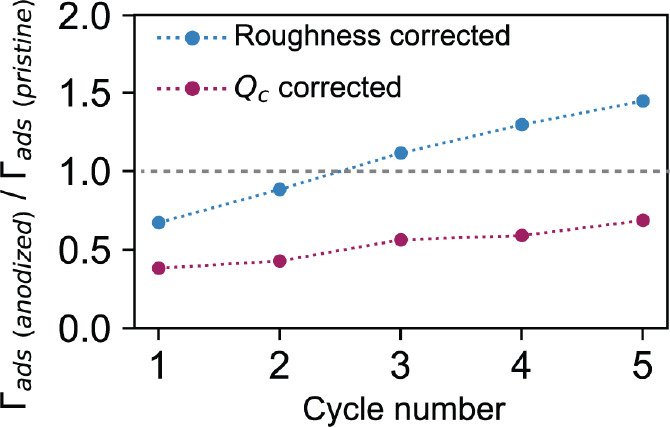
Dopamine (DA) adsorption and electron-transfer kinetics are strongly sensitive to the structure and composition of carbon electrodes. Activation of carbon surfaces is a popular method to improve DA detection, but the role of carbon structural features on DA behavior remains uncertain. Herein, we use scanning electrochemical cell microscopy (SECCM) for local anodization of glassy carbon (GC) electrodes in acid media followed by electrochemical imaging of DA adsorption and electrochemistry covering both unmodified and anodized GC regions of the same electrode. Electrochemical measurements of adsorbed DA involve the delivery of DA from the SECCM meniscus (30 μM) for 1 s periods followed by voltammetric analysis at a reasonable sweep rate (47 V s). This general approach reduces effects from interelectrode variability and allows for considerable numbers of measurements and statistical analysis of electrochemical data sets. Localized electrode activity is correlated to surface structure and chemistry by a range of characterization techniques. Anodization enhances DA electron-transfer kinetics and provides more sites for adsorption (higher specific surface area). A consequence is that adsorption takes longer to approach completion on the anodized surface. In fact, normalizing DA surface coverage by the electrochemical surface area (ECSA) reveals that adsorption is less extensive on anodized surfaces compared to as-prepared GC on the same time scale. Thus, ECSA, which has often been overlooked when calculating DA surface coverage on carbon electrodes, even where different activation methods would be expected to result in different surface roughness and nanostructure, is an important consideration. Lower graphitic and higher oxygen content on anodized GC also suggest that oxygen-containing functional groups do not necessarily enhance DA adsorption and may have the opposite effect. This work further demonstrates SECCM as a powerful technique for revealing surface structure-function relationships and correlations at heterogeneous electrodes.
多巴胺(DA)的吸附和电子转移动力学对碳电极的结构和组成高度敏感。碳表面的活化是改善DA检测的常用方法,但碳结构特征对DA行为的作用仍不明确。在此,我们使用扫描电化学池显微镜(SECCM)在酸性介质中对玻碳(GC)电极进行局部阳极氧化,随后对同一电极的未修饰和阳极氧化GC区域进行DA吸附和电化学的电化学成像。吸附DA的电化学测量包括从SECCM弯月面(30 μM)输送DA 1 s,然后以合理的扫描速率(47 V/s)进行伏安分析。这种通用方法减少了电极间变异性的影响,并允许对电化学数据集进行大量测量和统计分析。通过一系列表征技术将局部电极活性与表面结构和化学性质相关联。阳极氧化增强了DA的电子转移动力学,并提供了更多的吸附位点(更高的比表面积)。结果是,在阳极氧化表面上吸附达到完成所需的时间更长。事实上,通过电化学表面积(ECSA)对DA表面覆盖率进行归一化处理后发现,在相同时间尺度上,与制备好的GC相比,阳极氧化表面上的吸附不太广泛。因此,在计算碳电极上的DA表面覆盖率时,ECSA是一个重要的考虑因素,即使在不同的活化方法预计会导致不同的表面粗糙度和纳米结构的情况下,它也常常被忽视。阳极氧化GC上较低的石墨化程度和较高的氧含量还表明,含氧官能团不一定会增强DA吸附,可能会产生相反的效果。这项工作进一步证明了SECCM是一种揭示异质电极表面结构 - 功能关系和相关性的强大技术。