Raidt Johanna, Maitre Bernard, Pennekamp Petra, Altenburg Josje, Anagnostopoulou Pinelopi, Armengot Miguel, Bloemsma Lizan D, Boon Mieke, Borrelli Melissa, Brinkmann Folke, Carr Siobhan B, Carroll Mary P, Castillo-Corullón Silvia, Coste André, Cutrera Renato, Dehlink Eleonora, Destouches Damien M S, Di Cicco Maria E, Dixon Lucy, Emiralioglu Nagehan, Erdem Eralp Ela, Haarman Eric G, Hogg Claire, Karadag Bulent, Kobbernagel Helene E, Lorent Natalie, Mall Marcus A, Marthin June K, Martinu Vendula, Narayanan Manjith, Ozcelik Ugur, Peckham Daniel, Pifferi Massimo, Pohunek Petr, Polverino Eva, Range Simon, Ringshausen Felix C, Robson Evie, Roehmel Jobst, Rovira-Amigo Sandra, Santamaria Francesca, Schlegtendal Anne, Szépfalusi Zsolt, Tempels Petra, Thouvenin Guillaume, Ullmann Nicola, Walker Woolf T, Wetzke Martin, Yiallouros Panayiotis, Omran Heymut, Nielsen Kim G
Dept of General Pediatrics, University Hospital Muenster, Muenster, Germany.
Service de Pneumologie, Hôpital Henri Mondor et Centre Hospitalier Intercommunal de Créteil, Assistance Publique-Hôpitaux de Paris (AP-HP), Créteil, France.
ERJ Open Res. 2022 Aug 15;8(3). doi: 10.1183/23120541.00139-2022. eCollection 2022 Jul.
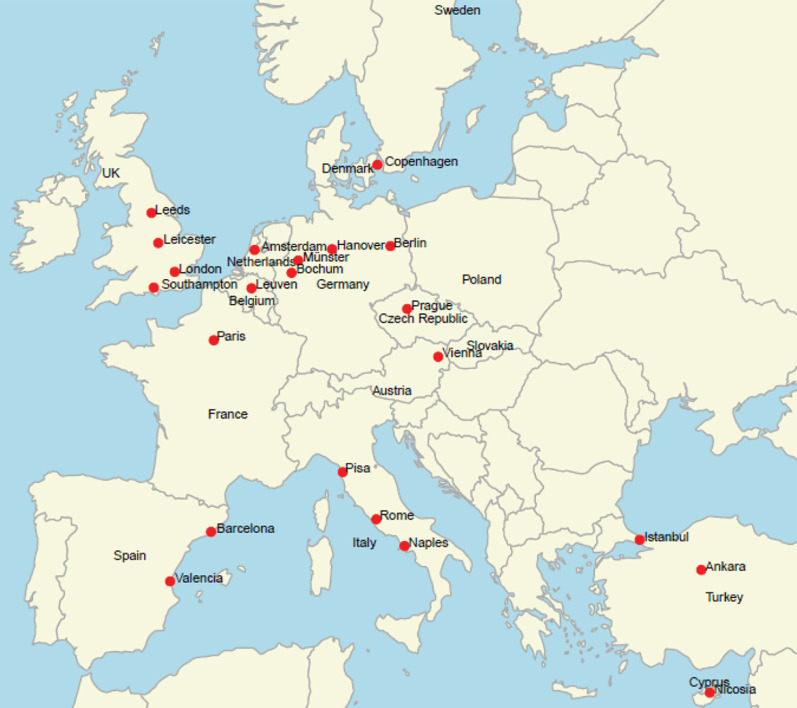
Primary ciliary dyskinesia (PCD) is a rare genetic disorder characterised by impaired mucociliary clearance leading to irreversible lung damage. In contrast to other rare lung diseases like cystic fibrosis (CF), there are only few clinical trials and limited evidence-based treatments. Management is mainly based on expert opinions and treatment is challenging due to a wide range of clinical manifestations and disease severity. To improve clinical and translational research and facilitate development of new treatments, the clinical trial network for PCD (PCD-CTN) was founded in 2020 under the framework of the European Reference Network (ERN)-LUNG PCD Core. Applications from European PCD sites interested in participating in the PCD-CTN were requested. Inclusion criteria consisted of patient numbers, membership of ERN-LUNG PCD Core, use of associated standards of care, experience in PCD and/or CF clinical research, resources to run clinical trials, good clinical practice (GCP) certifications and institutional support. So far, applications from 22 trial sites in 18 European countries have been approved, including >1400 adult and >1600 paediatric individuals with PCD. The PCD-CTN is headed by a coordinating centre and consists of a steering and executive committee, a data safety monitoring board and committees for protocol review, training and standardisation. A strong association with patient organisations and industrial companies are further cornerstones. All participating trial sites agreed on a code of conduct. As CTNs from other diseases have demonstrated successfully, this newly formed PCD-CTN operates to establish evidence-based treatments for this orphan disease and to bring new personalised treatment approaches to patients.
原发性纤毛运动障碍(PCD)是一种罕见的遗传性疾病,其特征是黏液纤毛清除功能受损,导致不可逆的肺损伤。与其他罕见的肺部疾病如囊性纤维化(CF)不同,PCD的临床试验很少,基于证据的治疗方法也很有限。由于临床表现和疾病严重程度范围广泛,管理主要基于专家意见,治疗具有挑战性。为了改善临床和转化研究,并促进新治疗方法的开发,PCD临床试验网络(PCD-CTN)于2020年在欧洲参考网络(ERN)-LUNG PCD核心框架下成立。该网络征集了欧洲有兴趣参与PCD-CTN的PCD研究中心的申请。纳入标准包括患者数量、ERN-LUNG PCD核心成员资格、相关护理标准的使用、PCD和/或CF临床研究经验、开展临床试验的资源、良好临床实践(GCP)认证以及机构支持。到目前为止,来自18个欧洲国家的22个试验点的申请已获批准,其中包括1400多名成年PCD患者和1600多名儿童PCD患者。PCD-CTN由一个协调中心领导,由指导委员会、执行委员会、数据安全监测委员会以及方案审查、培训和标准化委员会组成。与患者组织和工业公司的紧密合作是另外的基石。所有参与的试验点都商定了一项行为准则。正如其他疾病的CTN已成功证明的那样,这个新成立的PCD-CTN致力于为这种罕见病建立基于证据的治疗方法,并为患者带来新的个性化治疗方案。