Gentizon Jenny, Fleury Mapi, Pilet Eric, Büla Christophe, Mabire Cedric
Institute of Higher Education and Research in Healthcare, Lausanne University Hospital and University of Lausanne, Lausanne, Switzerland.
Service of Geriatric Medicine and Geriatric Rehabilitation, Lausanne University Hospital, Lausanne, Switzerland.
J Patient Rep Outcomes. 2022 Aug 19;6(1):87. doi: 10.1186/s41687-022-00495-2.
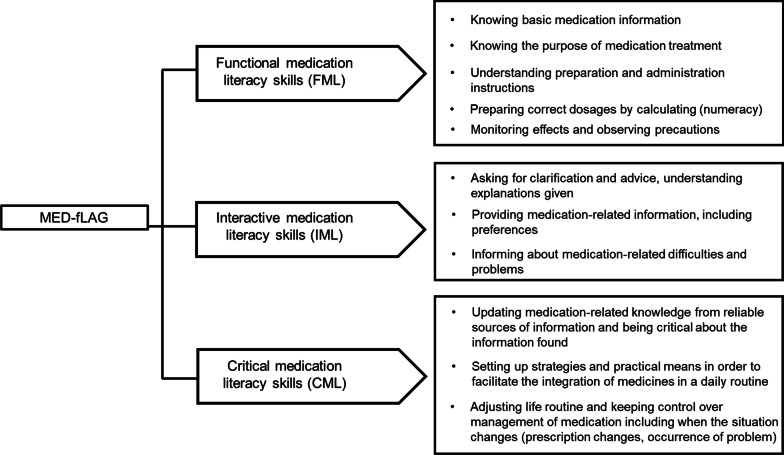
The assessment of patients' medication literacy skills (i.e., abilities to access, comprehend and interact with medication-related information) is an important step in assisting clinicians to plan for appropriate care. Despite several attempts by researchers to develop measures of medication literacy, an instrument tailored to the specific needs of older adults remains a significant shortfall. Therefore, an interprofessional team that included a citizen co-researcher conceptualized a new standardised measure of medication literacy-the MEDedication Literacy Assessment of Geriatric patients and informal caregivers (MED-fLAG). MED-fLAG was designed as a three-dimensional self-reported measure of functional, interactive and critical skills. This study describes the conceptualization process and provides the results of an evaluation of MED-fLAG's content validity, acceptability, and feasibility during a hospital stay.
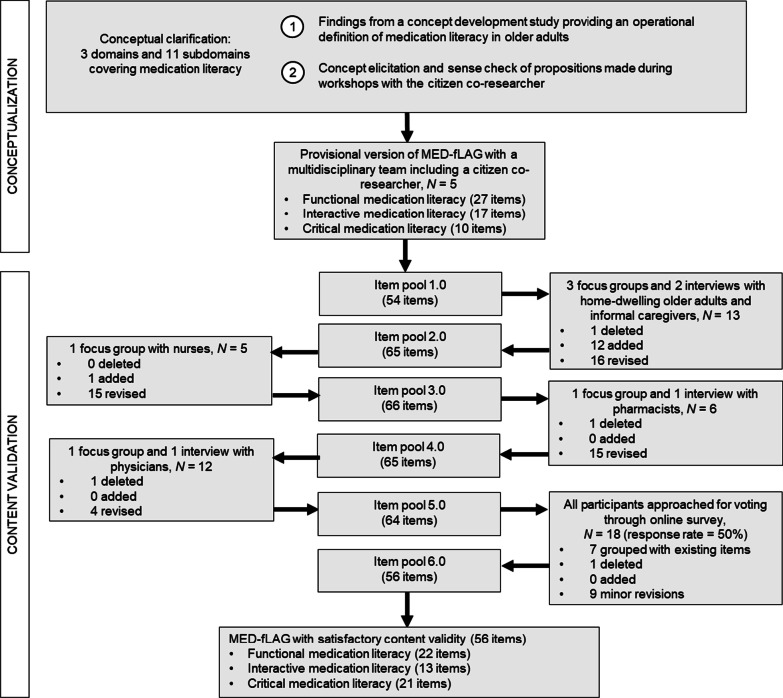
MED-fLAG was developed in accordance with the guidance on scale development and standards for good content validity, by using the following steps: (I) conceptualization of a provisional version of MED-fLAG; (II) iterative qualitative evaluation of its content validity by older adults, informal caregivers and healthcare professionals.
The qualitative assessment of the initial 54-item MED-fLAG was conducted in 36 participants, namely 13 home-dwelling older adults and/or informal caregivers and 23 healthcare professionals. Six rounds of revisions were performed to achieve content validity and to propose a 56-item revised MED-fLAG. Participants reported benefits of using a standardized assessment of medication literacy during a hospital stay but warned about certain limitations and prerequisites. The extent to which MED-fLAG could be integrated into discharge planning needs to be further investigated.
MED-fLAG is the first medication literacy measure tailored to the specific needs of older patients and informal caregivers. A unique feature of this measure is that it includes prescribed and non-prescribed medications, irrespective of the galenic form. Additional studies are required to evaluate the other measurement properties of MED-fLAG, and to reduce the number of items before considering its clinical application.
评估患者的用药知识技能(即获取、理解与药物相关信息并与之互动的能力)是帮助临床医生规划适当护理的重要一步。尽管研究人员多次尝试开发用药知识的测量方法,但针对老年人特定需求量身定制的工具仍存在重大不足。因此,一个包括公民共同研究者在内的跨专业团队构思了一种新的用药知识标准化测量方法——老年患者及非正式照护者用药知识评估(MED-fLAG)。MED-fLAG被设计为一种关于功能、互动和批判性技能的三维自我报告测量方法。本研究描述了其概念化过程,并给出了在住院期间对MED-fLAG的内容效度、可接受性和可行性进行评估的结果。
MED-fLAG是根据量表开发指南和良好内容效度标准,通过以下步骤开发的:(I)构思MED-fLAG的临时版本;(II)由老年人、非正式照护者和医疗保健专业人员对其内容效度进行迭代定性评估。
对最初包含54个条目的MED-fLAG进行了定性评估,共有36名参与者,即13名居家老年人和/或非正式照护者以及23名医疗保健专业人员。进行了六轮修订以实现内容效度,并提出了一个包含56个条目的修订版MED-fLAG。参与者报告了在住院期间使用用药知识标准化评估的益处,但也警告了某些局限性和前提条件。MED-fLAG可融入出院计划的程度需要进一步研究。
MED-fLAG是首个针对老年患者和非正式照护者的特定需求量身定制的用药知识测量方法。该测量方法的一个独特之处在于,它涵盖了处方药和非处方药,无论其剂型如何。在考虑将MED-fLAG应用于临床之前,需要进行更多研究以评估其其他测量属性,并减少条目数量。