Department of Epidemiology, University of North Carolina at Chapel Hill, Chapel Hill, North Carolina.
Lineberger Comprehensive Cancer Center, University of North Carolina at Chapel Hill, Chapel Hill, North Carolina.
Cancer Epidemiol Biomarkers Prev. 2022 Nov 2;31(11):2079-2086. doi: 10.1158/1055-9965.EPI-22-0495.
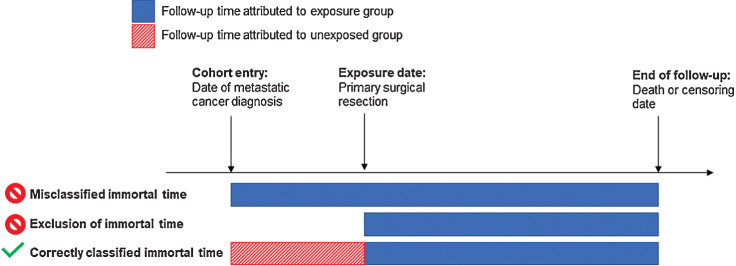
Studies evaluating the effects of cancer treatments are prone to immortal time bias that, if unaddressed, can lead to treatments appearing more beneficial than they are.
To demonstrate the impact of immortal time bias, we compared results across several analytic approaches (dichotomous exposure, dichotomous exposure excluding immortal time, time-varying exposure, landmark analysis, clone-censor-weight method), using surgical resection among women with metastatic breast cancer as an example. All adult women diagnosed with incident metastatic breast cancer from 2013-2016 in the National Cancer Database were included. To quantify immortal time bias, we also conducted a simulation study where the "true" relationship between surgical resection and mortality was known.
24,329 women (median age 61, IQR 51-71) were included, and 24% underwent surgical resection. The largest association between resection and mortality was observed when using a dichotomized exposure [HR, 0.54; 95% confidence interval (CI), 0.51-0.57], followed by dichotomous with exclusion of immortal time (HR, 0.62; 95% CI, 0.59-0.65). Results from the time-varying exposure, landmark, and clone-censor-weight method analyses were closer to the null (HR, 0.67-0.84). Results from the plasmode simulation found that the time-varying exposure, landmark, and clone-censor-weight method models all produced unbiased HRs (bias -0.003 to 0.016). Both standard dichotomous exposure (HR, 0.84; bias, -0.177) and dichotomous with exclusion of immortal time (HR, 0.93; bias, -0.074) produced meaningfully biased estimates.
Researchers should use time-varying exposures with a treatment assessment window or the clone-censor-weight method when immortal time is present.
Using methods that appropriately account for immortal time will improve evidence and decision-making from research using real-world data.
评估癌症治疗效果的研究容易受到不朽时间偏倚的影响,如果不加以解决,可能会导致治疗效果看起来比实际更好。
为了展示不朽时间偏倚的影响,我们以女性转移性乳腺癌为例,比较了几种分析方法(二分暴露、二分暴露排除不朽时间、时变暴露、 landmark 分析、克隆 censoring 加权法)的结果。所有在国家癌症数据库中被诊断为患有偶发性转移性乳腺癌的成年女性均被纳入研究。为了量化不朽时间偏倚,我们还进行了一项模拟研究,其中已知手术切除与死亡率之间的“真实”关系。
共纳入 24329 名女性(中位年龄 61 岁,IQR 51-71),其中 24%接受了手术切除。切除与死亡率之间最大的关联是在使用二分暴露时观察到的[HR,0.54;95%置信区间(CI),0.51-0.57],其次是排除不朽时间的二分暴露[HR,0.62;95% CI,0.59-0.65]。时变暴露、landmark 和克隆 censoring 加权法的分析结果更接近无效(HR,0.67-0.84)。来自 plasmode 模拟的结果发现,时变暴露、landmark 和克隆 censoring 加权法模型均产生了无偏的 HR(偏差-0.003 至 0.016)。标准二分暴露(HR,0.84;偏差,-0.177)和排除不朽时间的二分暴露(HR,0.93;偏差,-0.074)均产生了有意义的偏差估计。
当存在不朽时间时,研究人员应使用具有治疗评估窗口的时变暴露或克隆 censoring 加权法。
使用适当考虑不朽时间的方法将提高使用真实世界数据进行研究的证据和决策质量。