
对现代方法的思考:存在不朽时间偏倚时的试验模拟。利用观察性数据评估老年肺癌患者接受大手术的获益。
Reflection on modern methods: trial emulation in the presence of immortal-time bias. Assessing the benefit of major surgery for elderly lung cancer patients using observational data.
作者信息
Maringe Camille, Benitez Majano Sara, Exarchakou Aimilia, Smith Matthew, Rachet Bernard, Belot Aurélien, Leyrat Clémence
机构信息
Department of Non-Communicable Disease Epidemiology, London School of Hygiene & Tropical Medicine, London, UK.
Department of Medical Statistics, London School of Hygiene & Tropical Medicine, London, UK.
出版信息
Int J Epidemiol. 2020 Oct 1;49(5):1719-1729. doi: 10.1093/ije/dyaa057.
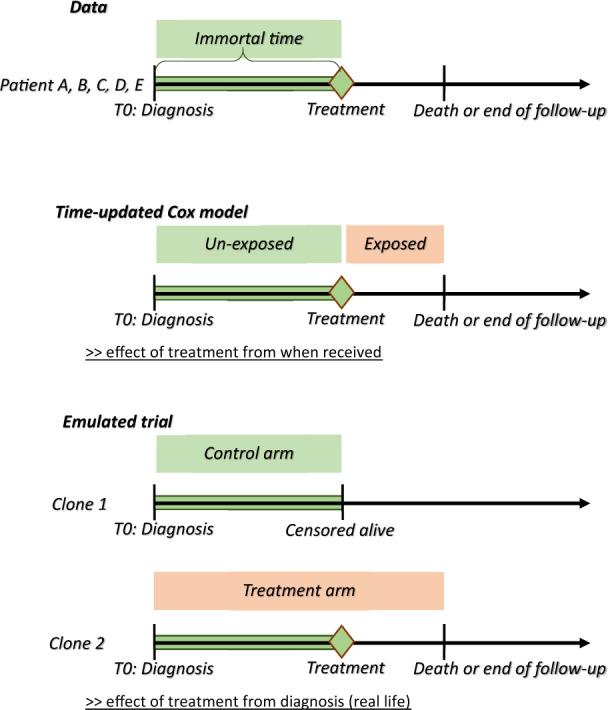
Acquiring real-world evidence is crucial to support health policy, but observational studies are prone to serious biases. An approach was recently proposed to overcome confounding and immortal-time biases within the emulated trial framework. This tutorial provides a step-by-step description of the design and analysis of emulated trials, as well as R and Stata code, to facilitate its use in practice. The steps consist in: (i) specifying the target trial and inclusion criteria; (ii) cloning patients; (iii) defining censoring and survival times; (iv) estimating the weights to account for informative censoring introduced by design; and (v) analysing these data. These steps are illustrated with observational data to assess the benefit of surgery among 70-89-year-old patients diagnosed with early-stage lung cancer. Because of the severe unbalance of the patient characteristics between treatment arms (surgery yes/no), a naïve Kaplan-Meier survival analysis of the initial cohort severely overestimated the benefit of surgery on 1-year survival (22% difference), as did a survival analysis of the cloned dataset when informative censoring was ignored (17% difference). By contrast, the estimated weights adequately removed the covariate imbalance. The weighted analysis still showed evidence of a benefit, though smaller (11% difference), of surgery among older lung cancer patients on 1-year survival. Complementing the CERBOT tool, this tutorial explains how to proceed to conduct emulated trials using observational data in the presence of immortal-time bias. The strength of this approach is its transparency and its principles that are easily understandable by non-specialists.
获取真实世界证据对于支持卫生政策至关重要,但观察性研究容易出现严重偏差。最近有人提出了一种方法,以克服模拟试验框架内的混杂偏倚和不朽时间偏倚。本教程逐步介绍了模拟试验的设计与分析,以及R和Stata代码,以促进其在实际中的应用。步骤包括:(i)明确目标试验和纳入标准;(ii)克隆患者;(iii)定义删失和生存时间;(iv)估计权重以考虑设计引入的信息性删失;以及(v)分析这些数据。通过观察性数据说明了这些步骤,以评估手术对70-89岁早期肺癌患者的益处。由于治疗组(手术与否)之间患者特征严重不平衡,对初始队列进行简单的Kaplan-Meier生存分析严重高估了手术对1年生存率的益处(相差22%),忽略信息性删失时对克隆数据集进行的生存分析也是如此(相差17%)。相比之下,估计的权重充分消除了协变量不平衡。加权分析仍显示老年肺癌患者手术对1年生存率有获益证据,尽管获益较小(相差11%)。作为对CERBOT工具的补充,本教程解释了在存在不朽时间偏倚的情况下如何使用观察性数据进行模拟试验。这种方法的优点在于其透明度以及非专业人员易于理解的原则。


 Zotero 插件