Department of Diagnostic and Interventional Radiology, University Medical Center of the Johannes Gutenberg University Mainz, Langenbeckst. 1, 55131, Mainz, Germany.
Department of Radiology, Charité - University Medicine Berlin, Berlin, Germany.
Eur Radiol. 2023 Feb;33(2):1031-1039. doi: 10.1007/s00330-022-09069-8. Epub 2022 Aug 20.
Low bone mineral density (BMD) was recently identified as a novel risk factor for patients with hepatocellular carcinoma (HCC). In this multicenter study, we aimed to validate the role of BMD as a prognostic factor for patients with HCC undergoing transarterial chemoembolization (TACE).
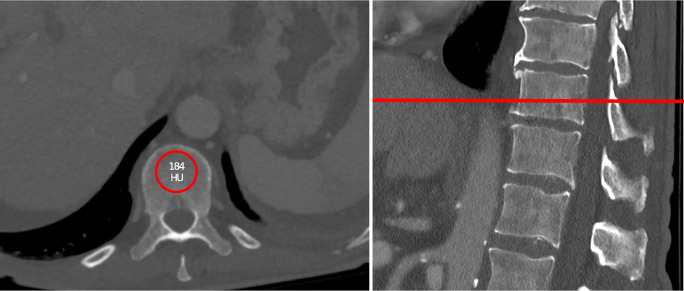
This retrospective multicenter trial included 908 treatment-naïve patients with HCC who were undergoing TACE as a first-line treatment, at six tertiary care centers, between 2010 and 2020. BMD was assessed by measuring the mean Hounsfield units (HUs) in the midvertebral core of the 11 thoracic vertebra, on contrast-enhanced computer tomography performed before treatment. We assessed the influence of BMD on median overall survival (OS) and performed multivariate analysis including established estimates for survival.
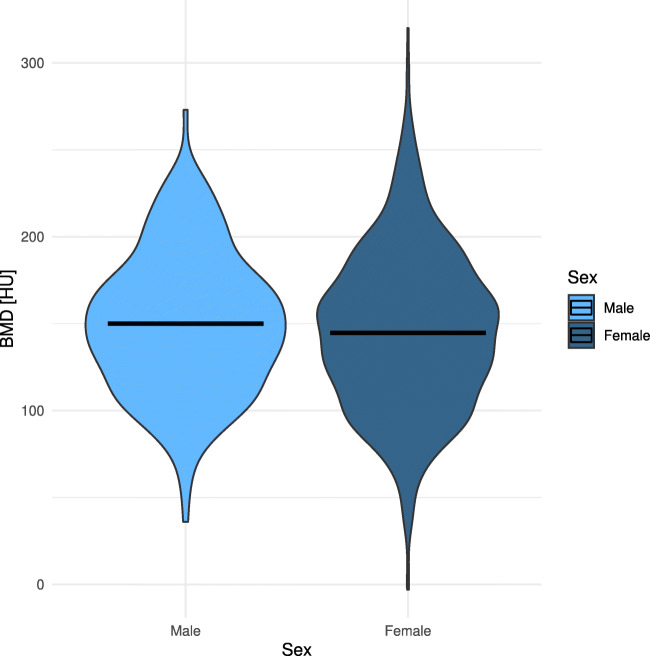
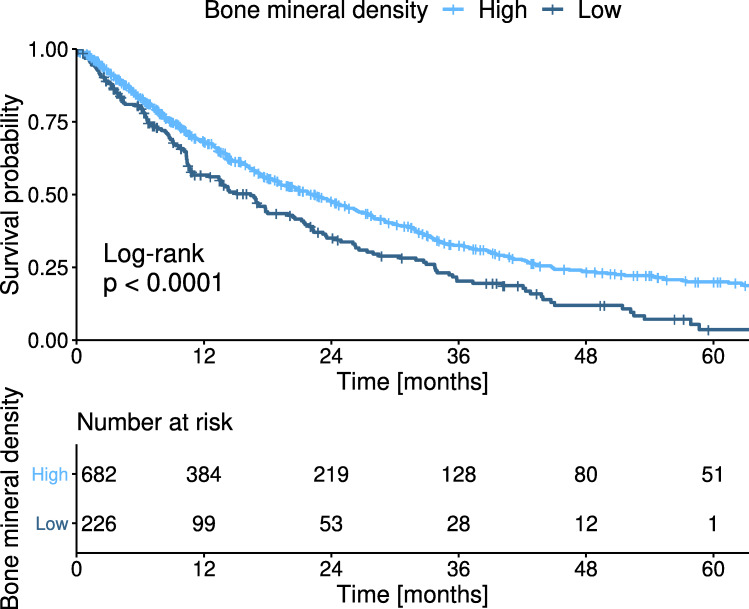
The median BMD was 145 HU (IQR, 115-175 HU). Patients with a high BMD (≥ 114 HU) had a median OS of 22.2 months, while patients with a low BMD (< 114 HU) had a lower median OS of only 16.2 months (p < .001). Besides albumin, bilirubin, tumor number, and tumor diameter, BMD remained an independent prognostic factor in multivariate analysis.
BMD is an independent predictive factor for survival in elderly patients with HCC undergoing TACE. The integration of BMD into novel scoring systems could potentially improve survival prediction and clinical decision-making.
• Bone mineral density can be easily assessed in routinely acquired pre-interventional computed tomography scans. • Bone mineral density is an independent predictive factor for survival in elderly patients with HCC undergoing TACE. • Thus, bone mineral density is a novel imaging biomarker for prognosis prediction in elderly patients with HCC undergoing TACE.
低骨密度(BMD)最近被确定为肝细胞癌(HCC)患者的一个新的危险因素。在这项多中心研究中,我们旨在验证 BMD 作为接受经动脉化疗栓塞(TACE)治疗的 HCC 患者的预后因素的作用。
这项回顾性多中心试验纳入了 2010 年至 2020 年期间在六家三级护理中心接受 TACE 作为一线治疗的 908 例初治 HCC 患者。在治疗前进行的增强计算机断层扫描中,通过测量第 11 胸椎中间椎体的平均 Hounsfield 单位(HU)来评估 BMD。我们评估了 BMD 对中位总生存期(OS)的影响,并进行了包括生存的既定估计在内的多变量分析。
中位 BMD 为 145HU(IQR,115-175HU)。BMD 较高(≥114HU)的患者中位 OS 为 22.2 个月,而 BMD 较低(<114HU)的患者中位 OS 仅为 16.2 个月(p<0.001)。除白蛋白、胆红素、肿瘤数量和肿瘤直径外,BMD 在多变量分析中仍然是一个独立的预后因素。
BMD 是接受 TACE 治疗的老年 HCC 患者生存的独立预测因素。将 BMD 纳入新的评分系统可能会提高生存预测和临床决策的准确性。
BMD 可以在常规获取的介入前计算机断层扫描扫描中轻松评估。
BMD 是接受 TACE 治疗的老年 HCC 患者生存的独立预测因素。
因此,BMD 是接受 TACE 治疗的老年 HCC 患者预后预测的新型影像学生物标志物。