Guangdong Province Key Laboratory for Biotechnology Drug Candidates, School of Life Sciences and Biopharmaceutics, Guangdong Pharmaceutical University, Guangzhou, China.
Department of Cardiothoracic Surgery, Taizhou Hospital of Zhejiang Province affiliated to Wenzhou Medical University, Taizhou, China.
Cell Death Dis. 2022 Aug 20;13(8):727. doi: 10.1038/s41419-022-05180-2.
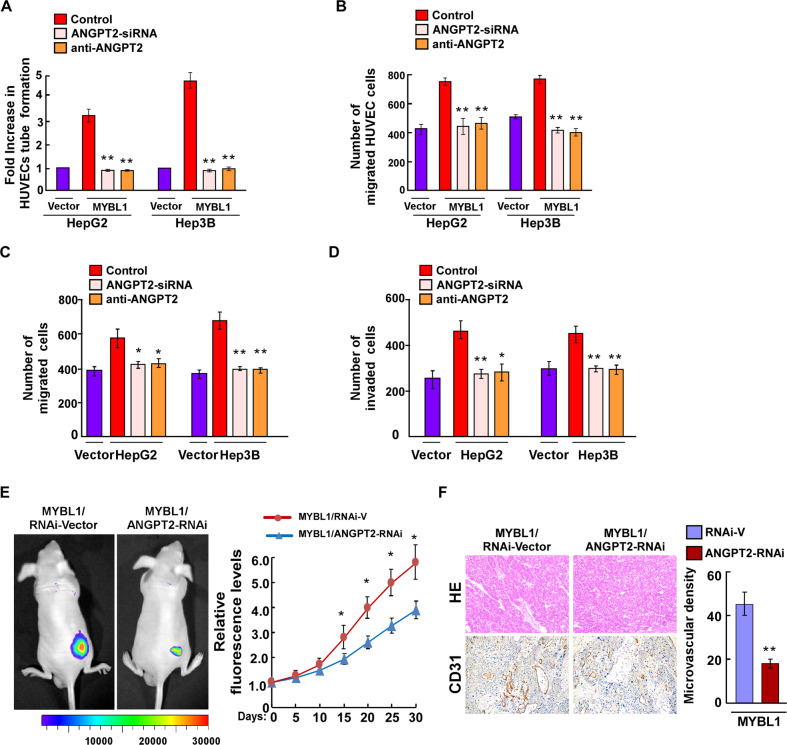
Angiogenesis is considered as an important process in tumor growth, metastasis of hepatocellular carcinoma (HCC) and associated with cancer progression, suggesting that an important research and development field of clinical molecular targeted drugs for HCC. However, the molecular mechanisms underlying tumor angiogenesis in HCC remains elusive. In the current study, we demonstrate that upregulation of AMYB proto-oncogene-like 1 (MYBL1) was associated with high endothelial vessel (EV) density and contributed to poor prognosis of HCC patient. Functionally, MYBL1 overexpressing enhanced the capacity of HCC cells to induce tube formation, migration of HUVECs, neovascularization in CAMs, finally, enhanced HCC cells metastasis, while silencing MYBL1 had the converse effect. Furthermore, HCC cells with high MYBL1 expression were more resistance to sorafenib treatment. We observed that CD31 staining was significantly increased in tumors formed by MYBL1-overexpressing cells but decreased in MYBL1-silenced tumors. Mechanistically, MYBL1 binds to the ANGPT2 promoter and transcriptionally upregulate ANGPT2 mRNA expression. Strikingly, treatment with monoclonal antibody against ANGPT2 significantly inhibited the growth of MYBL1-overexpressing tumors and efficiently impaired angiogenesis. Furthermore, the histone post-translational factors: protein arginine methyltransferase 5 (PRMT5), MEP50, and WDR5 were required for MYBL1-mediated ANGPT2 upregulation. Importantly, we confirmed the correlation between MYBL1 and ANGPT2 expression in a large cohort of clinical HCC samples and several published datasets in pancreatic cancer, esophageal carcinoma, stomach adenocarcinoma, and colon cancer. Our results demonstrate that MYBL1 upregulated the ANGPT2 expression, then induced angiogenesis and confer sorafenib resistance to HCC cells, and MYBL1 may represent a novel prognostic biomarker and therapeutic target for patients with HCC.
血管生成被认为是肿瘤生长、肝癌(HCC)转移的重要过程,与癌症进展相关,提示 HCC 临床分子靶向药物的一个重要研究和开发领域。然而,HCC 中肿瘤血管生成的分子机制仍不清楚。在本研究中,我们证明 AMYB 原癌基因样 1(MYBL1)的上调与高内皮血管(EV)密度相关,并与 HCC 患者的不良预后相关。功能上,MYBL1 过表达增强了 HCC 细胞诱导管形成、HUVEC 迁移、CAM 中新血管形成的能力,最终增强了 HCC 细胞的转移能力,而沉默 MYBL1 则有相反的效果。此外,高 MYBL1 表达的 HCC 细胞对索拉非尼治疗更有抵抗力。我们观察到,MYBL1 过表达细胞形成的肿瘤中 CD31 染色明显增加,而 MYBL1 沉默肿瘤中 CD31 染色减少。在机制上,MYBL1 结合到 ANGPT2 启动子上,并转录上调 ANGPT2 mRNA 表达。引人注目的是,用针对 ANGPT2 的单克隆抗体治疗可显著抑制 MYBL1 过表达肿瘤的生长,并有效地抑制血管生成。此外,组蛋白翻译后修饰因子:精氨酸甲基转移酶 5(PRMT5)、MEP50 和 WDR5 是 MYBL1 介导的 ANGPT2 上调所必需的。重要的是,我们在大量临床 HCC 样本和几个已发表的胰腺癌、食管癌、胃腺癌和结肠癌数据集,证实了 MYBL1 与 ANGPT2 表达之间的相关性。我们的研究结果表明,MYBL1 上调了 ANGPT2 的表达,继而诱导血管生成,并赋予 HCC 细胞对索拉非尼的耐药性,MYBL1 可能成为 HCC 患者的一个新的预后标志物和治疗靶点。