Human Nutrition Research Centre, Centre for Healthier Lives, Population Health Sciences Institute, Newcastle University, Newcastle upon Tyne, UK.
Research Division, Faculty of Medicine, Siriraj Hospital, Mahidol University, Bangkok, Thailand.
Clin Epigenetics. 2022 Aug 20;14(1):103. doi: 10.1186/s13148-022-01325-4.
DNA methylation in the human genome is established and maintained by DNA methyltransferases (DNMTs). DNMT isoforms show differential expression by cell lineage and during development, but much remains to be elucidated about their shared and unique genomic targets.
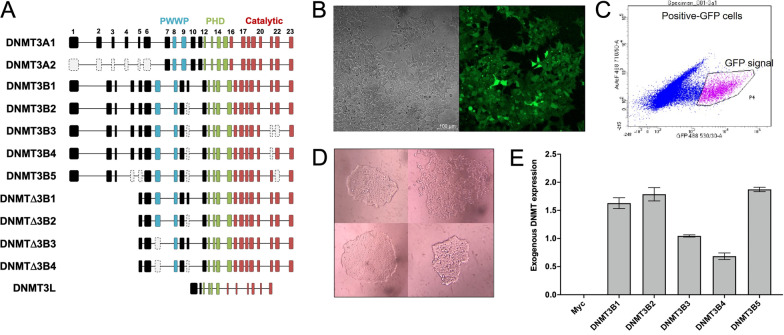
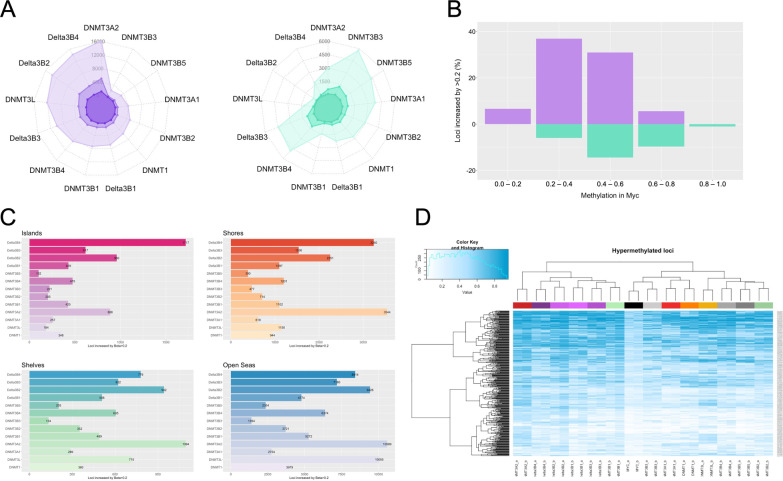
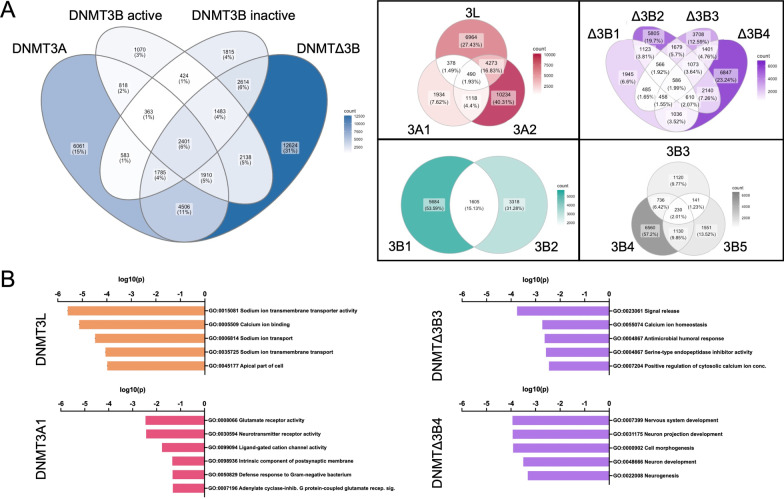
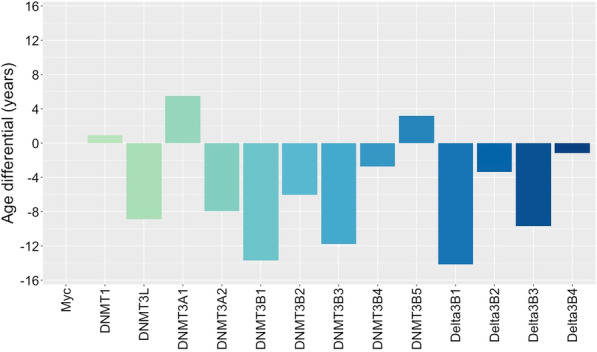
We examined changes in the epigenome following overexpression of 13 DNMT isoforms in HEK293T cells. We observed increased methylation (Δβ > 0.2) at 43,405 CpG sites, with expression of DNMT3A2, DNMTΔ3B4 and DNMTΔ3B2 associated with the greatest impact. De novo methylation occurred primarily within open sea regions and at loci with intermediate methylation levels (β: 0.2-0.6). 53% of differentially methylated loci showed specificity towards a single DNMT subfamily, primarily DNMTΔ3B and DNMT3A and 39% towards a single isoform. These loci were significantly enriched for pathways related to neuronal development (DNMTΔ3B4), calcium homeostasis (DNMTΔ3B3) and ion transport (DNMT3L). Repetitive elements did not display differential sensitivity to overexpressed DNMTs, but hypermethylation of Alu elements was associated with their evolutionary age following overexpression of DNMT3A2, DNMT3B1, DNMT3B2 and DNMT3L. Differential methylation (Δβ > 0.1) was observed at 121 of the 353 loci associated with the Horvath 'epigenetic clock' model of ageing, with 51 showing isoform specificity, and was associated with reduction of epigenetic age by 5-15 years following overexpression of seven isoforms. Finally, we demonstrate the potential for dietary constituents to modify epigenetic marks through isoform-specific inhibition of methylation activity.
Our results provide insight into regions of the genome methylated uniquely by specific DNMT isoforms and demonstrate the potential for dietary intervention to modify the epigenome.
人类基因组中的 DNA 甲基化由 DNA 甲基转移酶 (DNMTs) 建立和维持。DNMT 同工型在细胞谱系和发育过程中表现出不同的表达,但它们的共同和独特的基因组靶标仍有许多需要阐明。
我们在 HEK293T 细胞中转染 13 种 DNMT 同工型,观察到组蛋白甲基化的变化。我们观察到 43405 个 CpG 位点的甲基化增加 (Δβ>0.2),其中 DNMT3A2、DNMTΔ3B4 和 DNMTΔ3B2 的表达与最大影响相关。从头甲基化主要发生在开放海区域和中等甲基化水平的基因座内 (β:0.2-0.6)。43%的差异甲基化基因座对单个 DNMT 亚家族具有特异性,主要是 DNMTΔ3B 和 DNMT3A,39%对单个同工型具有特异性。这些基因座显著富集了与神经元发育 (DNMTΔ3B4)、钙稳态 (DNMTΔ3B3) 和离子转运 (DNMT3L) 相关的途径。重复元件对过表达的 DNMT 没有表现出不同的敏感性,但 Alu 元件的过度甲基化与它们在过表达 DNMT3A2、DNMT3B1、DNMT3B2 和 DNMT3L 后的进化年龄有关。在与 Horvath 衰老表观遗传钟模型相关的 353 个基因座中的 121 个中观察到差异甲基化 (Δβ>0.1),其中 51 个具有同工型特异性,并与过表达七种同工型后表观遗传年龄减少 5-15 年相关。最后,我们证明了膳食成分通过同工型特异性抑制甲基化活性来修饰表观遗传标记的潜力。
我们的研究结果提供了对由特定 DNMT 同工型独特甲基化的基因组区域的深入了解,并证明了膳食干预修饰表观基因组的潜力。