Department of Anesthesiology, The First Affiliated Hospital of Jinan University, Guangzhou, 510630, China.
Department of General Surgery, The First Affiliated Hospital of Jinan University, Guangzhou, China.
BMC Gastroenterol. 2022 Aug 20;22(1):391. doi: 10.1186/s12876-022-02467-8.
Painless gastrointestinal endoscopy is widely used for the diagnosis and treatment of digestive diseases. At present, propofol is commonly used to perform painless gastrointestinal endoscopy, but the high dose of propofol often leads to a higher incidence of cardiovascular and respiratory complications. Studies have shown that the application of propofol combined with ketamine in painless gastrointestinal endoscopy is beneficial to reduce the dosage of propofol and the incidence of related complications. Esketamine is dextrorotatory structure of ketamine with a twice as great anesthetic effect as normal ketamine but fewer side effects. We hypothesized that esketamine may reduce the consumption of propofol and to investigate the safety of coadministration during gastrointestinal endoscopy.
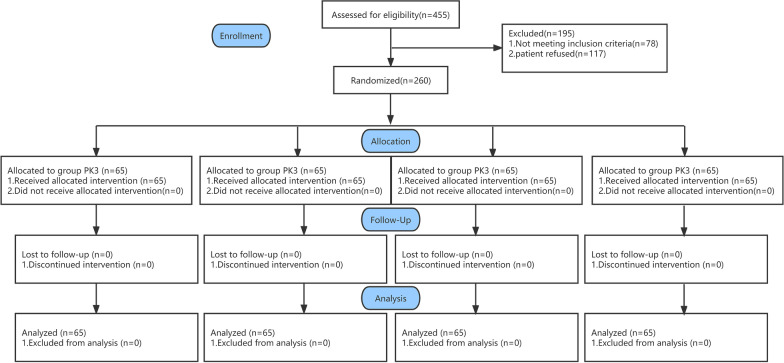
A total of 260 patients undergoing painless gastrointestinal endoscopy (gastroscope and colonoscopy) were randomly divided into P group (propofol + saline), PK1 group (propofol + esketamine 0.05 mg/kg), PK2 group (propofol + esketamine 0.1 mg/kg), and PK3 group (propofol + esketamine 0.2 mg/kg). Anesthesia was achieved by 1.5 mg/kg propofol with different doses of esketamine. Propofol consumption per minute was recorded. Hemodynamic index, pulse oxygen saturation, operative time, induction time, awakening status, orientation recovery time, adverse events, and Mini-Mental State Examination (MMSE) were also recorded during gastrointestinal endoscopy.
Propofol consumption per minute was 11.78, 10.56, 10.14, and 9.57 (mg/min) in groups P, PK1, PK2, and PK3, respectively; compared with group P, groups PK2 and PK3 showed a decrease of 13.92% (P = 0.021) and 18.76% (P = 0.000), respectively. In all four groups, systolic blood pressure (SBP), diastolic blood pressure (DBP), heart rate (HR), but not pulse oxygen saturation (SpO) significantly decreased (P = 0.000) immediately after administration of induction, but there were no significant differences between the groups. The induction time of groups P, PK1, PK2, and PK3 was 68.52 ± 18.394, 64.83 ± 13.543, 62.23 ± 15.197, and 61.35 ± 14.470 s, respectively (P = 0.041). Adverse events and psychotomimetic effects were observed but without significant differences between the groups.
The combination of 0.2 mg/kg esketamine and propofol was effective and safe in painless gastrointestinal endoscopy as evidenced by less propofol consumption per minute, shorter induction time, and lower incidence of cough and body movement relative to propofol alone. The lack of significant differences in hemodynamic results, anesthesia-related indices, adverse events, and MMSE results showed the safety to apply this combination for painless gastrointestinal endoscopy. Trial registration This study was registered with China Clinical Trial Registration on 07/11/2020 (registration website: chictr.org.cn; registration numbers: ChiCTR https://clinicaltrials.gov/ct2/show/2000039750 ).
无痛胃肠镜检查广泛应用于消化疾病的诊断和治疗。目前,临床上常采用丙泊酚进行无痛胃肠镜检查,但丙泊酚用量大常导致心血管和呼吸并发症发生率增高。研究表明,丙泊酚复合氯胺酮应用于无痛胃肠镜检查有利于减少丙泊酚用量和相关并发症的发生。艾司氯胺酮是氯胺酮的右旋结构,其麻醉作用是普通氯胺酮的两倍,但副作用较少。我们假设艾司氯胺酮可能会减少丙泊酚的用量,并研究其在胃肠镜检查中的安全性。
将 260 例行无痛胃肠镜(胃镜和结肠镜)的患者随机分为 P 组(丙泊酚+生理盐水)、PK1 组(丙泊酚+艾司氯胺酮 0.05mg/kg)、PK2 组(丙泊酚+艾司氯胺酮 0.1mg/kg)和 PK3 组(丙泊酚+艾司氯胺酮 0.2mg/kg)。不同剂量的艾司氯胺酮与 1.5mg/kg 丙泊酚联合应用达到麻醉效果。记录每分钟丙泊酚的用量。记录血流动力学指标、脉搏血氧饱和度、手术时间、诱导时间、苏醒状态、定向恢复时间、不良反应和简易精神状态检查表(MMSE)。
P、PK1、PK2 和 PK3 组每分钟丙泊酚用量分别为 11.78、10.56、10.14 和 9.57(mg/min);与 P 组相比,PK2 和 PK3 组丙泊酚用量减少了 13.92%(P=0.021)和 18.76%(P=0.000)。四组患者在诱导后即刻均出现收缩压(SBP)、舒张压(DBP)、心率(HR)显著下降(P=0.000),但组间无显著差异。P、PK1、PK2 和 PK3 组的诱导时间分别为 68.52±18.394、64.83±13.543、62.23±15.197 和 61.35±14.470s(P=0.041)。各组均观察到不良反应和拟精神病作用,但组间无显著差异。
与单独使用丙泊酚相比,0.2mg/kg 艾司氯胺酮与丙泊酚联合应用在无痛胃肠镜检查中具有更好的效果和安全性,表现为每分钟丙泊酚用量减少、诱导时间缩短、咳嗽和躯体运动发生率降低。血流动力学结果、麻醉相关指标、不良反应和 MMSE 结果无显著差异,表明该联合应用在无痛胃肠镜检查中是安全的。
本研究于 2020 年 7 月 11 日在中国临床试验注册中心注册(注册网站:chictr.org.cn;注册号:ChiCTR2000039750)。