Binzhou Medical University Hospital, Binzhou, China.
Department of Anesthesiology, Binzhou Medical University Hospital, Huanghe-Str.2, Binzhou, China.
BMC Anesthesiol. 2023 Jul 18;23(1):240. doi: 10.1186/s12871-023-02204-y.
Propofol is the most commonly used drug for procedural sedation during gastroscopy. However, independent use of propofol can lead to increased dosage and additional side effects. Esketamine was found to be exceptional in combination with propofol for painless gastroscopy. No studies have calculated the median effective dose (ED) of esketamine combined with propofol in pediatric painless gastroscopy. Here, we designed a research to study the ED of esketamine combined with propofol using the Dixon and Massey up-and-down sequential method for inhibiting the response of gastroscope insertion.
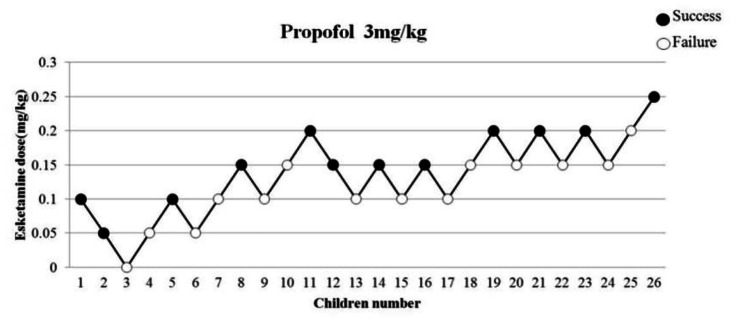
Children who met the inclusion and exclusion criteria were included in this study. Propofol and esketamine were used as anesthetics for painless gastroscopy in children. To explore the ED, the initial propofol dose was set at 3 mg/kg in all children. The first child was given an esketamine dose of 0.1 mg/kg, followed by 30 s of slow bolus injection propofol. If anesthesia induction failed (coughing or body movement of children during gastroscope insertion), the esketamine dose was elevated in the next child, with a interval difference of 0.05 mg/kg. Otherwise, if the anesthesia induction was successful, the next dosage was reduced by 0.05 mg/kg. The study was stopped if nine crossover inflection points were reached. The ED of esketamine was calculated using probit regression, and the blood pressure, pulse oxygen saturation, heart rate, recovery time, and side effects were recorded in all children.
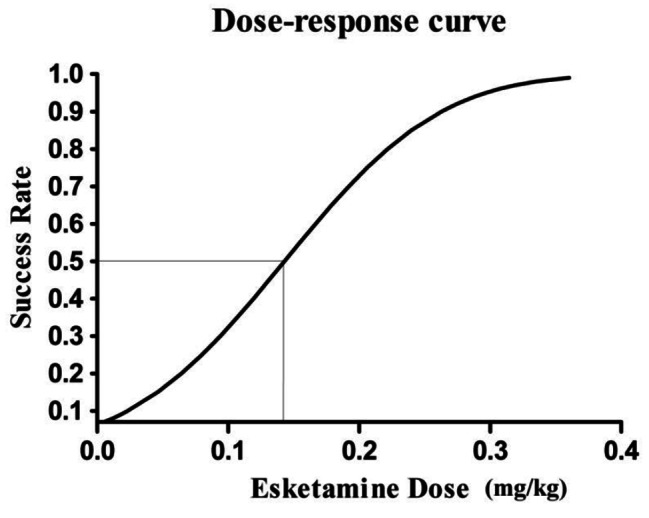
A total of 26 children were included in this study. The ED of esketamine combined with 3 mg/kg propofol was 0.143 mg/kg (95% CI 0.047-0.398 mg/kg). The total consumption of propofol was 16.04 ± 5.37 mg. The recovery time was 16.38 ± 8.70 min. Adverse effects recorded were delayed awakening in two cases and increased oral secretions of another child during the examination inducing cough and hypoxemia (86% was the lowest).
The ED of esketamine was 0.143 mg/kg when combined with 3 mg/kg propofol for successful sedation in pediatric gastroscope insertion. This sub-anaesthetic dose of esketamine was safe and efficacious with few complications in pediatric painless gastroscopy.
The study was registered at the Chinese Clinical Trial Registry ( www.chictr.org.cn ; registration number: ChiCTR2100052830 on 06/11/2021).
异丙酚是胃镜检查中最常用的镇静药物。然而,单独使用异丙酚可能会导致剂量增加和额外的副作用。氯胺酮与异丙酚联合使用被发现对无痛胃镜检查有特殊作用。目前还没有研究计算氯胺酮联合异丙酚在小儿无痛胃镜检查中的中效剂量(ED)。在这里,我们设计了一项研究,使用 Dixon 和 Massey 上下序贯法来抑制胃镜插入反应,以研究氯胺酮联合异丙酚的 ED。
符合纳入和排除标准的儿童被纳入本研究。异丙酚和氯胺酮被用作儿童无痛胃镜的麻醉剂。为了探索 ED,所有儿童的初始异丙酚剂量设定为 3mg/kg。第一例儿童给予氯胺酮剂量为 0.1mg/kg,然后缓慢推注异丙酚 30s。如果麻醉诱导失败(儿童在胃镜插入过程中咳嗽或身体运动),则在下一个儿童中增加氯胺酮剂量,间隔差为 0.05mg/kg。否则,如果麻醉诱导成功,则下一个剂量减少 0.05mg/kg。如果达到 9 个交叉拐点,则停止研究。使用概率回归计算氯胺酮的 ED,并记录所有儿童的血压、脉搏血氧饱和度、心率、恢复时间和副作用。
本研究共纳入 26 例儿童。氯胺酮联合 3mg/kg 异丙酚的 ED 为 0.143mg/kg(95%CI 0.047-0.398mg/kg)。异丙酚总用量为 16.04±5.37mg。恢复时间为 16.38±8.70min。记录的不良反应有 2 例苏醒延迟,1 例检查中因口腔分泌物增加而引起咳嗽和低氧血症(86%为最低)。
氯胺酮与 3mg/kg 异丙酚联合用于小儿胃镜插入时,ED 为 0.143mg/kg。这种亚麻醉剂量的氯胺酮在小儿无痛胃镜检查中安全有效,并发症少。
该研究在中国临床试验注册中心(www.chictr.org.cn;注册号:ChiCTR2100052830,于 2021 年 06 月 11 日注册)。