State Key Laboratory of Agrobiotechnology / Beijing Key Laboratory of Crop Genetic Improvement, China Agricultural University, Beijing 100193, China; Institute of Crop Science, Plant Precision Breeding Academy, Zhejiang Provincial Key Laboratory of Crop Genetic Resources, College of Agriculture and Biotechnology, Zhejiang University, Hangzhou, China.
Institute of Crop Sciences, Chinese Academy of Agricultural Sciences, Beijing 100081, China; The College of Agronomy, Anhui Agricultural University, Hefei, China.
J Adv Res. 2022 Dec;42:1-16. doi: 10.1016/j.jare.2022.08.004. Epub 2022 Aug 18.
Rice, Oryza sativa L. (Os), is one of the oldest domesticated cereals that has also gone through extensive improvement in modern breeding.
How rice was domesticated and impacted by modern breeding.
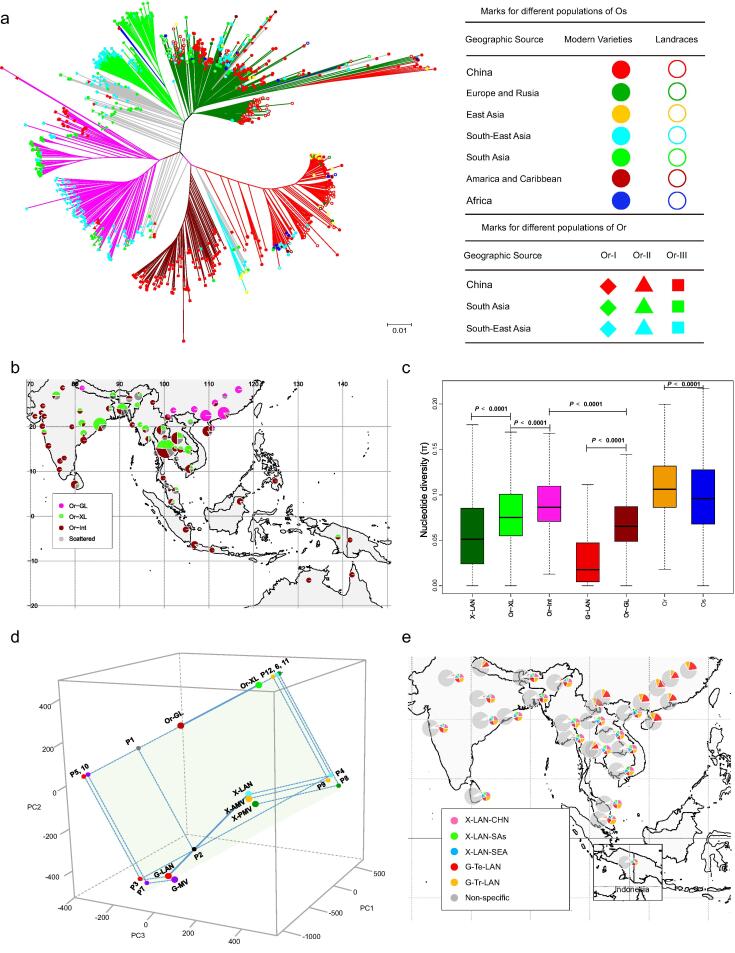
We performed comprehensive analyses of genomic sequences of 504 accessions of Os and 456 accessions of O. rufipogon/O. nivara (Or).
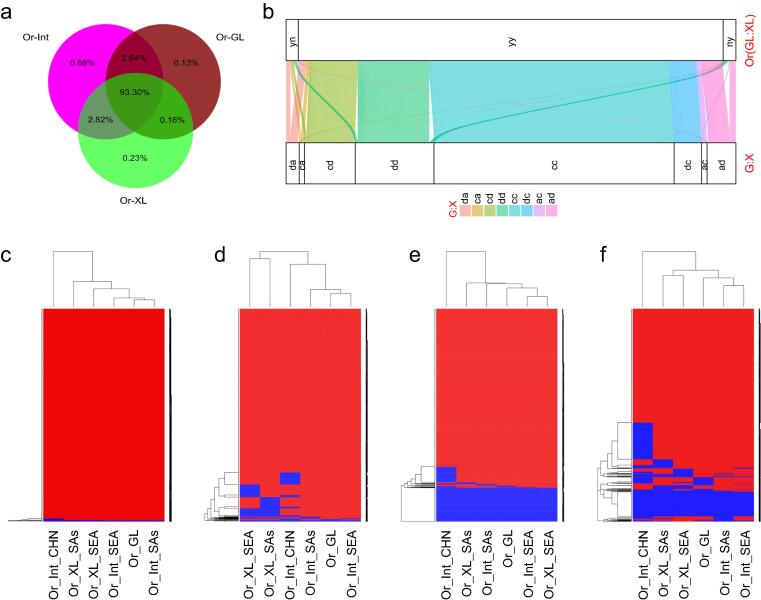
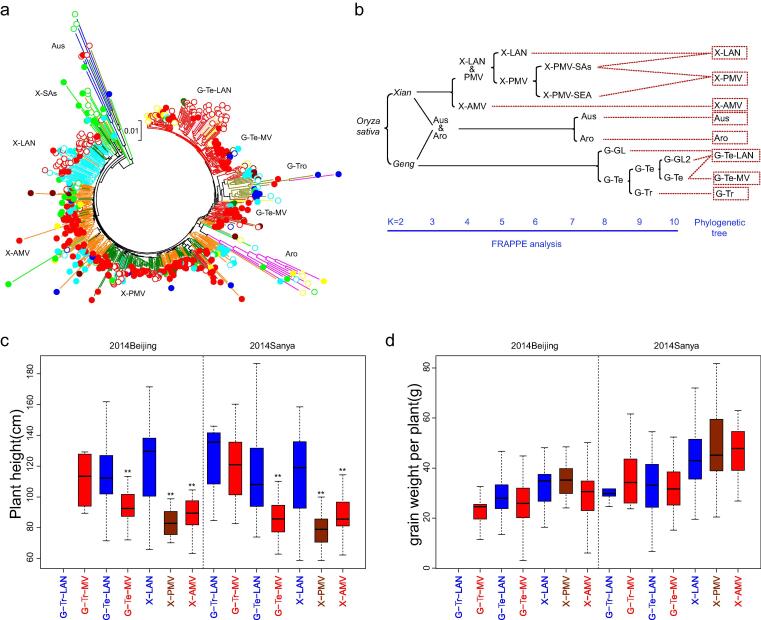
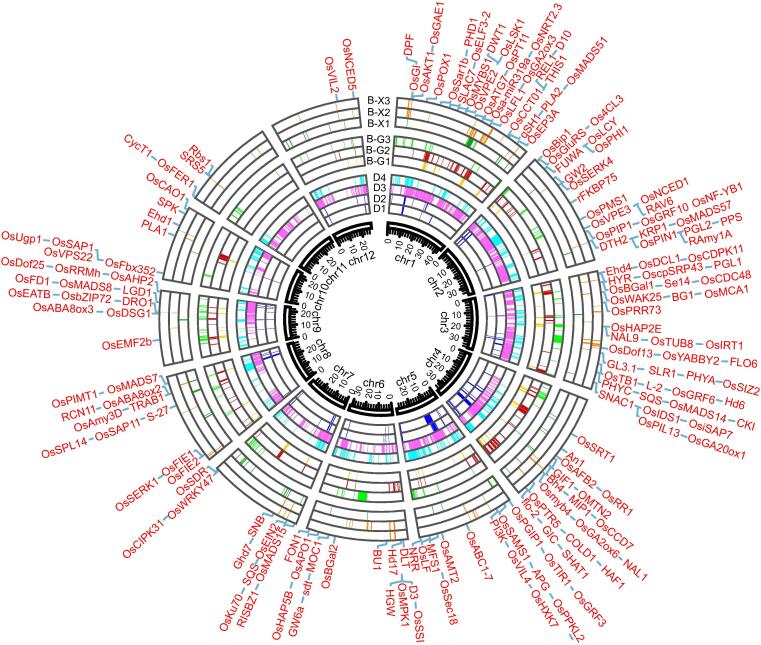
The natural selection on Or before domestication and the natural and artificial selection during domestication together shaped the well-differentiated genomes of two subspecies, geng(j) (japonica) and xian(i) (indica), while breeding has made apparent genomic imprints between landrace and modern varieties of each subspecies, and also between primary modern and advanced modern varieties of xian(i). Selection during domestication and breeding left genome-wide selective signals covering ∼ 22.8 % and ∼ 8.6 % of the Os genome, significantly reduced within-population genomic diversity by ∼ 22 % in xian(i) and ∼ 53 % in geng(j) plus more pronounced subspecific differentiation. Only ∼ 10 % reduction in the total genomic diversity was observed between the Os and Or populations, indicating domestication did not suffer severe genetic bottleneck.
Our results revealed clear differentiation of the Or accessions into three large populations, two of which correspond to the well-differentiated Os subspecies, geng(j) and xian(i). Improved productivity and common changes in the same suit of adaptive traits in xian(i) and geng(j) during domestication and breeding resulted apparently from compensatory and convergent selections for different genes/alleles acting in the common KEGG terms and/or same gene families, and thus maintaining or even increasing the within population diversity and subspecific differentiation of Os, while more genes/alleles of novel function were selected during domestication than modern breeding. Our results supported the multiple independent domestication of Os in Asia and suggest the more efficient utilization of the rich diversity within Os by exploiting inter-subspecific and among population diversity in future rice improvement.
水稻,即 Oryza sativa L.(稻属),是最古老的驯化谷物之一,在现代育种中也经历了广泛的改良。
探讨水稻的驯化方式以及现代育种对其产生的影响。
我们对 504 份稻属和 456 份 O. rufipogon/O. nivara(野生稻属)的基因组序列进行了全面分析。
在驯化之前,野生稻属经历了自然选择,而在驯化过程中,自然选择和人工选择共同塑造了两个亚种粳(japonica)和籼(indica)截然不同的基因组,同时,育种在每个亚种的地方品种和现代品种之间,以及在籼稻亚种的初级现代品种和高级现代品种之间,都留下了明显的基因组印记。驯化和育种过程中的选择在整个稻属基因组中留下了约 22.8%的全基因组选择信号,导致籼稻的群体内基因组多样性显著减少了约 22%,粳稻减少了约 53%,同时亚种分化更加明显。在稻属和野生稻属群体之间,总基因组多样性仅减少了约 10%,这表明驯化过程并未遭受严重的遗传瓶颈。
我们的研究结果表明,野生稻属的 3 个大型群体清晰地分化为两个亚种,即粳稻和籼稻。在驯化和育种过程中,籼稻和粳稻的生产力提高和相同适应性状的常见变化,显然是由于不同基因/等位基因在共同的 KEGG 术语和/或相同基因家族中作用的补偿和趋同选择的结果,从而维持甚至增加了稻属的群体内多样性和亚种分化,同时在驯化过程中选择了更多具有新功能的基因/等位基因。我们的研究结果支持了亚洲地区稻属的多次独立驯化,并表明在未来的水稻改良中,通过利用稻属内的种间和群体间多样性,可以更有效地利用其丰富的多样性。