Hebei Agricultural University, Baoding, China.
Department of Botany and Plant Sciences, University of California, Riverside, CA, USA.
Plant Biotechnol J. 2020 Jan;18(1):57-67. doi: 10.1111/pbi.13170. Epub 2019 Jun 26.
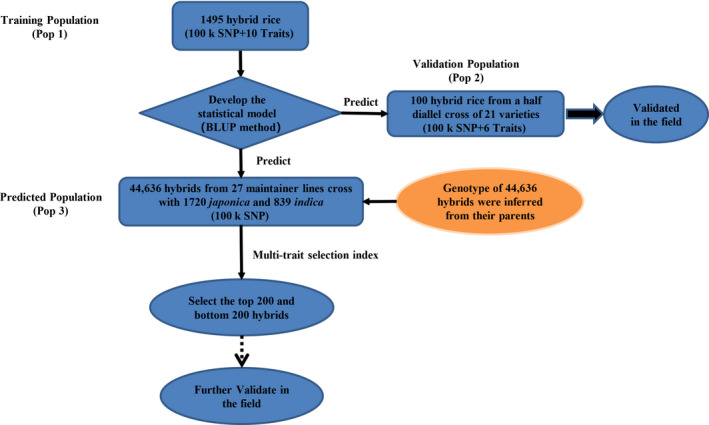
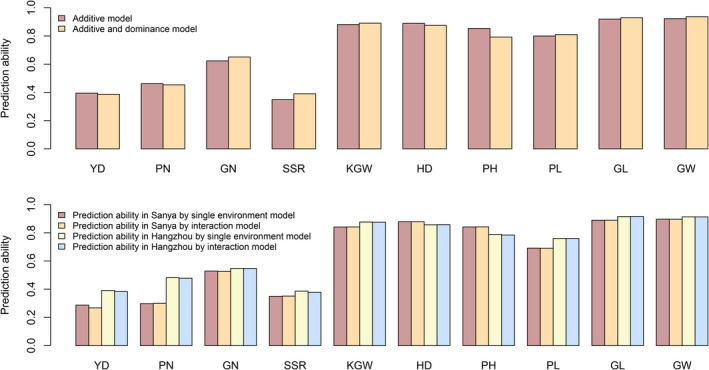
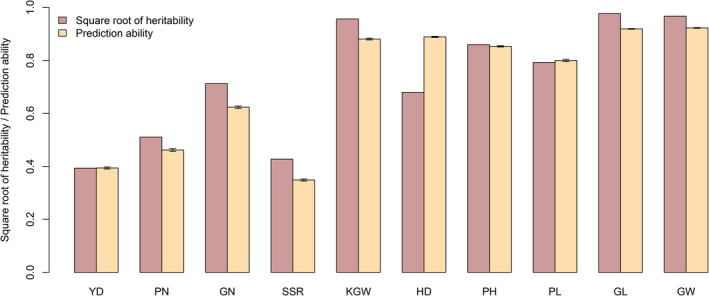
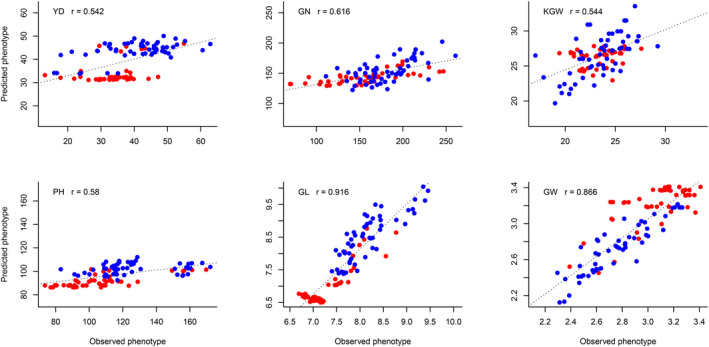
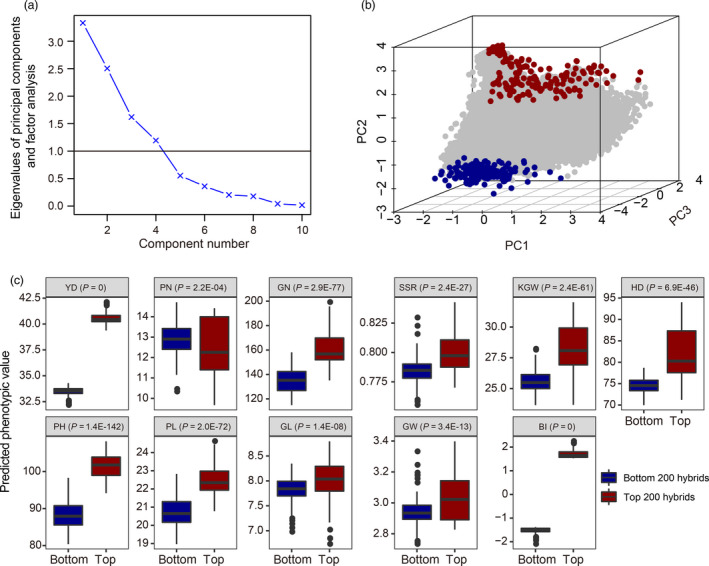
Hybrid breeding is the main strategy for improving productivity in many crops, especially in rice and maize. Genomic hybrid breeding is a technology that uses whole-genome markers to predict future hybrids. Predicted superior hybrids are then field evaluated and released as new hybrid cultivars after their superior performances are confirmed. This will increase the opportunity of selecting true superior hybrids with minimum costs. Here, we used genomic best linear unbiased prediction to perform hybrid performance prediction using an existing rice population of 1495 hybrids. Replicated 10-fold cross-validations showed that the prediction abilities on ten agronomic traits ranged from 0.35 to 0.92. Using the 1495 rice hybrids as a training sample, we predicted six agronomic traits of 100 hybrids derived from half diallel crosses involving 21 parents that are different from the parents of the hybrids in the training sample. The prediction abilities were relatively high, varying from 0.54 (yield) to 0.92 (grain length). We concluded that the current population of 1495 hybrids can be used to predict hybrids from seemingly unrelated parents. Eventually, we used this training population to predict all potential hybrids of cytoplasm male sterile lines from 3000 rice varieties from the 3K Rice Genome Project. Using a breeding index combining 10 traits, we identified the top and bottom 200 predicted hybrids. SNP genotypes of the training population and parameters estimated from this training population are available for general uses and further validation in genomic hybrid prediction of all potential hybrids generated from all varieties of rice.
杂种优势利用是提高许多作物,特别是水稻和玉米生产力的主要策略。基因组杂种优势利用是一种利用全基因组标记物来预测未来杂种的技术。预测的优良杂种随后进行田间评价,在确认其优良表现后作为新的杂交品种释放。这将增加以最小成本选择真正优良杂种的机会。在这里,我们使用基因组最佳线性无偏预测,利用现有的 1495 个杂种水稻群体进行杂种表现预测。重复的 10 倍交叉验证表明,在 10 个农艺性状上的预测能力范围从 0.35 到 0.92。使用 1495 个水稻杂种作为训练样本,我们预测了 21 个亲本的半双列杂交产生的 100 个杂种的 6 个农艺性状,这些亲本与训练样本中的杂种亲本不同。预测能力相对较高,范围从 0.54(产量)到 0.92(粒长)。我们得出结论,当前的 1495 个杂种群体可用于预测来自看似不相关亲本的杂种。最终,我们使用这个训练群体来预测来自 3000 个水稻品种的 3K 水稻基因组计划中的细胞质雄性不育系的所有潜在杂种。使用结合了 10 个性状的育种指数,我们确定了前 200 个和后 200 个预测杂种。训练群体的 SNP 基因型和从该训练群体中估计的参数可用于一般用途,并在所有水稻品种产生的所有潜在杂种的基因组杂种预测中进行进一步验证。