Wang Bingyang, Xie Wenlin, Lu Xiaofang, Song Jian, Liang Hongsen
Department of Pathology, Seventh Affiliated Hospital, Sun Yat-sen University, Shenzhen, CHN.
Department of Thoracic Surgery, Seventh Affiliated Hospital, Sun Yat-sen University, Shenzhen, CHN.
Cureus. 2022 Jul 15;14(7):e26903. doi: 10.7759/cureus.26903. eCollection 2022 Jul.
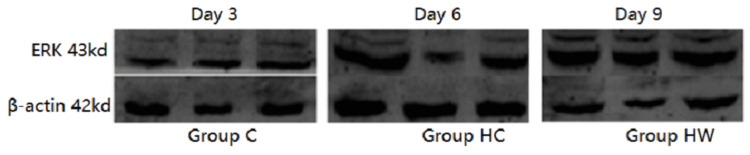
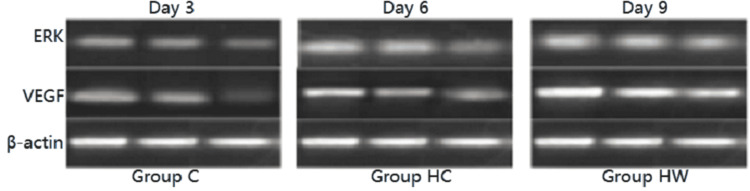
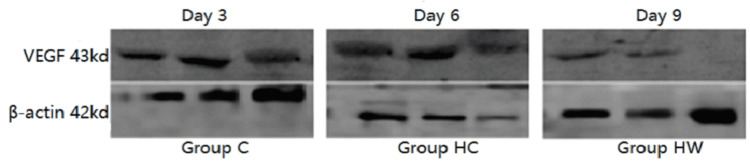
Objective Through the preparation of the diabetic mice skin ulcer model, we investigated the effect of Mongolian medicine external ulcer powder (WYK) on the treatment of diabetic skin ulcers and the expression of angiogenesis-related factors such as vascular endothelial growth factor (VEGF) and extracellular regulated protein kinases (ERK). Methods Thirty male clean Kunming mice were randomly divided into normal control group (group C), diabetic control group (group HC), and diabetic topical ulcer powder group (group HW). After successful modeling in the HC group and the HW group, the rats in the HW group were given external ulcer powder, which was applied to the back of the mice once a day. In addition, the rats in group C and group HC were treated with gentamicin injection external application once a day. The mice were sacrificed on the 3rd, the sixth, and the ninth day of dosing, and samples were taken. The adopted methods included protein immunoblotting (western blot) and reverse transcription-polymerase chain reaction (RT-PCR). The expression differences of angiogenesis-related factors such as VEGF and ERK in the repair process were detected. SPSS 13 software was used to analyze the results of angiogenesis-related factors VEGF and ERK. Results Comparison of VEGF and ERK Contents The serum VEGF content of mice in the HC group was significantly lower than that in the C group on days 3, 6, and 9 (p <0.05). The VEGF content in the HW group was significantly higher than that in the HC group (p <0.05). The content of ERK in serum was basically consistent with that of VEGF. The results of the western blot assay were consistent with those of the RT-PCR assay. Conclusion WYK can effectively promote the healing of skin ulcer wounds in diabetic mice, accelerate the proliferation of granulation tissue, enrich the contents of capillary blood tubes and collagen fibers, and increase the microvascular content. WYK can improve the expression level of VEGF and ERK in the serum of mice and advance the peak value of protein expression.
目的 通过制备糖尿病小鼠皮肤溃疡模型,研究蒙药外用溃疡散(WYK)对糖尿病皮肤溃疡的治疗作用及血管内皮生长因子(VEGF)、细胞外调节蛋白激酶(ERK)等血管生成相关因子的表达。方法 将30只雄性清洁级昆明小鼠随机分为正常对照组(C组)、糖尿病对照组(HC组)、糖尿病外用溃疡散组(HW组)。HC组和HW组造模成功后,HW组给予外用溃疡散,每天1次涂抹于小鼠背部。此外,C组和HC组大鼠每天1次给予庆大霉素注射液外用。给药第3天、第6天和第9天处死小鼠并取材。采用的方法包括蛋白质免疫印迹法(western blot)和逆转录-聚合酶链反应(RT-PCR)。检测修复过程中VEGF、ERK等血管生成相关因子的表达差异。采用SPSS 13软件分析血管生成相关因子VEGF和ERK的结果。结果 VEGF和ERK含量比较 HC组小鼠血清VEGF含量在第3天、第6天和第9天均显著低于C组(p<0.05)。HW组VEGF含量显著高于HC组(p<0.05)。血清中ERK含量与VEGF基本一致。western blot检测结果与RT-PCR检测结果一致。结论 WYK能有效促进糖尿病小鼠皮肤溃疡创面愈合,加速肉芽组织增殖,丰富毛细血管和胶原纤维含量,增加微血管含量。WYK能提高小鼠血清中VEGF和ERK的表达水平,提前蛋白表达峰值。