Searchfield Grant D, Sanders Philip J
Section of Audiology, The University of Auckland, Auckland, New Zealand.
Eisdell Moore Centre, The University of Auckland, Auckland, New Zealand.
Front Neurol. 2022 Aug 5;13:958730. doi: 10.3389/fneur.2022.958730. eCollection 2022.
This randomized single-blind controlled trial tested the hypothesis that a prototype digital therapeutic developed to provide goal-based counseling with personalized passive and active game-based sound therapy would provide superior tinnitus outcomes, and similar usability, to a popular passive sound therapy app over a 12 week trial period.
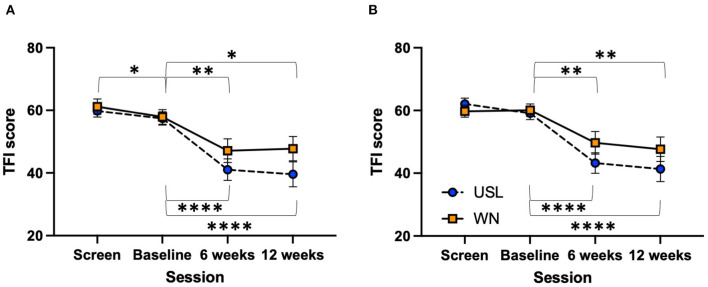
The digital therapeutic consisted of an app for iPhone or Android smartphone, Bluetooth bone conduction headphones, neck pillow speaker, and a cloud-based clinician dashboard to enable messaging and app personalization. The control app was a popular self-help passive sound therapy app called White Noise Lite (WN). The primary outcome measure was clinically meaningful change in Tinnitus Functional Index (TFI) between baseline and 12 weeks of therapy. Secondary tinnitus measures were the TFI total score and subscales across sessions, rating scales and the Client Oriented Scale of Improvement in Tinnitus (COSIT). Usability of the US and WN interventions were assessed using the System Usability Scale (SUS) and the mHealth App Usability Questionnaire (MAUQ). Ninety-eight participants who were smartphone app users and had chronic moderate-severe tinnitus (>6 months, TFI score > 40) were enrolled and were randomly allocated to one of the intervention groups. Thirty-one participants in the USL group and 30 in the WN group completed 12 weeks of trial.
Mean changes in TFI for the USL group at 6 (16.36, SD 17.96) and 12 weeks (17.83 points, SD 19.87) were clinically meaningful (>13 points reduction), the mean change in WN scores were not clinically meaningful (6 weeks 10.77, SD 18.53; 12 weeks 10.12 points, SD 21.36). A statistically higher proportion of USL participants achieved meaningful TFI change at 6 weeks (55%) and 12 weeks (65%) than the WN group at 6 weeks (33%) and 12 weeks (43%). Mean TFI, rating and COSIT scores favored the US group but were not statistically different from WN. Usability measures were similar for both groups.
The USL group demonstrated a higher proportion of responders than the WN group. The usability of the USL therapeutic was similar to the established WN app. The digital polytherapeutic demonstrated significant benefit for tinnitus reduction supporting further development.
本随机单盲对照试验检验了以下假设:一款为提供基于目标的咨询服务以及个性化被动和主动游戏化声音疗法而开发的数字疗法原型,在为期12周的试验期内,相较于一款流行的被动声音疗法应用程序,能带来更优的耳鸣治疗效果以及相似的可用性。
数字疗法由一款适用于iPhone或安卓智能手机的应用程序、蓝牙骨传导耳机、颈枕扬声器以及一个基于云的临床医生仪表板组成,该仪表板用于实现信息传递和应用程序个性化设置。对照应用程序是一款名为“White Noise Lite(WN)”的流行自助被动声音疗法应用程序。主要结局指标是治疗基线至12周期间耳鸣功能指数(TFI)的临床意义显著变化。耳鸣的次要测量指标包括TFI总分、各疗程的子量表、评分量表以及耳鸣患者导向改善量表(COSIT)。使用系统可用性量表(SUS)和移动健康应用程序可用性问卷(MAUQ)评估美国数字疗法(US)和WN干预措施的可用性。招募了98名智能手机应用程序用户且患有慢性中度至重度耳鸣(>6个月,TFI评分>40)的参与者,并将他们随机分配到其中一个干预组。美国数字疗法组(USL)的31名参与者和WN组的30名参与者完成了12周的试验。
USL组在6周时(16.36,标准差17.96)和12周时(17.83分,标准差19.87)TFI的平均变化具有临床意义(降低>13分),WN组的分数平均变化无临床意义(6周时10.77,标准差18.53;12周时10.12分,标准差21.36)。在6周时(55%)和12周时(65%),实现TFI有意义变化的USL参与者比例在统计学上高于WN组在6周时(33%)和12周时(43%)的比例。平均TFI、评分和COSIT分数有利于美国数字疗法组,但与WN组无统计学差异。两组的可用性测量结果相似。
USL组的有反应者比例高于WN组。USL疗法的可用性与成熟的WN应用程序相似。数字综合疗法在减轻耳鸣方面显示出显著益处,支持进一步开发。