Department of Biochemistry and Biomedical Sciences, McMaster University, Hamilton, Canada.
Farncombe Family Digestive Health Research Institute, McMaster University, Hamilton, Canada.
Physiol Rep. 2022 Aug;10(16):e15439. doi: 10.14814/phy2.15439.
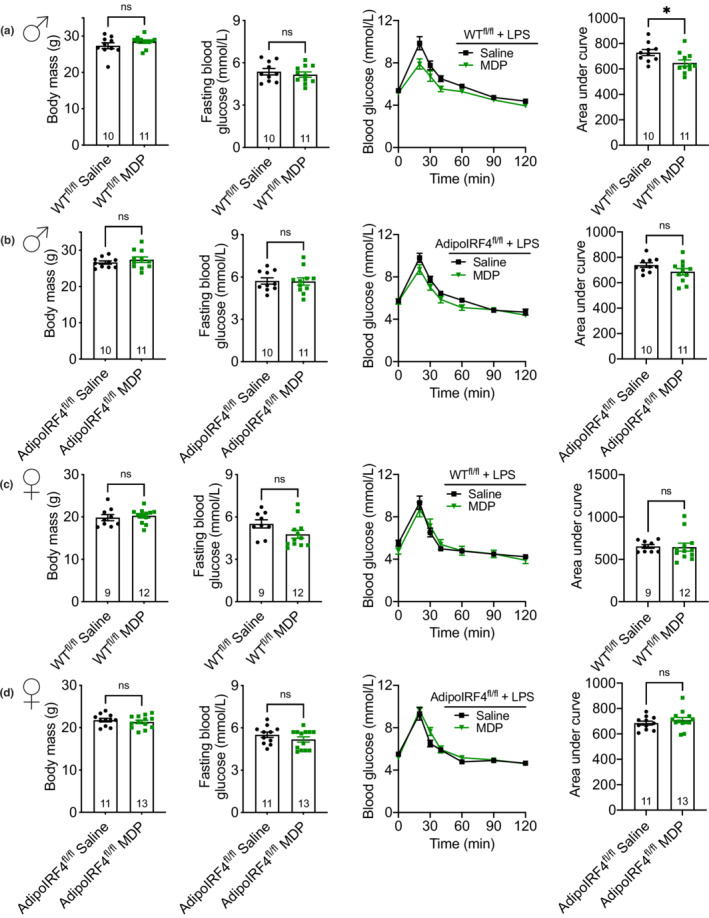
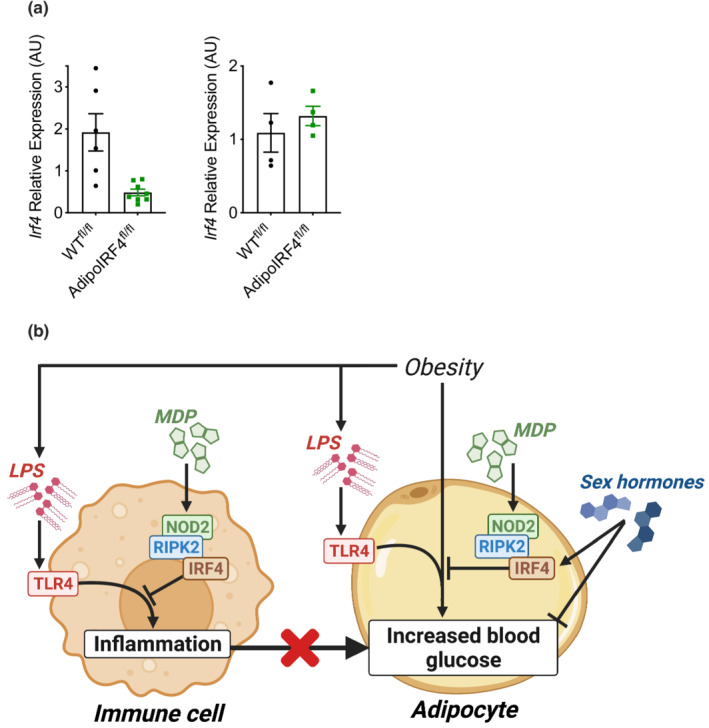
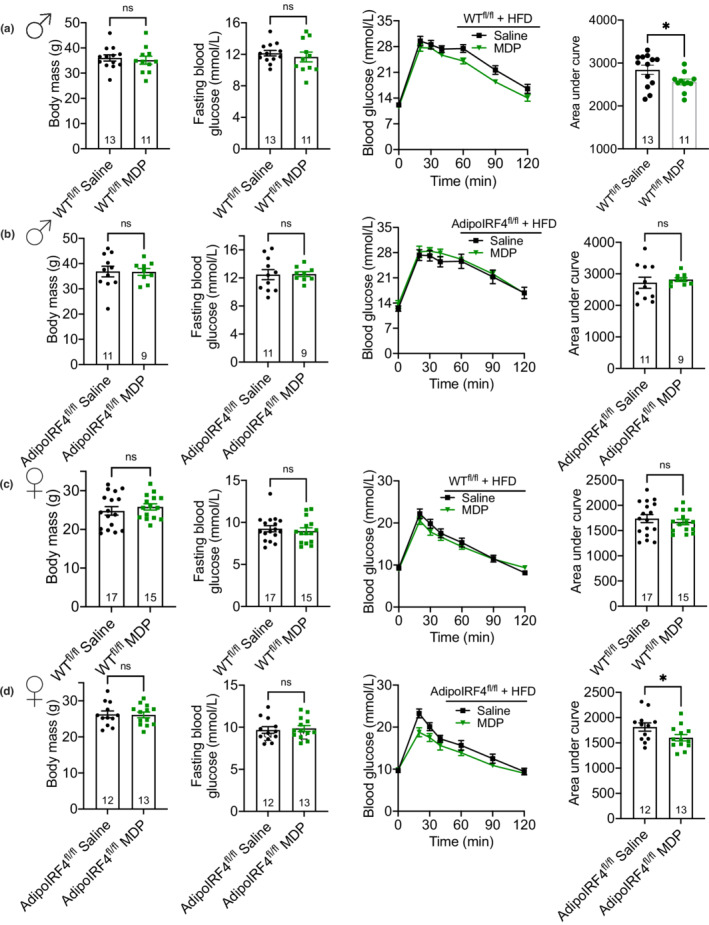
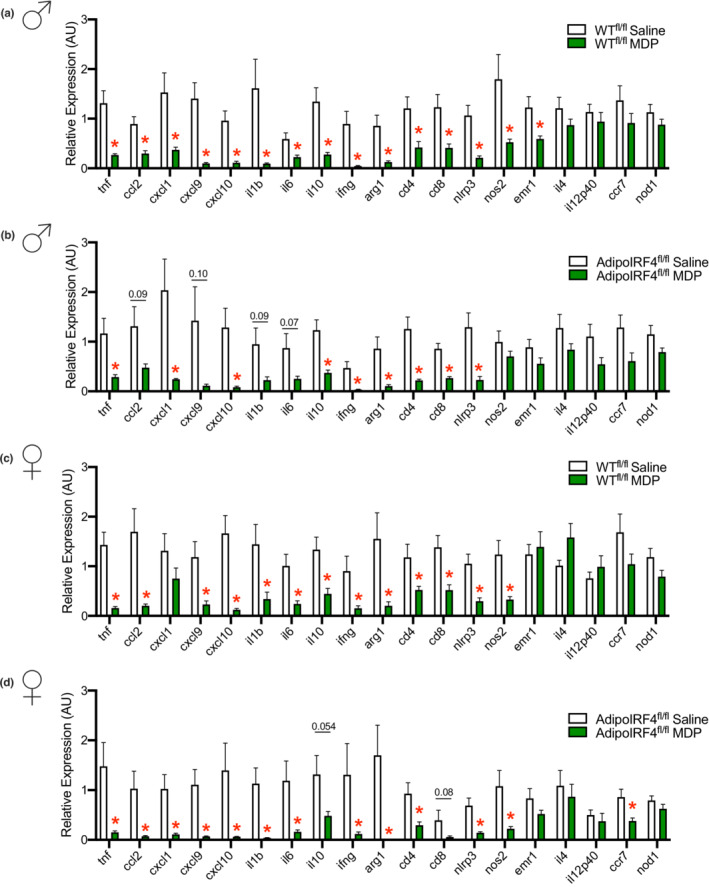
Postbiotics are microbial-derived components or metabolites that can influence host immunity and metabolism. Some postbiotics can improve blood glucose control and lower inflammation during bacterial or nutritional stress. Bacterial cell wall-derived muramyl dipeptide (MDP) is a potent insulin-sensitizing postbiotic that engages NOD2, RIPK2, and requires interferon regulatory factor 4 (IRF4) to lower inflammation and improve blood glucose. However, the sex-dependent effects of this postbiotic and the cell type required for IRF4 to cause inflammatory versus glycemic responses to MDP were unknown. Here, we measured how MDP injection altered glucose tolerance and adipose tissue inflammation during low-level endotoxemia and high fat diet (HFD)-induced obesity in male and female adipocyte-specific IRF4 knockout mice (AdipoIRF4 ) compared to WT mice. Adipocyte IRF4 was required for the blood glucose-lowering effects of MDP during endotoxemia and HFD-induced obesity in male mice. However, MDP did not alter blood glucose in female WT and AdipoIRF4 mice during endotoxemia. Unexpectedly, female HFD-fed AdipoIRF4 mice had lower blood glucose after MDP treatment compared to WT mice. MDP lowered inflammatory gene expression in adipose tissue of HFD-fed WT and AdipoIRF4 mice of both sexes. Therefore, MDP-mediated lowering of adipose inflammation does not require adipocyte IRF4 and was independent of sex. Together, these data show that injection of MDP, an insulin-sensitizing postbiotic, lowers adipose tissue inflammation in male and female mice, but lower adipose inflammation is not always associated with improved blood glucose. The blood glucose-lowering effect of the postbiotic MDP and dependence on adipocyte IRF4 is sex-dependent.
后生元是微生物衍生的成分或代谢物,可以影响宿主的免疫和代谢。一些后生元可以改善血糖控制,并在细菌或营养应激期间降低炎症。细菌细胞壁衍生的 muramyl dipeptide (MDP) 是一种有效的胰岛素增敏后生元,它与 NOD2、RIPK2 结合,需要干扰素调节因子 4 (IRF4) 来降低炎症和改善血糖。然而,这种后生元的性别依赖性以及 IRF4 所需的细胞类型,以使 MDP 产生炎症与血糖反应,尚不清楚。在这里,我们测量了 MDP 注射如何改变雄性和雌性脂肪细胞特异性 IRF4 敲除小鼠(AdipoIRF4)与 WT 小鼠相比,在低水平内毒素血症和高脂肪饮食(HFD)诱导肥胖期间的葡萄糖耐量和脂肪组织炎症。脂肪细胞 IRF4 是 MDP 在雄性小鼠内毒素血症和 HFD 诱导肥胖期间降低血糖的必需条件。然而,MDP 在雌性 WT 和 AdipoIRF4 小鼠内毒素血症期间并未改变血糖。出乎意料的是,雌性 HFD 喂养的 AdipoIRF4 小鼠在用 MDP 治疗后血糖水平低于 WT 小鼠。MDP 降低了 HFD 喂养的 WT 和 AdipoIRF4 小鼠脂肪组织中炎症基因的表达。因此,MDP 介导的降低脂肪炎症不需要脂肪细胞 IRF4,并且与性别无关。总之,这些数据表明,注射胰岛素增敏后生元 MDP 可降低雄性和雌性小鼠脂肪组织炎症,但降低脂肪炎症并不总是与改善血糖相关。后生元 MDP 的降血糖作用和对脂肪细胞 IRF4 的依赖性具有性别依赖性。