Sharma Ashish Ranjan, Lee Yeon-Hee, Gankhuyag Buyankhishig, Chakraborty Chiranjib, Lee Sang-Soo
Institute for Skeletal Aging & Orthopedic Surgery, Hallym University-Chuncheon Sacred Heart Hospital, Chuncheon 24252, Korea.
Department of Biotechnology, School of Life Science and Biotechnology, Adamas University, Barasat-Barrackpore Rd, Kolkata 700126, India.
J Funct Biomater. 2022 Jul 28;13(3):105. doi: 10.3390/jfb13030105.
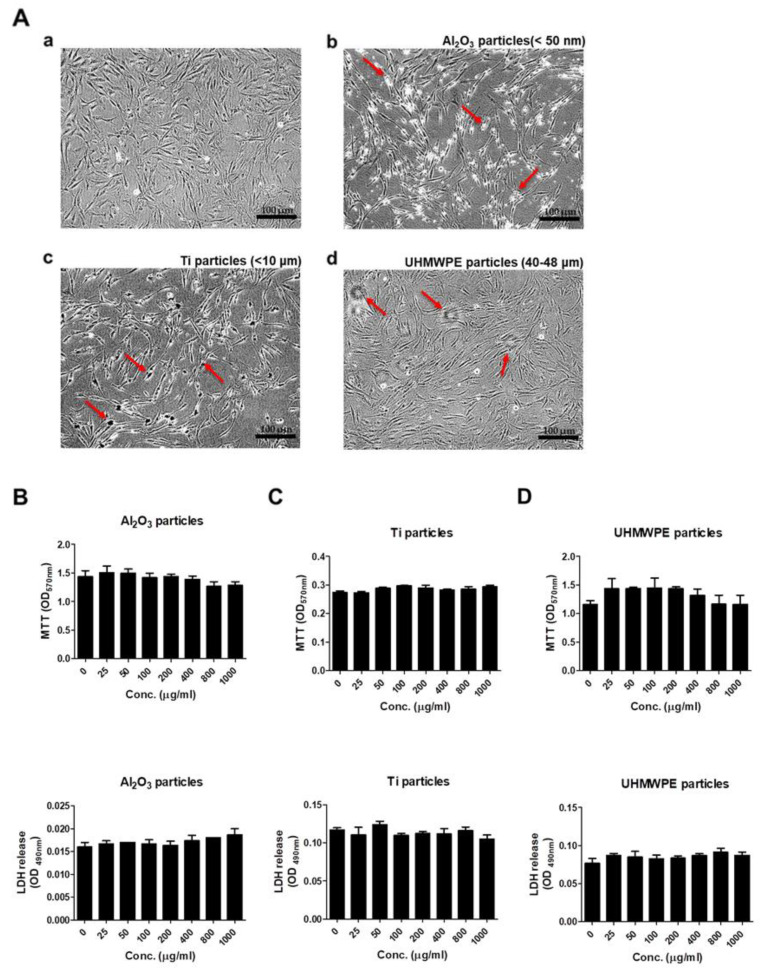
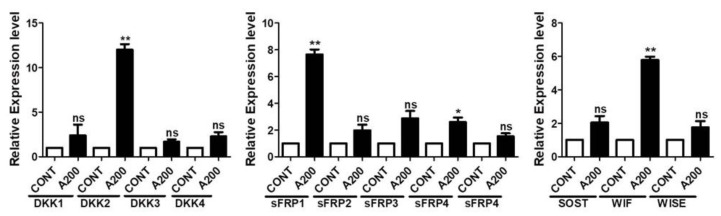
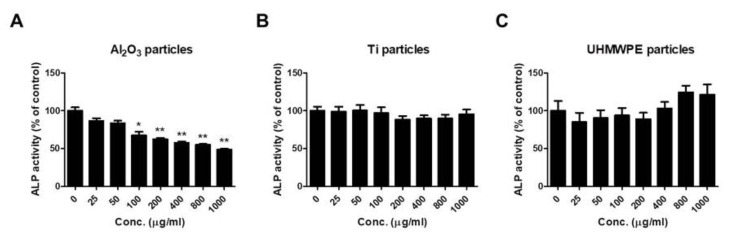
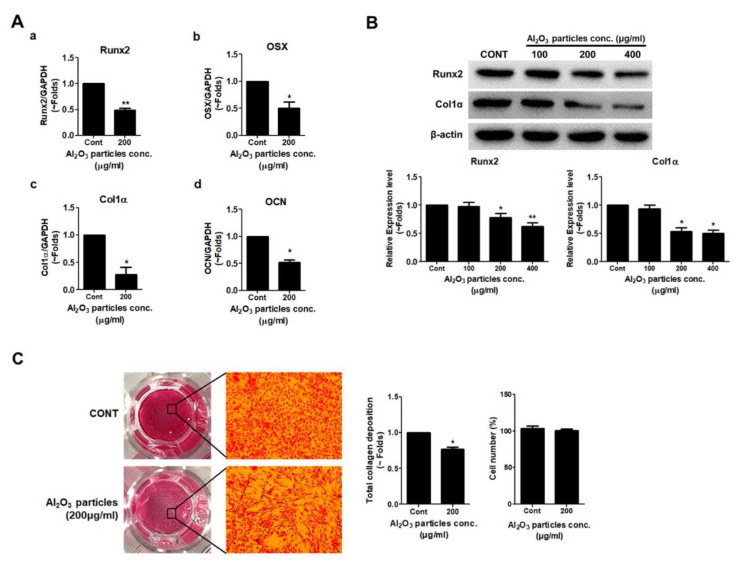
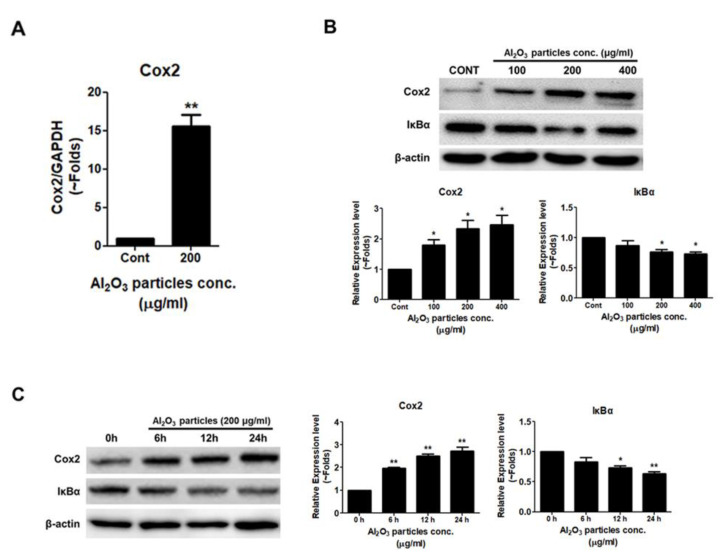
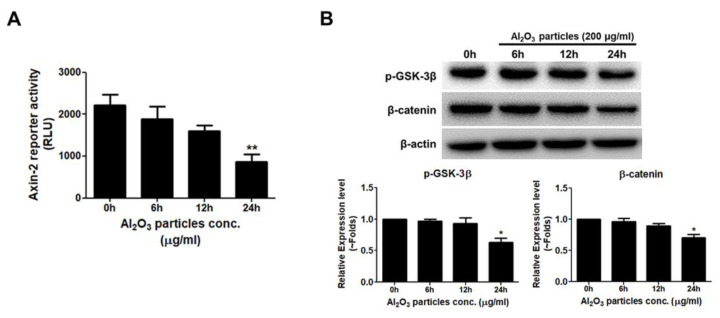
Biomaterials are used as implants for bone and dental disabilities. However, wear particles from the implants cause osteolysis following total joint arthroplasty (TJA). Ceramic implants are considered safe and elicit a minimal response to cause periprosthetic osteolysis. However, few reports have highlighted the adverse effect of ceramic particles such as alumina (AlO) on various cell types. Hence, we aimed to investigate the effect of AlO particles on osteoprogenitors. A comparative treatment of AlO, Ti, and UHMWPE particles to osteoprogenitors at a similar concentration of 200 μg/mL showed that only AlO particles were able to suppress the early and late differentiation markers of osteoprogenitors, including collagen synthesis, alkaline phosphatase (ALP) activity and mRNA expression of Runx2, OSX, Col1α, and OCN. AlO particles even induced inflammation and activated the NFkB signaling pathway in osteoprogenitors. Moreover, bone-forming signals such as the WNT/β-catenin signaling pathway were inhibited by the AlO particles. AlO particles were found to induce the mRNA expression of WNT/β-catenin signaling antagonists such as DKK2, WIF, and sFRP1 several times in osteoprogenitors. Taken together, this study highlights a mechanistic view of the effect of AlO particles on osteoprogenitors and suggests therapeutic targets such as NFĸB and WNT signaling pathways for ceramic particle-induced osteolysis.
生物材料被用作治疗骨和牙齿残疾的植入物。然而,植入物产生的磨损颗粒会在全关节置换术(TJA)后导致骨溶解。陶瓷植入物被认为是安全的,并且引起假体周围骨溶解的反应最小。然而,很少有报告强调陶瓷颗粒(如氧化铝(AlO))对各种细胞类型的不良影响。因此,我们旨在研究AlO颗粒对骨祖细胞的影响。以200μg/mL的相似浓度将AlO、钛和超高分子量聚乙烯(UHMWPE)颗粒对骨祖细胞进行对比处理,结果显示只有AlO颗粒能够抑制骨祖细胞的早期和晚期分化标志物,包括胶原蛋白合成、碱性磷酸酶(ALP)活性以及Runx2、OSX、Col1α和OCN的mRNA表达。AlO颗粒甚至在骨祖细胞中诱导炎症并激活NFkB信号通路。此外,AlO颗粒抑制了诸如WNT/β-连环蛋白信号通路等骨形成信号。研究发现,AlO颗粒在骨祖细胞中多次诱导WNT/β-连环蛋白信号拮抗剂(如DKK2、WIF和sFRP1)的mRNA表达。综上所述,本研究揭示了AlO颗粒对骨祖细胞作用的机制,并提出了针对陶瓷颗粒诱导的骨溶解的治疗靶点,如NFκB和WNT信号通路。