National Institute for Public Health and the Environment (RIVM), Bilthoven, the Netherlands.
Ministry of Infrastructure and Water Management, The Hague, The Netherlands.
Br J Clin Pharmacol. 2022 Dec;88(12):5074-5082. doi: 10.1111/bcp.15509. Epub 2022 Sep 14.
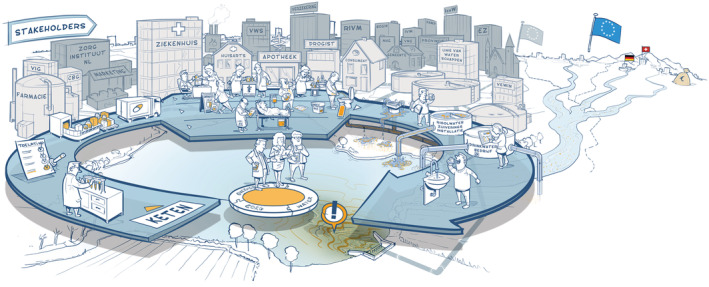
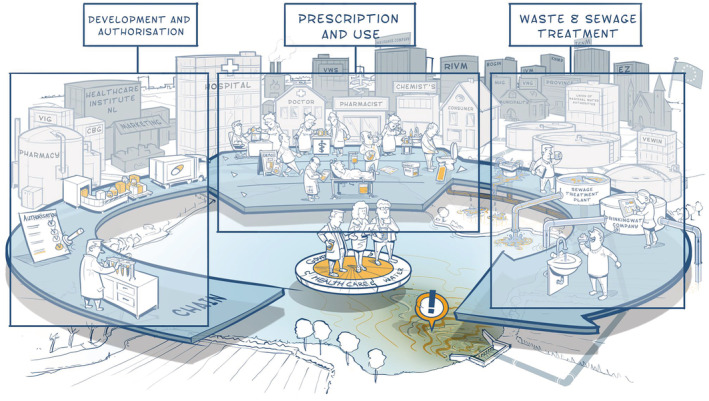
Sewage treatment effluent with pharmaceutical residues is discharged into surface waters, raising societal concerns. The aim of this paper is to describe the Dutch chain approach on medicinal residues in water that has been implemented by the Dutch government. We show how stakeholders from both the health and water sectors have got actively involved. Within this chain approach, source measures as well as end-of-pipe measures are identified and, where feasible and effective, implemented.
Descriptive paper on the Dutch chain approach.
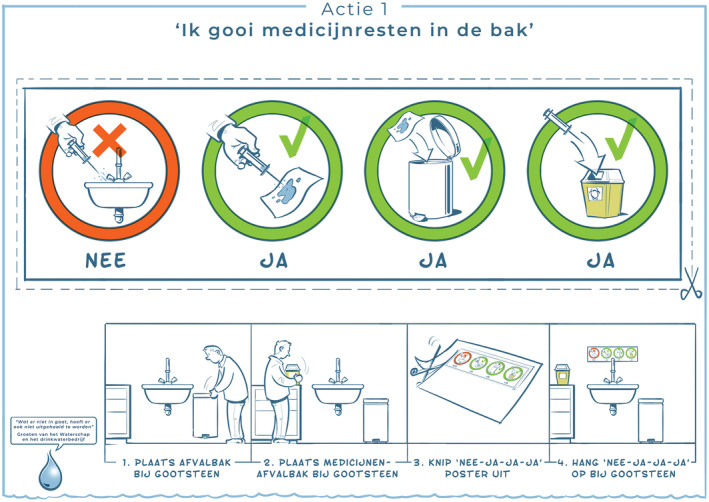
Getting the water and health care sectors to talk with each other instead of about each other was the key accomplishment. Comprehension of each other's viewpoints, terminology, policy goals and span of control, was pivotal in setting shared goals, creating perspective about possible measures and actually taking (joint) action. Together, stakeholders agreed to act within their own possibilities, without pointing at others, and to focus on pragmatic measures. In this article, we provide examples of measures taken, pilot projects performed, and of measures that were not implemented. Besides this, we discuss the most important barriers encountered during this process and how they were overcome.
The issue of pharmaceuticals in the environment is a wicked problem, which makes it necessary to work together with many stakeholders on possible solutions, avoiding paralysis by complexity. Most importantly, stakeholders need to invest in mutual understanding, keep an open communication, and feel invited to bring in solutions for their part of the chain.
含有药物残留的污水处理厂排放到地表水中,引起了社会的关注。本文旨在描述荷兰政府实施的水中药物残留的荷兰链式方法。我们展示了卫生和水部门的利益相关者如何积极参与其中。在这种链式方法中,确定了源头措施和末端措施,并在可行和有效的情况下进行了实施。
描述性论文,介绍荷兰链式方法。
让水和医疗保健部门相互交流而不是相互指责是关键成就。相互理解对方的观点、术语、政策目标和控制范围,对于设定共同目标、创造可能措施的视角以及实际采取(联合)行动至关重要。利益相关者共同商定在各自的能力范围内采取行动,不指责他人,并专注于务实的措施。在本文中,我们提供了已采取措施、已进行试点项目以及未实施措施的示例。此外,我们还讨论了在这个过程中遇到的最重要的障碍以及如何克服这些障碍。
环境中药物的问题是一个棘手的问题,因此有必要与许多利益相关者合作,寻找可能的解决方案,避免因复杂性而陷入瘫痪。最重要的是,利益相关者需要投资于相互理解,保持开放的沟通,并感到受邀为他们所在的链环节提出解决方案。