Finucane Suzanne B, Hargrove Levi J, Simon Ann M
Center for Bionic Medicine, Shirley Ryan Abilitylab, Chicago, IL, USA.
Department of Physical Medicine and Rehabilitation, Northwestern University, Chicago, IL, USA.
Front Rehabil Sci. 2022;3. doi: 10.3389/fresc.2022.790538. Epub 2022 Apr 11.
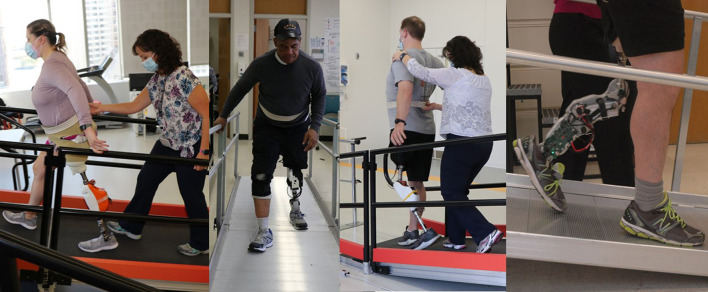
Limb loss at the transfemoral or knee disarticulation level results in a significant decrease of mobility. Powered lower limb prostheses have the potential to provide increased functional mobility and return individuals to activities of daily living that are limited due to their amputation. Providing power at the knee and/or ankle, new and innovative training is required for the amputee and the clinician to understand the capabilities of these advanced devices. This protocol for functional mobility training with a powered knee and ankle prosthesis was developed while training 30 participants with a unilateral transfemoral or knee disarticulation amputation at a nationally ranked physical medicine and rehabilitation research hospital. Participants received instruction for level ground walking, stair climbing, incline walking and sit to stand transitions. A therapist provided specific training for each mode including verbal, visual and tactile cueing along with patient education on the functionality of the device. The primary outcome measure was the ability of each participant to demonstrate independence with walking and sit to stand transitions along with modified independence for stair climbing and incline walking due to use of a handrail. Every individual was successful in comfortable ambulation of level ground walking and 27 out of 30 were successful in all other functional modes after participating in 1-3 sessions of 1-2 hours in length (3 terminated their participation prior to attempting all activities). As these prosthetic devices continue to advance, therapy techniques must advance as well and this paper serves as an education on new training techniques that can provide amputees with the best possible tools to take advantage of these powered devices in order to achieve their desired clinical outcomes.
经股骨截肢或膝关节离断导致行动能力显著下降。动力下肢假肢有潜力增加功能移动性,并使个体能够重新参与因截肢而受限的日常生活活动。在膝关节和/或踝关节提供动力时,截肢者和临床医生需要全新且创新的训练,以了解这些先进设备的功能。本动力膝关节和踝关节假肢功能移动训练方案是在一家全国排名靠前的物理医学与康复研究医院对30名单侧经股骨截肢或膝关节离断的参与者进行训练时制定的。参与者接受了平地上行走、爬楼梯、斜坡行走以及从坐到站转换的指导。治疗师针对每种模式提供了具体训练,包括言语、视觉和触觉提示,以及关于设备功能的患者教育。主要结局指标是每位参与者在行走和从坐到站转换时表现出独立能力,以及因使用扶手在爬楼梯和斜坡行走时表现出改进的独立能力。在参加了1至3次时长为1至2小时的训练课程后,每个人都成功实现了在平地上舒适行走,30人中有27人在所有其他功能模式上取得成功(3人在尝试所有活动之前终止了参与)。随着这些假肢设备不断进步,治疗技术也必须与时俱进,本文旨在介绍新的训练技术,为截肢者提供最佳工具,以便他们利用这些动力设备实现预期的临床效果。