Key Laboratory of Environmental Medicine and Engineering of Ministry of Education, Department of Epidemiology & Biostatistics, School of Public Health, Southeast University, Nanjing 210009, China.
Department of Epidemiology, CAPHRI Care and Public Health Research Institute, Maastricht University, 6229 ER Maastricht, The Netherlands.
Curr Oncol. 2022 Jul 31;29(8):5442-5456. doi: 10.3390/curroncol29080430.
The molecular landscape of non-muscle-invasive (NMIBC) and muscle-invasive (MIBC) bladder cancer based on molecular characteristics is essential but poorly understood. In this pilot study we aimed to identify a multi-omics signature that can distinguish MIBC from NMIBC. Such a signature can assist in finding potential mechanistic biomarkers and druggable targets.
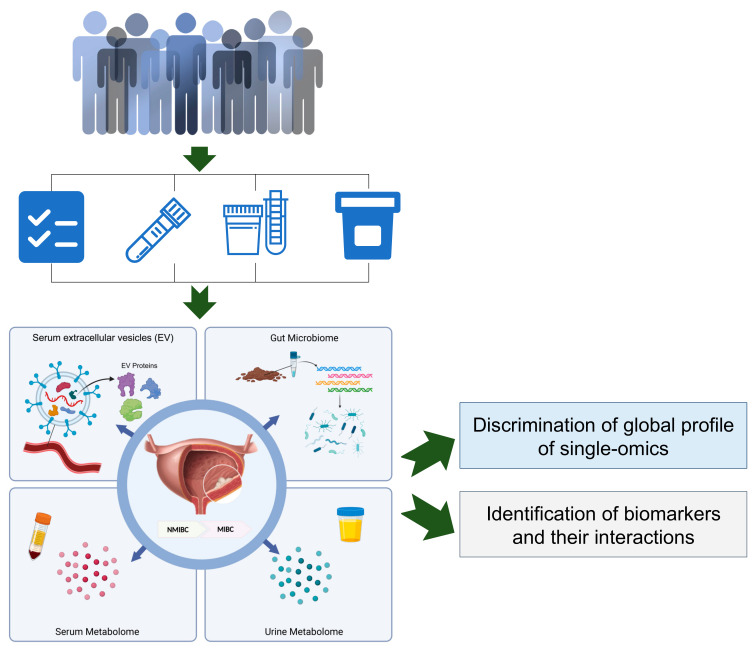
Patients diagnosed with NMIBC ( = 15) and MIBC ( = 11) were recruited at a tertiary-care hospital in Nanjing from 1 April 2021, and 31 July 2021. Blood, urine and stool samples per participant were collected, in which the serum metabolome, urine metabolome, gut microbiome, and serum extracellular vesicles (EV) proteome were quantified. The differences of the global profiles and individual omics measure between NMIBC vs. MIBC were assessed by permutational multivariate analysis and the Mann-Whitney test, respectively. Logistic regression analysis was used to assess the association of each identified analyte with NMIBC vs. MIBC, and the Spearman correlation was used to investigate the correlations between identified analytes, where both were adjusted for age, sex and smoking status.
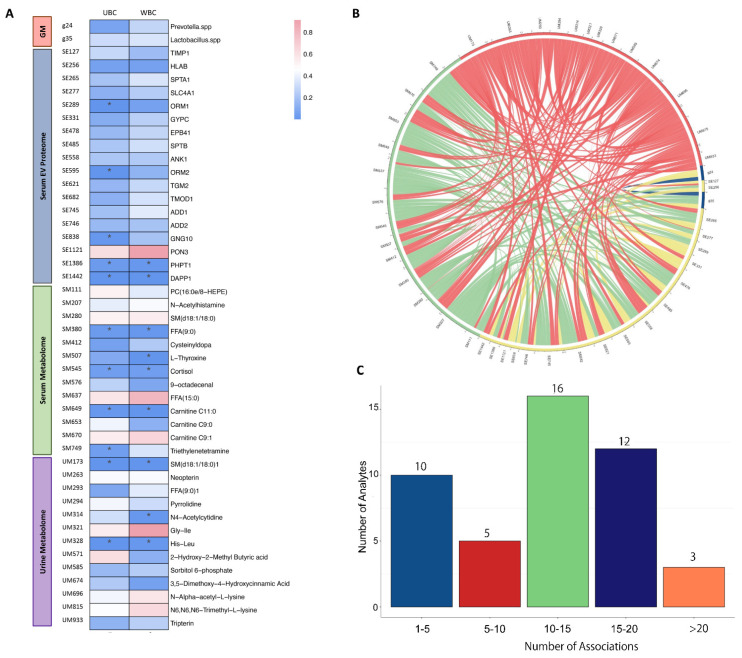
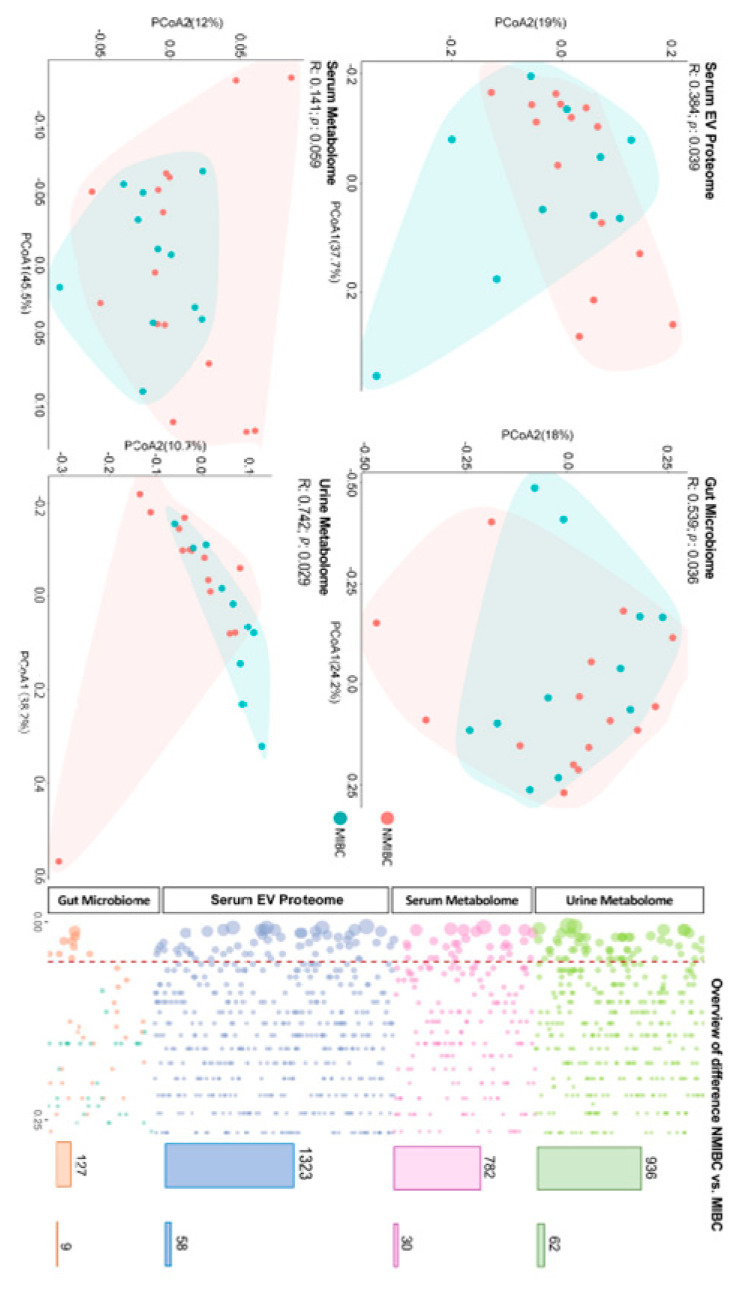
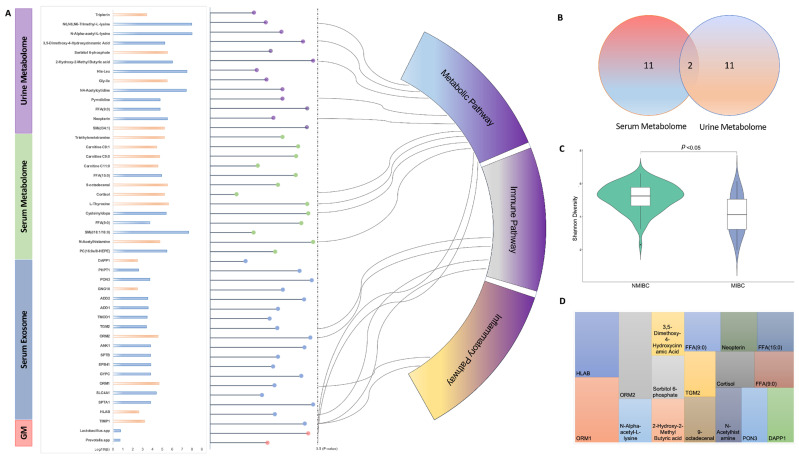
Among 3168 multi-omics measures that passed the quality control, 159 were identified to be differentiated in NMIBC vs. MIBC. Of these, 46 analytes were associated with bladder cancer progression. In addition, the global profiles showed significantly different urine metabolome ( = 0.029), gut microbiome ( = 0.036), and serum EV (extracellular vesicles) proteome ( = 0.039) but not serum metabolome ( = 0.059). We also observed 17 (35%) analytes that had been developed as drug targets. Multiple interactions were obtained between the identified analytes, whereas for the majority (61%), the number of interactions was at 11-20. Moreover, unconjugated bilirubin ( = 0.009) and white blood cell count ( = 0.006) were also shown to be different in NMIBC and MIBC, and associated with 11 identified omics analytes.
The pilot study has shown promising to monitor the progression of bladder cancer by integrating multi-omics data and deserves further investigations.
基于分子特征,非肌肉浸润性(NMIBC)和肌肉浸润性(MIBC)膀胱癌的分子图谱至关重要,但了解甚少。在这项初步研究中,我们旨在确定一种可以区分 MIBC 和 NMIBC 的多组学特征。这种特征可以帮助发现潜在的机制生物标志物和可用药靶。
2021 年 4 月 1 日至 2021 年 7 月 31 日,在南京一家三级医院招募了被诊断为 NMIBC(n=15)和 MIBC(n=11)的患者。每位患者采集血液、尿液和粪便样本,其中血清代谢组学、尿液代谢组学、肠道微生物组学和血清细胞外囊泡(EV)蛋白质组学进行定量分析。通过置换多元分析和曼-惠特尼检验分别评估 NMIBC 与 MIBC 之间的全局谱和个体组学指标的差异。逻辑回归分析用于评估每个鉴定出的分析物与 NMIBC 与 MIBC 的相关性,Spearman 相关性用于研究鉴定出的分析物之间的相关性,两者均针对年龄、性别和吸烟状况进行调整。
在通过质量控制的 3168 种多组学指标中,有 159 种在 NMIBC 与 MIBC 之间存在差异。其中,46 种分析物与膀胱癌进展有关。此外,全局谱显示尿液代谢组学(p=0.029)、肠道微生物组学(p=0.036)和血清 EV 蛋白质组学(p=0.039)有明显差异,但血清代谢组学(p=0.059)无明显差异。我们还观察到 17 种(35%)分析物已被开发为药物靶点。鉴定出的分析物之间存在多种相互作用,而对于大多数(61%)分析物,相互作用的数量为 11-20。此外,未结合胆红素(p=0.009)和白细胞计数(p=0.006)在 NMIBC 和 MIBC 中也存在差异,与 11 种鉴定出的组学分析物有关。
该初步研究表明,通过整合多组学数据有望监测膀胱癌的进展,值得进一步研究。