Wongta Anurak, Sawang Nootchakarn, Tongjai Phanika, Jatiket Marut, Hongsibsong Surat
Environmental, Occupational and NCD Center of Excellent, Research Institute for Health Sciences, Chiang Mai University, Chiang Mai 50200, Thailand.
Department of Community Medicine, Faculty of Medicine, Chiang Mai University, Chiang Mai 50200, Thailand.
Toxics. 2022 Jul 29;10(8):434. doi: 10.3390/toxics10080434.
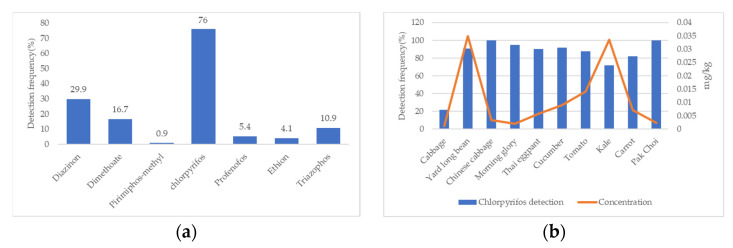
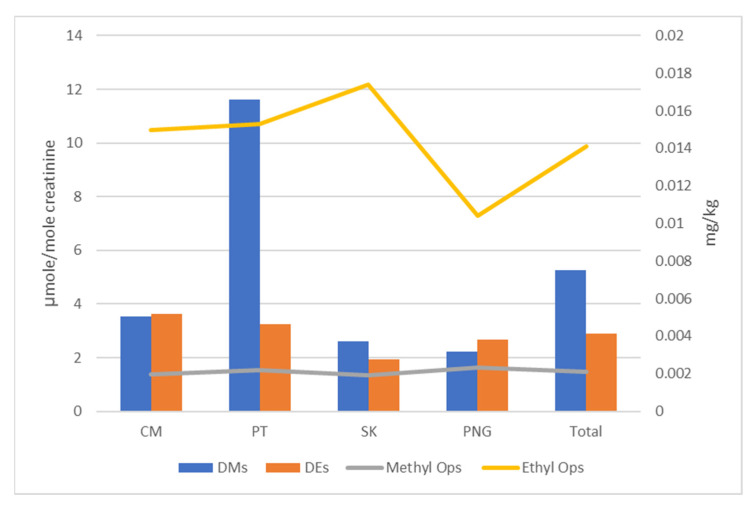
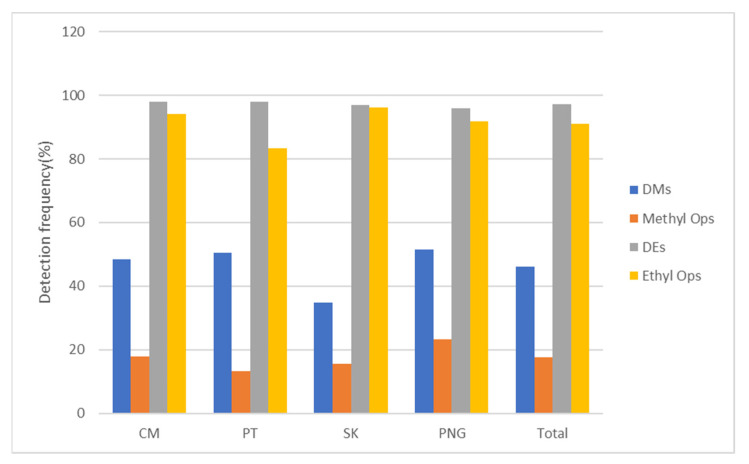
In Thailand, pesticides containing organophosphates (OP) are frequently applied to crops to suppress insects. School children can be exposed to OPs on a daily basis, from food consumption to breathing and touching pesticides drifted near classrooms. Living in an agricultural area can also be one of the causes. As a result, it is important to monitor OPs residues in the food chain and biomarkers of exposure. The Gas Chromatography-Flame Photometric Detector method was employed to examine the relationship between OPs residue and DAPs (Diakly phosphate) in four targeted locations in Thailand, as well as to examine the residues of OPs in vegetable samples and DAPs in 395 school children's urine samples. Vegetables were found to contain at least one OP, with chlorpyrifos being the most prevalent. The OPs detected frequencies for Sakon Nakhon, Chiang Mai, Phang Nga, and Pathum Thani are 96.1%, 94%, 91.7%, and 83.3%, respectively. The overall centration level of OPs showed 0.3261 mg/kg, 0.0636 mg/kg, 0.0023 mg/kg, 0.0150 mg/kg, 0.2003 mg/kg, 0.0295 mg/kg, and 0.0034 mg/kg for diazinon, dimethoate, pirimiphos-methyl, chlorpyrifos, profenofos, ethion, and triazophos, respectively. Nearly 98% of school children were detected with at least one DAP. The overall level of dimethyl phosphate metabolites (5.258 µmole/mole creatinine) in urine samples is higher than diethyl phosphate metabolites (2.884 µmole/mole creatinine), especially in the case of Pathum Thani. Our findings show a consistent relationship between OPs in vegetables from wet markets and DAPs in urine samples of school children in various parts of Thailand.
在泰国,含有有机磷酸酯(OP)的农药经常被用于农作物以抑制虫害。学童每天都可能接触到有机磷酸酯,从食物摄入到呼吸以及接触飘散在教室附近的农药。生活在农业地区也可能是原因之一。因此,监测食物链中的有机磷酸酯残留以及接触生物标志物非常重要。采用气相色谱 - 火焰光度检测法来研究泰国四个目标地点的有机磷酸酯残留与二烷基磷酸酯(DAPs)之间的关系,同时检测蔬菜样本中的有机磷酸酯残留以及395名学童尿液样本中的二烷基磷酸酯。发现蔬菜中至少含有一种有机磷酸酯,其中毒死蜱最为常见。呵叻府、清迈府、攀牙府和巴吞他尼府检测到有机磷酸酯的频率分别为96.1%、94%、91.7%和83.3%。有机磷酸酯的总体浓度水平显示,二嗪农、乐果、甲基嘧啶磷、毒死蜱、丙溴磷、乙硫磷和三唑磷分别为0.3261毫克/千克、0.0636毫克/千克、0.0023毫克/千克、0.0150毫克/千克、0.2003毫克/千克、0.0295毫克/千克和0.0034毫克/千克。近98%的学童被检测出至少含有一种二烷基磷酸酯。尿液样本中二甲基磷酸酯代谢物的总体水平(5.258微摩尔/摩尔肌酐)高于二乙基磷酸酯代谢物(2.884微摩尔/摩尔肌酐),尤其是在巴吞他尼府的情况。我们的研究结果表明,泰国各地湿货市场蔬菜中的有机磷酸酯与学童尿液样本中的二烷基磷酸酯之间存在一致的关系。