Department of Family Social Science, University of Minnesota, Saint Paul, Minnesota, USA.
Institute of Gerontology and Department of Psychology, Wayne State University, Detroit, Michigan, USA.
J Gerontol A Biol Sci Med Sci. 2023 Mar 30;78(4):630-636. doi: 10.1093/gerona/glac174.
Adults over 50 have high health care needs but also face high coronavirus disease 2019 (COVID-19)-related vulnerability. This may result in a reluctance to enter public spaces, including health care settings. Here, we examined factors associated with health care delays among adults over 50 early in the COVID-19 pandemic.
Using data from the 2020 wave of the Health and Retirement Study (N = 7 615), we evaluated how race/ethnicity, age, geographic region, and pandemic-related factors were associated with health care delays.
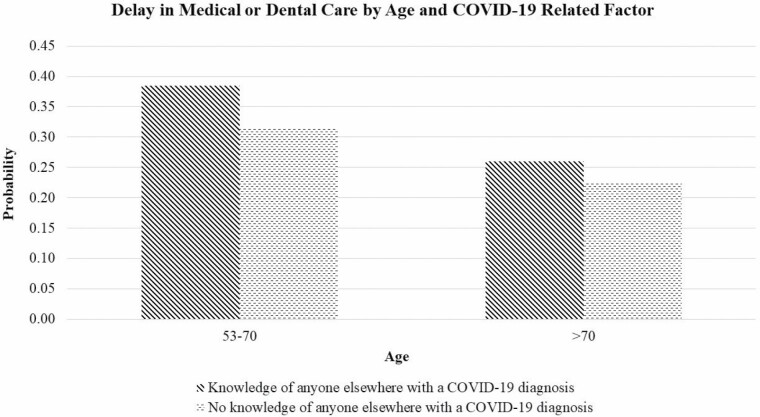
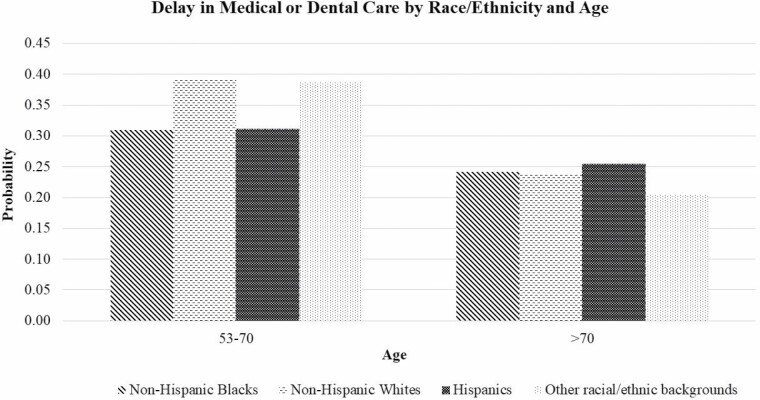
In our sample, 3 in 10 participants who were interviewed from March 2020 to June 2021 reported delays in medical or dental care in the early stages of the COVID-19 pandemic. Non-Hispanic Whites (odds ratio [OR]: 1.37; 95% confidence interval [CI]: 1.19-1.58) and those of other racial/ethnic backgrounds (OR: 1.31; 95% CI: 1.02-1.67) delayed care more than Non-Hispanic Blacks. Other factors associated with delayed care included younger age, living in the Midwest or West, knowing someone diagnosed with or who died from COVID-19, and having high COVID-19-related concerns. There were no differences in care delays among adults aged > 70; however, among those ≤ 70, those who knew someone diagnosed with COVID-19 were more likely to delay care than those who did not. Additionally, among those ≤ 70, Non-Hispanic Whites and those of other racial/ethnic backgrounds delayed care more than Non-Hispanic Blacks and Hispanics.
There is considerable heterogeneity in care delays among older adults based on age, race/ethnicity, and pandemic-related factors. As the pandemic continues, future studies should examine whether these patterns persist.
50 岁以上的成年人有较高的医疗保健需求,但也面临较高的 2019 年冠状病毒病(COVID-19)相关脆弱性。这可能导致他们不愿进入公共场所,包括医疗保健场所。在这里,我们研究了 COVID-19 大流行早期 50 岁以上成年人医疗保健延迟的相关因素。
利用 2020 年健康与退休研究(Health and Retirement Study,HRS)的调查数据(N=7615),我们评估了种族/族裔、年龄、地理位置和与大流行相关的因素与医疗保健延迟的关系。
在我们的样本中,30%的受访者在 2020 年 3 月至 2021 年 6 月期间接受采访时报告称,在 COVID-19 大流行的早期阶段,他们的医疗或牙科护理出现了延迟。非西班牙裔白人(比值比[OR]:1.37;95%置信区间[CI]:1.19-1.58)和其他种族/族裔背景的人(OR:1.31;95% CI:1.02-1.67)比非西班牙裔黑人更有可能延迟护理。其他与延迟护理相关的因素包括年龄较小、居住在中西部或西部、认识有人被诊断出患有或死于 COVID-19,以及对 COVID-19 相关问题的关注度较高。在年龄超过 70 岁的成年人中,护理延迟没有差异;然而,在年龄≤70 岁的成年人中,认识有人被诊断出 COVID-19 的人比不认识的人更有可能延迟护理。此外,在年龄≤70 岁的成年人中,非西班牙裔白人以及其他种族/族裔背景的人比非西班牙裔黑人以及西班牙裔人更有可能延迟护理。
根据年龄、种族/族裔和与大流行相关的因素,老年成年人的护理延迟存在相当大的异质性。随着大流行的继续,未来的研究应检查这些模式是否持续存在。