Luck Anneliese N, Elo Irma T, Preston Samuel H, Paglino Eugenio, Hempstead Katherine, Stokes Andrew C
Department of Sociology and Population Studies Center, University of Pennsylvania, Philadelphia, USA.
Robert Wood Johnson Foundation, Princeton, USA.
Popul Res Policy Rev. 2023 Aug;42(4). doi: 10.1007/s11113-023-09817-8. Epub 2023 Aug 3.
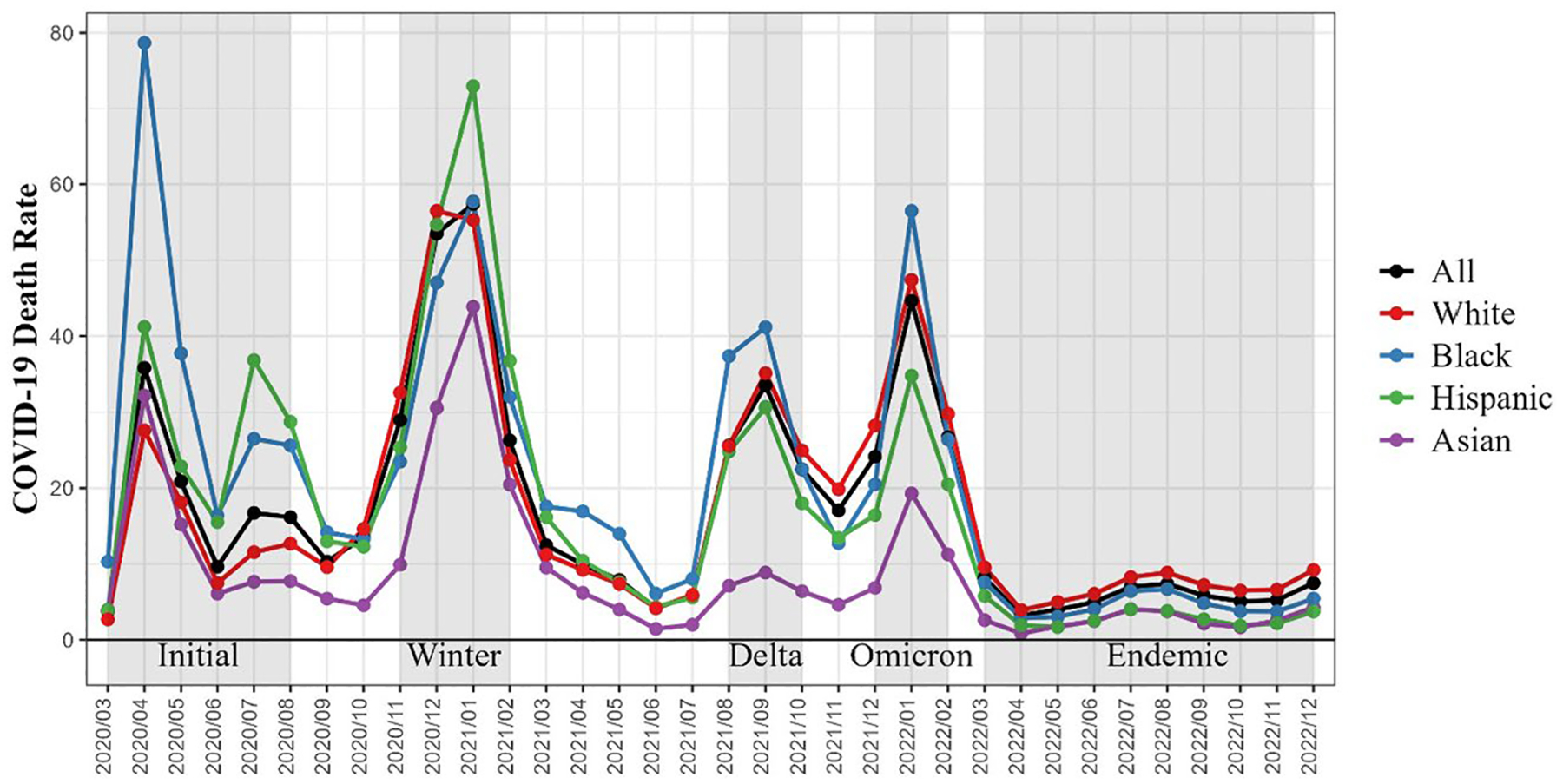
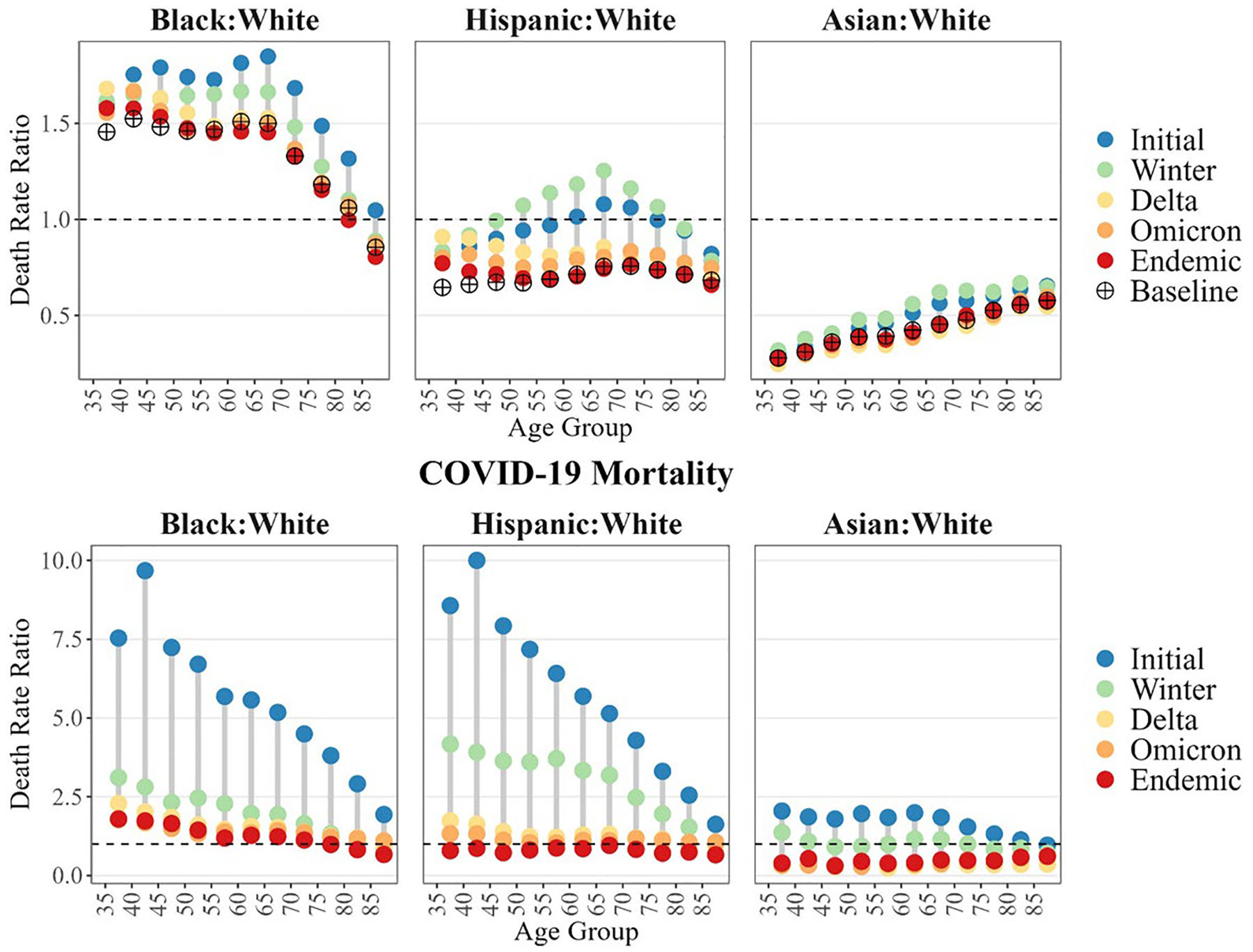
Racial/ethnic and age disparities in COVID-19 and all-cause mortality during 2020 are well documented, but less is known about their evolution over time. We examine changes in age-specific mortality across five pandemic periods in the United States from March 2020 to December 2022 among four racial/ethnic groups (non-Hispanic White, non-Hispanic Black, Hispanic, and non-Hispanic Asian) for ages 35+. We fit Gompertz models to all-cause and COVID-19 death rates by 5-year age groups and construct age-specific racial/ethnic mortality ratios across an Initial peak (Mar-Aug 2020), Winter peak (Nov 2020-Feb 2021), Delta peak (Aug-Oct 2021), Omicron peak (Nov 2021-Feb 2022), and Endemic period (Mar-Dec 2022). We then compare to all-cause patterns observed in 2019. The steep age gradients in COVID-19 mortality in the Initial and Winter peak shifted during the Delta peak, with substantial increases in mortality at working ages, before gradually returning to an older age pattern in the subsequent periods. We find a disproportionate COVID-19 mortality burden on racial and ethnic minority populations early in the pandemic, which led to an increase in all-cause mortality disparities and a temporary elimination of the Hispanic mortality advantage at certain age groups. Mortality disparities narrowed over time, with racial/ethnic all-cause inequalities during the Endemic period generally returning to pre-pandemic levels. Black and Hispanic populations, however, faced a younger age gradient in all-cause mortality in the Endemic period relative to 2019, with younger Hispanic and Black adults in a slightly disadvantageous position and older Black adults in a slightly advantageous position, relative to before the pandemic.
2020年期间,新冠疫情及全因死亡率方面的种族/族裔和年龄差异已有充分记录,但人们对其随时间的演变了解较少。我们研究了2020年3月至2022年12月美国五个疫情阶段中,四个种族/族裔群体(非西班牙裔白人、非西班牙裔黑人、西班牙裔和非西班牙裔亚裔)35岁及以上人群特定年龄死亡率的变化。我们针对5岁年龄组的全因死亡率和新冠死亡率拟合了冈珀茨模型,并构建了在初始高峰(2020年3月至8月)、冬季高峰(2020年11月至2021年2月)、德尔塔高峰(2021年8月至10月)、奥密克戎高峰(2021年11月至2022年2月)和流行期(2022年3月至12月)期间的特定年龄种族/族裔死亡率比值。然后,我们将其与2019年观察到的全因模式进行比较。在初始高峰和冬季高峰时,新冠死亡率的陡峭年龄梯度在德尔塔高峰期间发生了变化,工作年龄人群的死亡率大幅上升,随后在后续阶段逐渐恢复到以老年人为主的模式。我们发现,在疫情早期,少数族裔人群承担了不成比例的新冠死亡负担,这导致全因死亡率差异增加,以及西班牙裔在某些年龄组的死亡率优势暂时消失。随着时间的推移,死亡率差异缩小,流行期的种族/族裔全因不平等总体上恢复到疫情前的水平。然而,与2019年相比,黑人和西班牙裔人群在流行期的全因死亡率面临更年轻的年龄梯度,年轻的西班牙裔和黑人成年人处于略为不利的地位,而年长的黑人成年人则处于略为有利的地位,相对于疫情前而言。