Faculty of Ocean Engineering Technology and Informatics, Universiti Malaysia Terengganu, Terengganu, Malaysia.
London Centre for Neglected Tropical Disease Research, Department of Infectious Disease Epidemiology, St. Mary's Campus, Imperial College London, London, United Kingdom.
PLoS One. 2022 Aug 25;17(8):e0272600. doi: 10.1371/journal.pone.0272600. eCollection 2022.
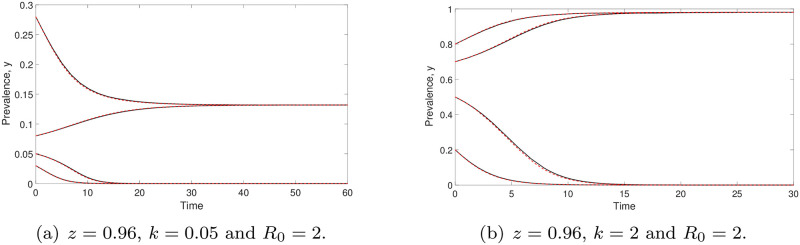
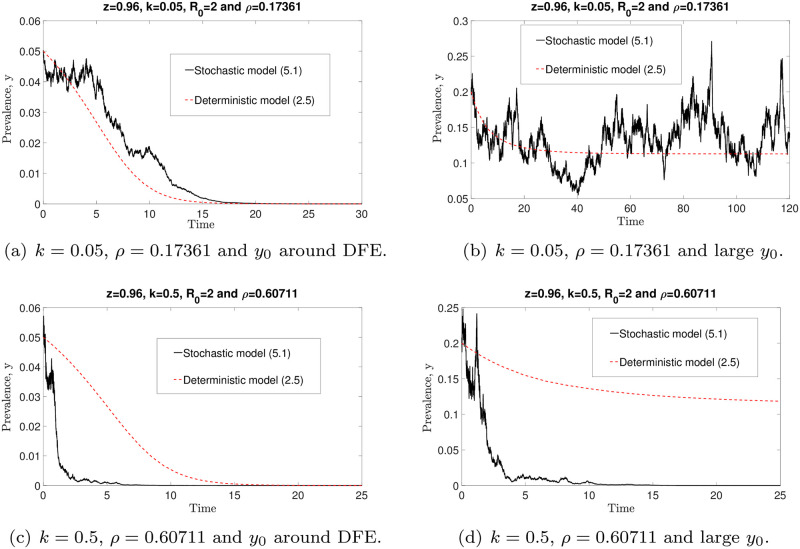
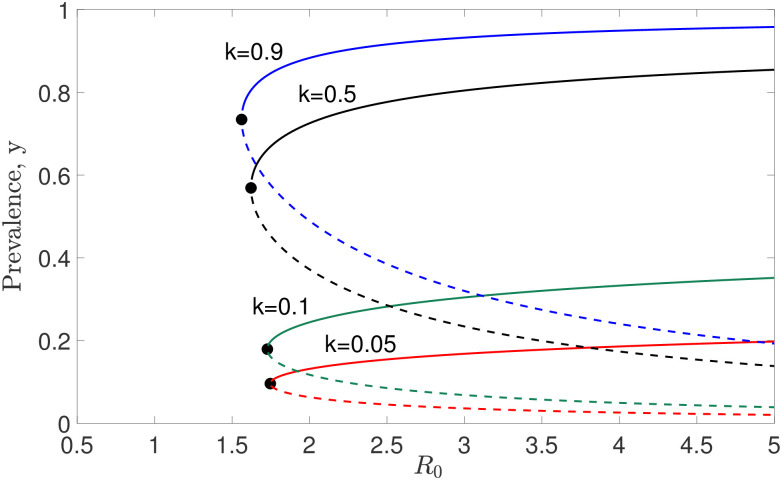
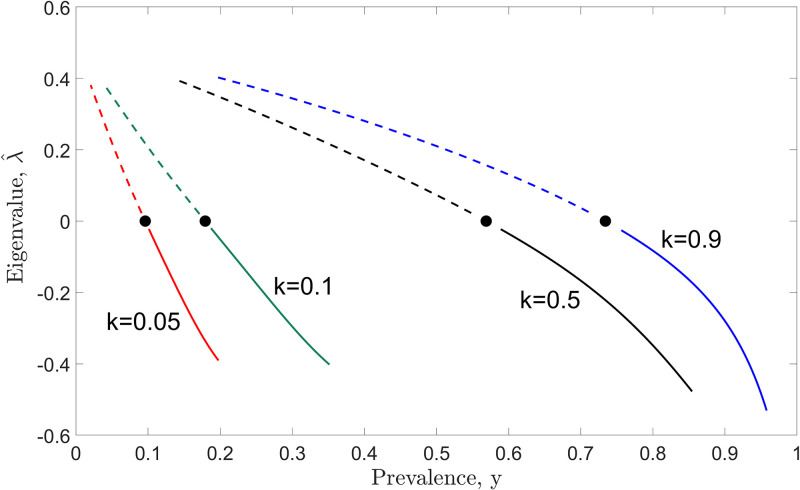
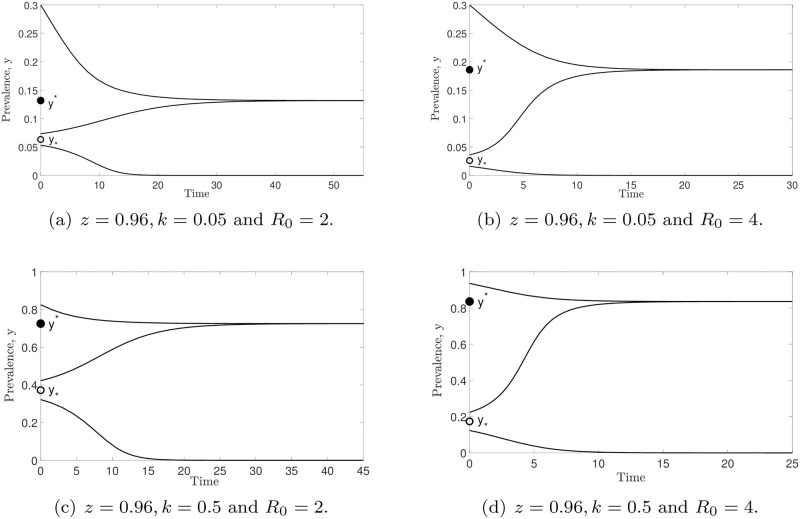
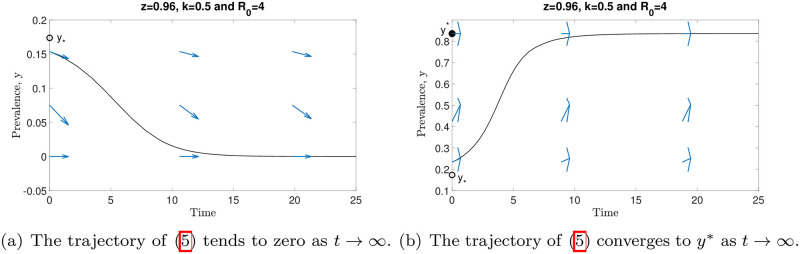
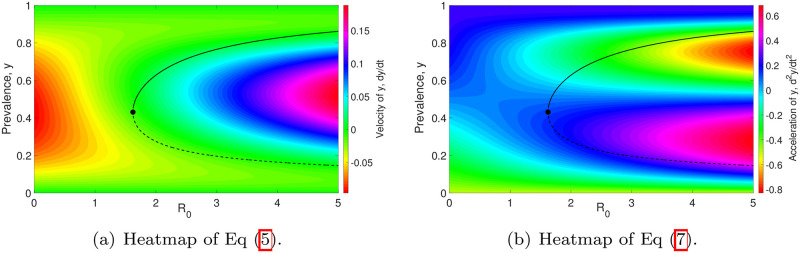
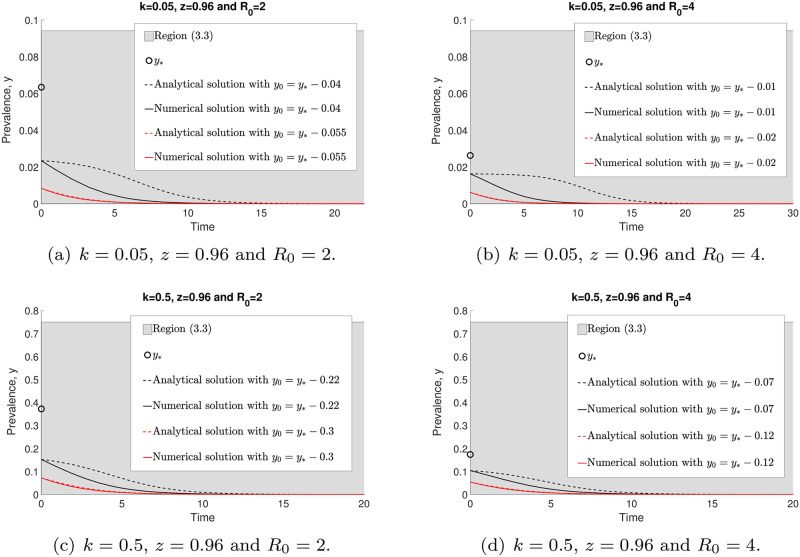
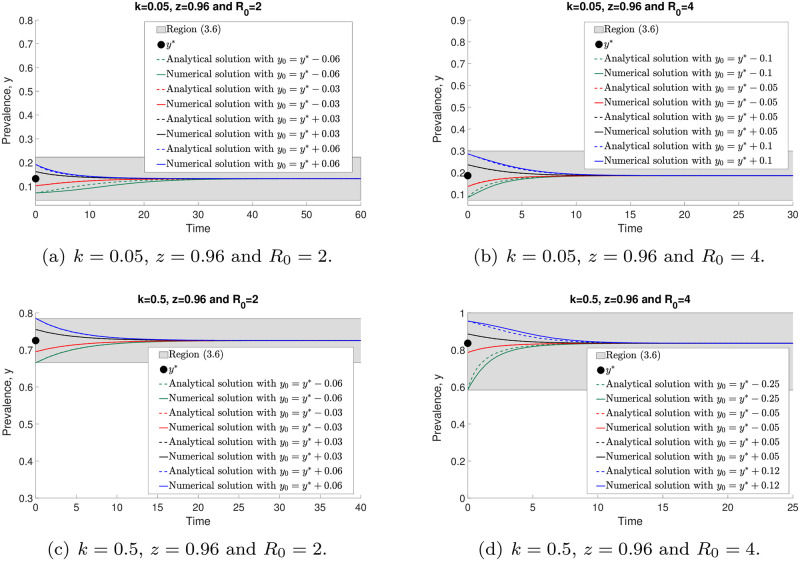
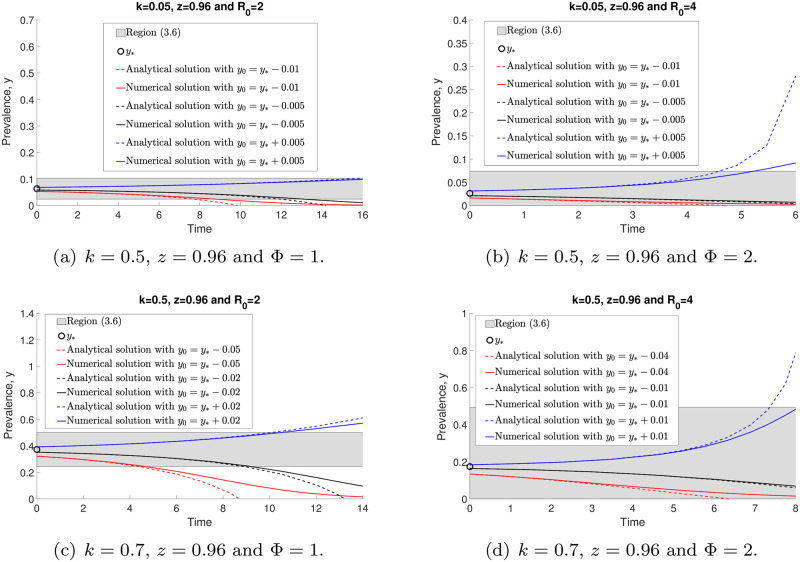
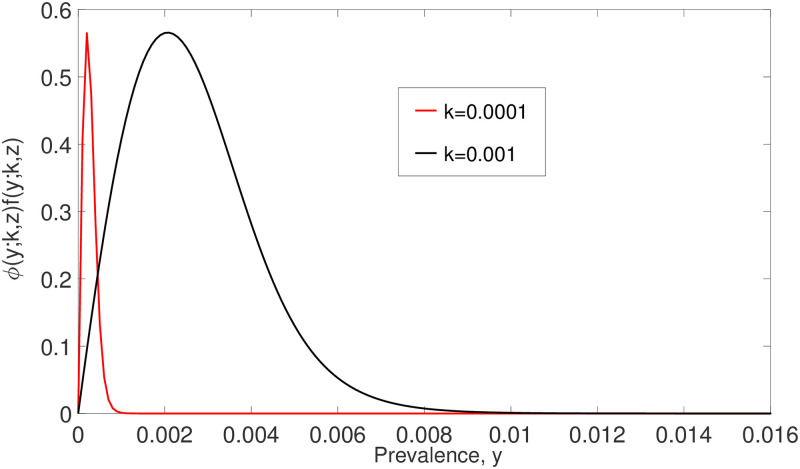
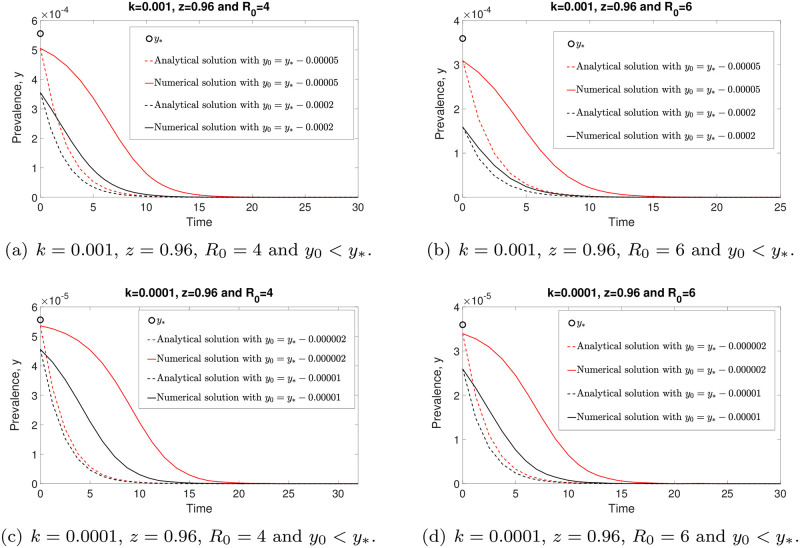
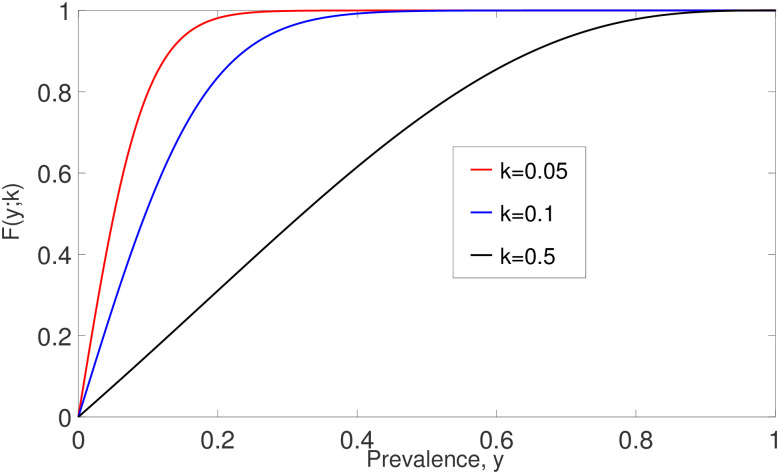
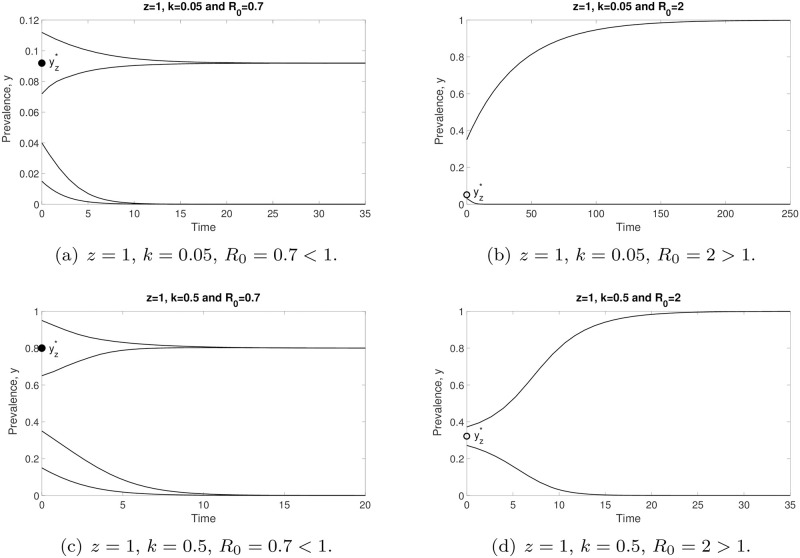
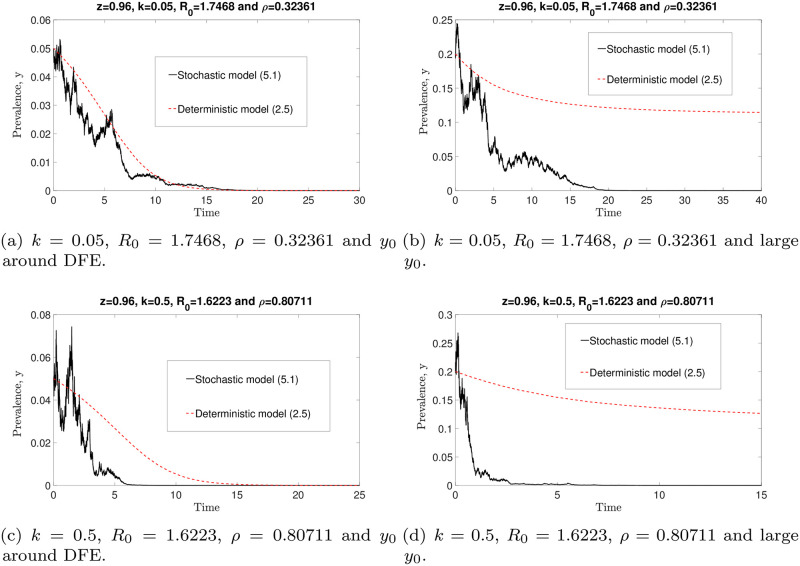
Much effort has been devoted by the World Health Organization (WHO) to eliminate soil-transmitted helminth (STH) infections by 2030 using mass drug administration targeted at particular risk groups alongside the availability to access water, sanitation and hygiene services. The targets set by the WHO for the control of helminth infections are typically defined in terms of the prevalence of infection, whereas the standard formulation of STH transmission models typically describe dynamic changes in the mean-worm burden. We develop a prevalence-based deterministic model to investigate the transmission dynamics of soil-transmitted helminthiasis in humans, subject to continuous exposure to infection over time. We analytically determine local stability criteria for all equilibria and find bifurcation points. Our model predicts that STH infection will either be eliminated (if the initial prevalence value, y(0), is sufficiently small) or remain endemic (if y(0) is sufficiently large), with the two stable points of endemic infection and parasite eradication separated by a transmission breakpoint. Two special cases of the model are analysed: (1) the distribution of the STH parasites in the host population is highly aggregated following a negative binomial distribution, and (2) no density-dependent effects act on the parasite population. We find that disease extinction is always possible for Case (1), but it is not so for Case (2) if y(0) is sufficiently large. However, by introducing stochastic perturbation into the deterministic model, we discover that chance effects can lead to outcomes not predicted by the deterministic model alone, with outcomes highly dependent on the degree of worm clumping, k. Specifically, we show that if the reproduction number and clumping are sufficiently bounded, then stochasticity will cause the parasite to die out. It follows that control of soil-transmitted helminths will be more difficult if the worm distribution tends towards clumping.
世界卫生组织(WHO)投入了大量努力,通过针对特定风险群体的大规模药物管理,结合获得水、环境卫生和个人卫生服务,来消除 2030 年之前的土壤传播性蠕虫(STH)感染。世卫组织控制蠕虫感染的目标通常是根据感染的流行率来定义的,而 STH 传播模型的标准表述通常描述了平均蠕虫负担的动态变化。我们开发了一种基于流行率的确定性模型,以研究人类土壤传播性蠕虫病的传播动态,该模型假设人类持续暴露于感染之中。我们分析确定了所有平衡点的局部稳定性标准,并找到了分岔点。我们的模型预测,STH 感染要么被消除(如果初始流行率 y(0)足够小),要么持续流行(如果 y(0)足够大),流行感染和寄生虫根除的两个稳定点由传播临界点隔开。对模型的两个特殊情况进行了分析:(1)STH 寄生虫在宿主种群中的分布高度聚集,符合负二项式分布;(2)寄生虫种群没有密度依赖效应。我们发现,对于案例 1,疾病灭绝总是可能的,但对于案例 2,如果 y(0)足够大,则情况并非如此。然而,通过在确定性模型中引入随机摄动,我们发现偶然效应可能导致仅由确定性模型无法预测的结果,结果高度依赖于蠕虫聚集度 k。具体来说,我们表明,如果繁殖数和聚集度足够有限,那么随机性将导致寄生虫灭绝。因此,如果蠕虫分布趋于聚集,则控制土壤传播性蠕虫将更加困难。