Ahmed Sajad, Asgher Mohd, Kumar Amit, Gandhi Sumit G
Indian Institute of Integrative Medicine, Canal Road, Jammu 180001, Jammu and Kashmir, India.
Department of Botanical and Environmental Sciences, Guru Nanak Dev University, Amritsar 143005, Punjab, India.
Antioxidants (Basel). 2022 Aug 3;11(8):1512. doi: 10.3390/antiox11081512.
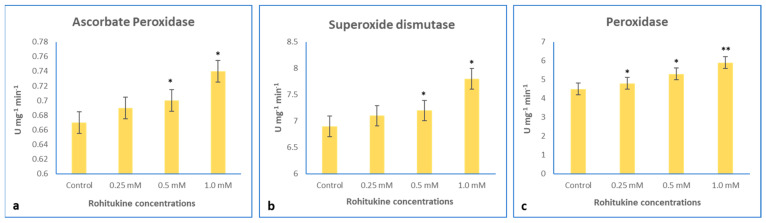
The secondary metabolite rohitukine has been reported in only a few plant species, including , , , and . It has several biological activities, such as anticancer, anti-inflammatory, antiadipogenic, immunomodulatory, gastroprotective, anti-implantation, antidyslipidemic, anti-arthritic and anti-fertility properties. However, the ecological and physiological roles of rohitukine in parent plants have yet to be explored. Here for the first time, we tried to decipher the physiological effect of rohitukine isolated from on the model system . Application of 0.25 mM and 0.5 mM rohitukine concentrations moderately affected the growth of , whereas a remarkable decrease in growth and the alteration of various morphological, physiological and biochemical mechanisms were observed in plants that received 1.0 mM of rohitukine as compared to the untreated control. showed considerable dose-dependent decreases in leaf area, fresh weight and dry weight when sprayed with 0.25 mM, 0.5 mM and 1.0 mM of rohitukine. Rohitukine exposure resulted in the disruption of photosynthesis, photosystem II (PSII) activity and degradation of chlorophyll content in . It also triggered oxidative stress in visualized tissues through antioxidant enzyme activity and the expression levels of key genes involved in the antioxidant system, such as superoxide dismutase (SOD), peroxidase (POD) and ascorbate peroxidase (APX). Rohitukine-induced changes in levels of metabolites (amino acids, sugars, organic acids, etc.) were also assessed. In light of these results, we discuss (i) the likely ecological importance of rohitukine in parent plants as well as (ii) the comparison of responses to rohitukine treatment in plants and mammals.
次生代谢产物洛希图碱仅在少数几种植物中被报道过,包括[具体植物名称1]、[具体植物名称2]、[具体植物名称3]、[具体植物名称4]和[具体植物名称5]。它具有多种生物活性,如抗癌、抗炎、抗脂肪生成、免疫调节、胃保护、抗着床、抗血脂异常、抗关节炎和抗生育特性。然而,洛希图碱在亲本植物中的生态和生理作用尚未得到探索。在此,我们首次尝试解读从[植物名称]中分离出的洛希图碱对模式系统[模式系统名称]的生理影响。施用0.25 mM和0.5 mM浓度的洛希图碱对[植物名称]的生长有中度影响,而与未处理的对照相比,接受1.0 mM洛希图碱处理的植物生长显著下降,并且观察到各种形态、生理和生化机制发生改变。当用0.25 mM、0.5 mM和1.0 mM的洛希图碱喷雾处理时,[植物名称]的叶面积、鲜重和干重呈现出显著的剂量依赖性下降。洛希图碱处理导致[植物名称]光合作用、光系统II(PSII)活性受到破坏,叶绿素含量降解。它还通过抗氧化酶活性以及抗氧化系统中关键基因如超氧化物歧化酶(SOD)、过氧化物酶(POD)和抗坏血酸过氧化物酶(APX)的表达水平,在可见组织中引发氧化应激。我们还评估了洛希图碱诱导的代谢物(氨基酸、糖类、有机酸等)水平变化。鉴于这些结果,我们讨论了(i)洛希图碱在亲本植物中可能的生态重要性,以及(ii)植物和哺乳动物对洛希图碱处理反应的比较。