Alarcón Josefa, Guzmán Jacob, Masuko Telma S, Cáceres Pablo Navarro, Fuentes Ramón
Research Center in Sciences (CICO-UFRO), Dental School-Facultad de Odontología, Universidad de La Frontera, Temuco 4780000, Chile.
Program of Master in Dental Science, Dental School-Facultad de Odontología, Universidad de La Frontera, Temuco 4780000, Chile.
Diagnostics (Basel). 2022 Aug 2;12(8):1869. doi: 10.3390/diagnostics12081869.
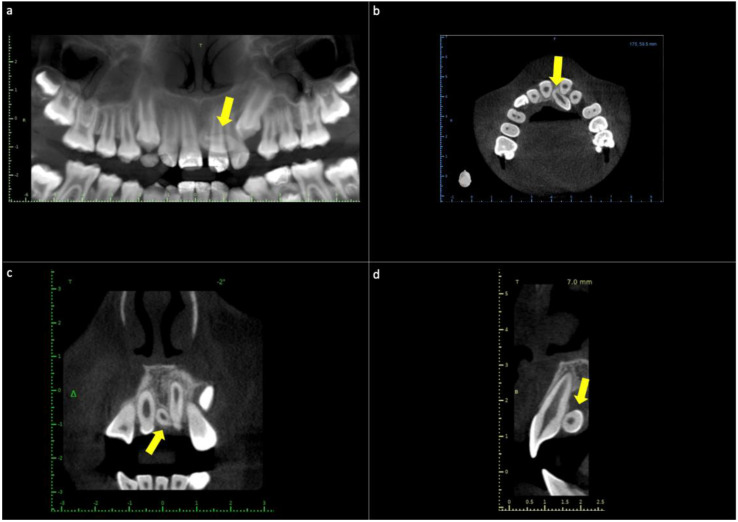
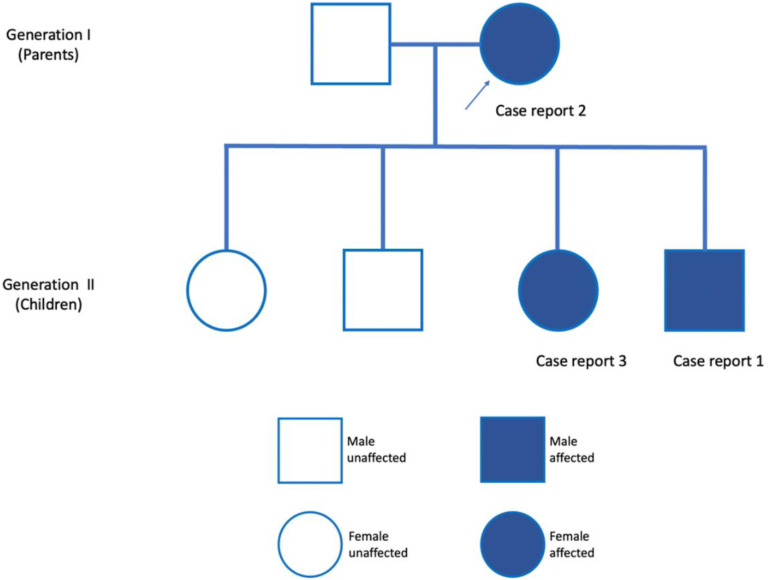
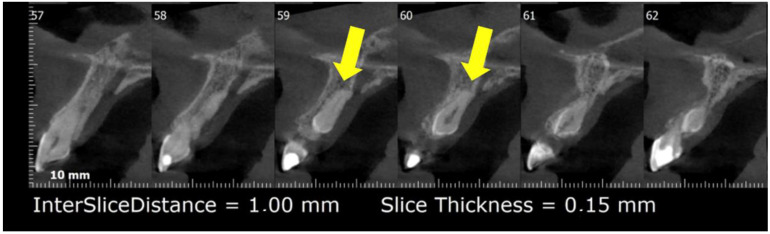
Mesiodens are the most common supernumerary teeth and are detected incidentally during routine radiographic examination, so late diagnosis complications are very common. The dentist must make a timely diagnosis and thus avoid clinical complications. Despite advances in knowledge of dental morphogenesis and differentiation, the etiology of mesiodens remains unclear. Therefore, several theories have been postulated to explain how and why they develop. It was described in the literature that heredity could play an important role in the appearance of supernumerary teeth, with a higher rate of appearance in relatives of those affected. This article reports three cases, a mother and two children, who present mesiodens, which shows that supernumerary teeth may involve a genetic factor. In addition, a literature review was carried out to assess the importance of the genetic factor as a possible cause of mesiodens. The relevance and implications of timely diagnosis in clinical practice to avoid manifestations of clinical complications are discussed. Therefore, the identification of the genetic risk factors responsible for the formation of supernumerary teeth is essential for developing a screening tool to determine an individual's genetic risk.
正中多生牙是最常见的多生牙,通常在常规影像学检查中偶然发现,因此晚期诊断的并发症非常常见。牙医必须及时做出诊断,从而避免临床并发症。尽管在牙齿形态发生和分化方面的知识有所进步,但正中多生牙的病因仍不清楚。因此,人们提出了几种理论来解释它们如何以及为何发育。文献中描述,遗传因素在多生牙的出现中可能起重要作用,患者亲属中多生牙的出现率更高。本文报告了三例病例,一位母亲和两个孩子,他们都有正中多生牙,这表明多生牙可能涉及遗传因素。此外,还进行了文献综述,以评估遗传因素作为正中多生牙可能病因的重要性。讨论了在临床实践中及时诊断以避免临床并发症表现的相关性和意义。因此,识别导致多生牙形成的遗传风险因素对于开发一种筛查工具以确定个体的遗传风险至关重要。