Gimenez Maria Cecilia, Reinaudi Luis, Vazquez Federico
FaMAF (UNC), IFEG (CONICET), Córdoba X5000HUA, Argentina.
Facultad de Ciencias Químicas (UNC), INFIQC (CONICET), Córdoba X5000HUA, Argentina.
Entropy (Basel). 2022 Aug 17;24(8):1140. doi: 10.3390/e24081140.
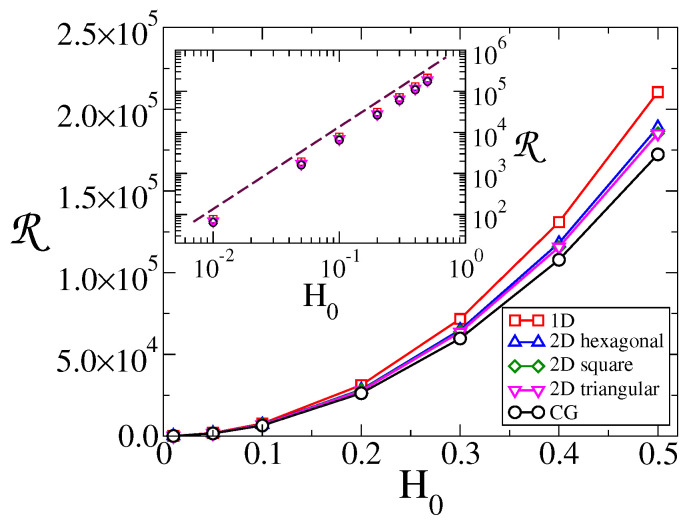
We study the contrarian voter model for opinion formation in a society under the influence of an external oscillating propaganda and stochastic noise. Each agent of the population can hold one of two possible opinions on a given issue—against or in favor—and interacts with its neighbors following either an imitation dynamics (voter behavior) or an anti-alignment dynamics (contrarian behavior): each agent adopts the opinion of a random neighbor with a time-dependent probability p(t), or takes the opposite opinion with probability 1−p(t). The imitation probability p(t) is controlled by the social temperature T, and varies in time according to a periodic field that mimics the influence of an external propaganda, so that a voter is more prone to adopt an opinion aligned with the field. We simulate the model in complete graph and in lattices, and find that the system exhibits a rich variety of behaviors as T is varied: opinion consensus for T=0, a bimodal behavior for T<Tc, an oscillatory behavior where the mean opinion oscillates in time with the field for T>Tc, and full disorder for T≫1. The transition temperature Tc vanishes with the population size N as Tc≃2/lnN in complete graph. In addition, the distribution of residence times tr in the bimodal phase decays approximately as tr−3/2. Within the oscillatory regime, we find a stochastic resonance-like phenomenon at a given temperature T*. Furthermore, mean-field analytical results show that the opinion oscillations reach a maximum amplitude at an intermediate temperature, and that exhibit a lag with respect to the field that decreases with T.
我们研究了在外部振荡宣传和随机噪声影响下社会中意见形成的反向选民模型。群体中的每个个体在给定问题上可以持有两种可能的意见之一——反对或支持——并根据模仿动态(选民行为)或反对齐动态(反向行为)与其邻居进行互动:每个个体以随时间变化的概率(p(t))采用随机邻居的意见,或以概率(1 - p(t))持相反意见。模仿概率(p(t))由社会温度(T)控制,并根据模拟外部宣传影响的周期性场随时间变化,因此选民更倾向于采用与该场一致的意见。我们在完全图和晶格中模拟该模型,发现随着(T)的变化,系统呈现出丰富多样的行为:(T = 0)时意见达成共识,(T < T_c)时出现双峰行为,(T > T_c)时出现振荡行为,即平均意见随场随时间振荡,(T \gg 1)时完全无序。在完全图中,转变温度(T_c)随着群体规模(N)的增加而消失,(T_c \simeq 2 / \ln N)。此外,双峰相中停留时间(t_r)的分布近似按(t_r^{-3/2})衰减。在振荡区域内,我们在给定温度(T^*)下发现了类似随机共振的现象。此外,平均场分析结果表明,意见振荡在中间温度下达到最大振幅,并且相对于场存在滞后,该滞后随(T)减小。