Ritter Andreas, Kreis Nina-Naomi, Hoock Samira Catharina, Solbach Christine, Louwen Frank, Yuan Juping
Obstetrics and Prenatal Medicine, Gynecology and Obstetrics, University Hospital Frankfurt, J. W. Goethe-University, Theodor-Stern-Kai 7, D-60590 Frankfurt, Germany.
Cancers (Basel). 2022 Aug 12;14(16):3908. doi: 10.3390/cancers14163908.
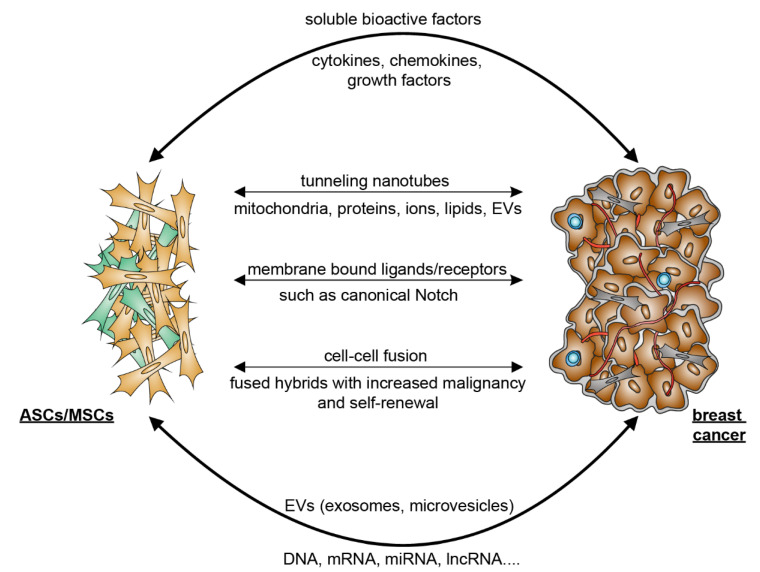
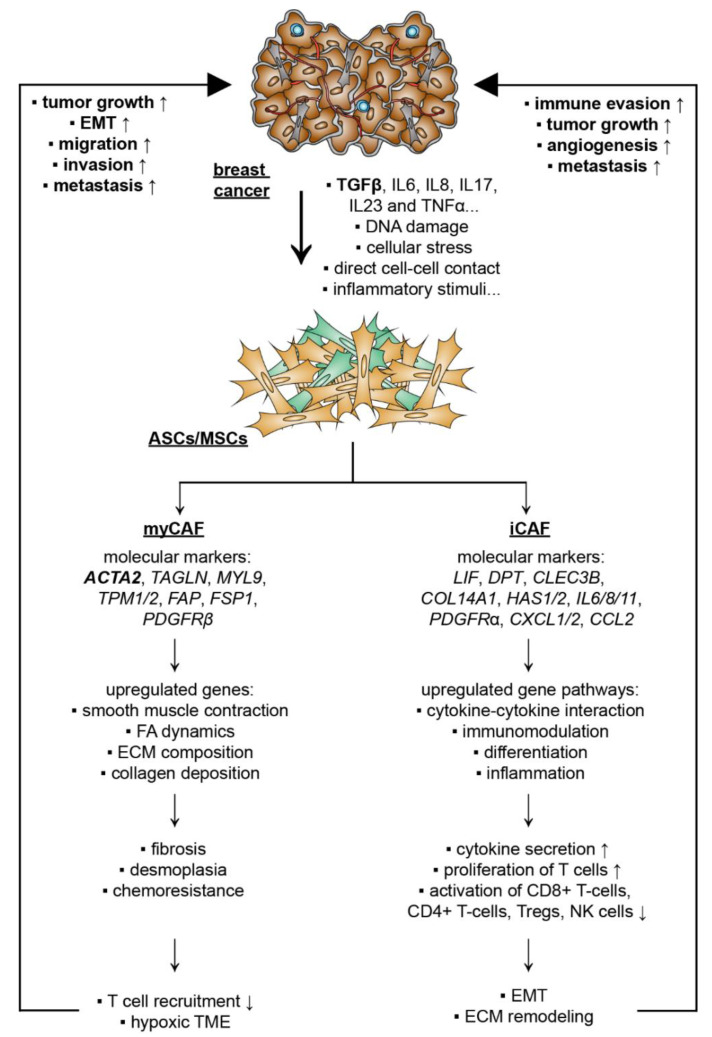
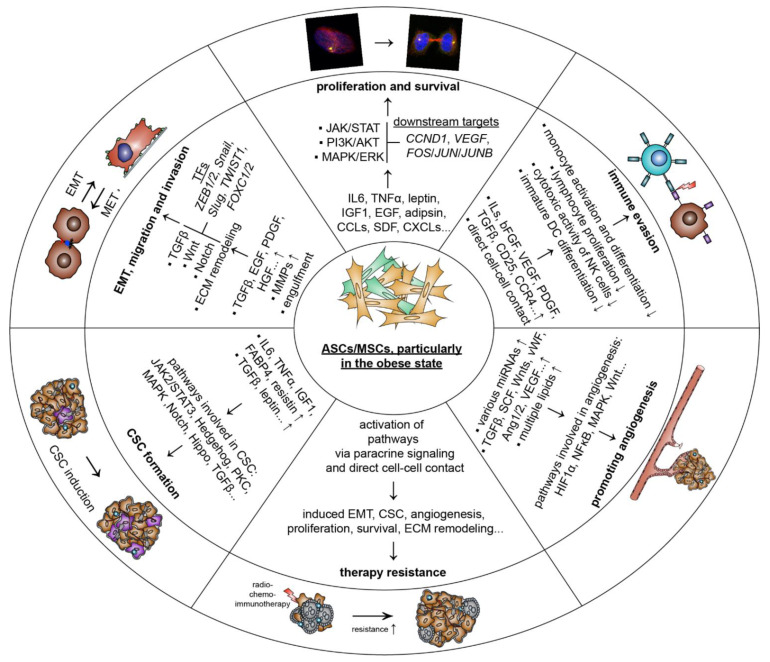
Breast cancer is the most frequently diagnosed cancer and a common cause of cancer-related death in women. It is well recognized that obesity is associated with an enhanced risk of more aggressive breast cancer as well as reduced patient survival. Adipose tissue is the major microenvironment of breast cancer. Obesity changes the composition, structure, and function of adipose tissue, which is associated with inflammation and metabolic dysfunction. Interestingly, adipose tissue is rich in ASCs/MSCs, and obesity alters the properties and functions of these cells. As a key component of the mammary stroma, ASCs play essential roles in the breast cancer microenvironment. The crosstalk between ASCs and breast cancer cells is multilateral and can occur both directly through cell-cell contact and indirectly via the secretome released by ASC/MSC, which is considered to be the main effector of their supportive, angiogenic, and immunomodulatory functions. In this narrative review, we aim to address the impact of obesity on ASCs/MSCs, summarize the current knowledge regarding the potential pathological roles of ASCs/MSCs in the development of breast cancer, discuss related molecular mechanisms, underline the possible clinical significance, and highlight related research perspectives. In particular, we underscore the roles of ASCs/MSCs in breast cancer cell progression, including proliferation and survival, angiogenesis, migration and invasion, the epithelial-mesenchymal transition, cancer stem cell development, immune evasion, therapy resistance, and the potential impact of breast cancer cells on ASCS/MSCs by educating them to become cancer-associated fibroblasts. We conclude that ASCs/MSCs, especially obese ASCs/MSCs, may be key players in the breast cancer microenvironment. Targeting these cells may provide a new path of effective breast cancer treatment.
乳腺癌是女性中最常被诊断出的癌症,也是癌症相关死亡的常见原因。众所周知,肥胖与侵袭性更强的乳腺癌风险增加以及患者生存率降低有关。脂肪组织是乳腺癌的主要微环境。肥胖会改变脂肪组织的组成、结构和功能,这与炎症和代谢功能障碍有关。有趣的是,脂肪组织富含脂肪干细胞/间充质干细胞,肥胖会改变这些细胞的特性和功能。作为乳腺基质的关键组成部分,脂肪干细胞在乳腺癌微环境中发挥着重要作用。脂肪干细胞与乳腺癌细胞之间的相互作用是多方面的,既可以通过细胞间接触直接发生,也可以通过脂肪干细胞/间充质干细胞释放的分泌组间接发生,分泌组被认为是其支持、血管生成和免疫调节功能的主要效应物。在这篇叙述性综述中,我们旨在探讨肥胖对脂肪干细胞/间充质干细胞的影响,总结目前关于脂肪干细胞/间充质干细胞在乳腺癌发生发展中潜在病理作用的认识,讨论相关分子机制,强调可能的临床意义,并突出相关研究前景。特别是,我们强调了脂肪干细胞/间充质干细胞在乳腺癌细胞进展中的作用,包括增殖和存活、血管生成、迁移和侵袭、上皮-间质转化、癌症干细胞发育、免疫逃逸、治疗耐药性,以及乳腺癌细胞通过将它们诱导为癌症相关成纤维细胞对脂肪干细胞/间充质干细胞的潜在影响。我们得出结论,脂肪干细胞/间充质干细胞,尤其是肥胖状态下的脂肪干细胞/间充质干细胞,可能是乳腺癌微环境中的关键参与者。针对这些细胞可能为乳腺癌的有效治疗提供一条新途径。