Department of Biomaterials Technology, Faculty of Mechanical Engineering and Ship Technology, Advanced Materials Centre, Gdańsk University of Technology, 80-233 Gdańsk, Poland.
Department of Laboratory Medicine, Medical University of Gdańsk, 80-210 Gdańsk, Poland.
Int J Mol Sci. 2022 Aug 13;23(16):9083. doi: 10.3390/ijms23169083.
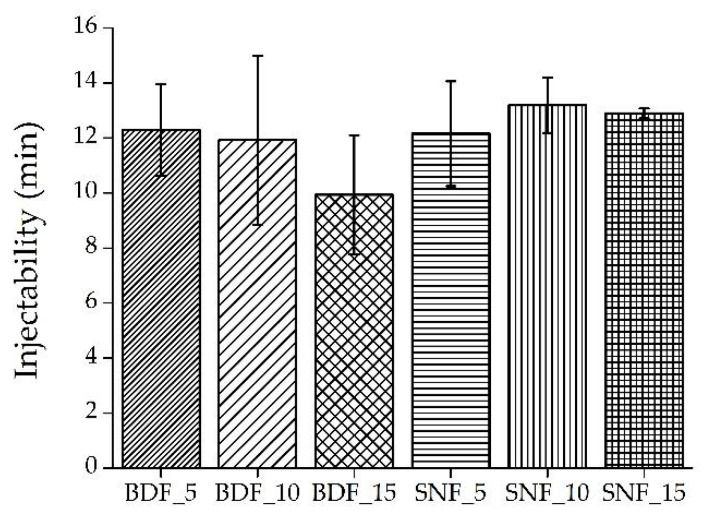
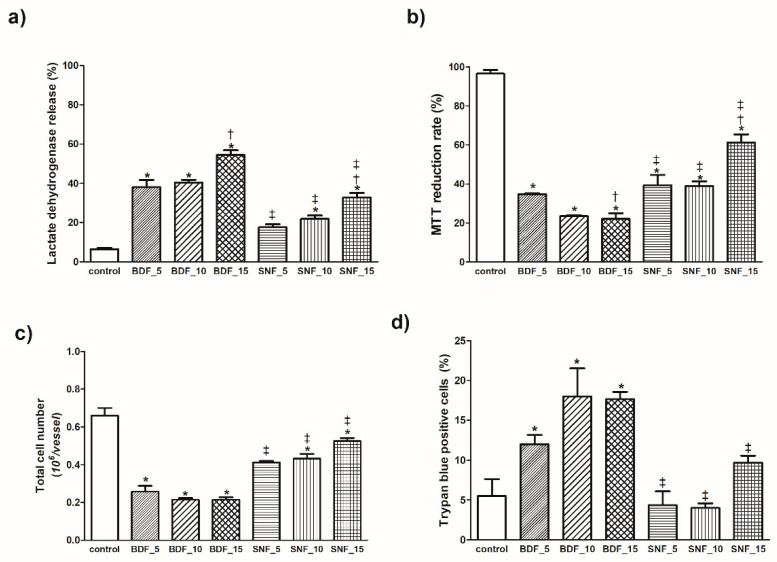
The main aim of the research was to develop a new biocompatible and injectable composite with the potential for application as a bone-to-implant bonding material or as a bone substitute. A composite based on hydroxyapatite, gelatin, and two various types of commercially available transglutaminase (TgBDF/TgSNF), as a cross-linking agent, was proposed. To evaluate the impacts of composite content and processing parameters on various properties of the material, the following research was performed: the morphology was examined by SEM microscopy, the chemical structure by FTIR spectroscopy, the degradation behavior was examined in simulated body fluid, the injectability test was performed using an automatic syringe pump, the mechanical properties using a nanoindentation technique, the surface wettability was examined by an optical tensiometer, and the cell viability was assayed by MTT and LDH. In all cases, a composite paste was successfully obtained. Injectability varied between 8 and 15 min. The type of transglutaminase did not significantly affect the surface topography or chemical composition. All samples demonstrated proper nanomechanical properties with Young's modulus and the hardness close to the values of natural bone. BDF demonstrated better hydrophilic properties and structural stability over 7 days in comparison with SNF. In all cases, the transglutaminase did not lead to cell necrosis, but cellular proliferation was significantly inhibited, especially for the BDF agent.
本研究的主要目的是开发一种新的生物相容性可注射复合材料,该材料具有作为骨-植入体结合材料或骨替代物的应用潜力。提出了一种基于羟磷灰石、明胶和两种不同类型的商业可得转谷氨酰胺酶(TgBDF/TgSNF)作为交联剂的复合材料。为了评估复合材料含量和加工参数对材料各种性能的影响,进行了以下研究:通过扫描电子显微镜(SEM)观察形貌,通过傅里叶变换红外光谱(FTIR)研究化学结构,通过在模拟体液中研究降解行为,通过自动注射器泵进行可注射性测试,通过纳米压痕技术研究力学性能,通过光学张力计研究表面润湿性,通过 MTT 和 LDH 测定细胞活力。在所有情况下,均成功获得了复合材料糊剂。可注射性在 8 至 15 分钟之间变化。转谷氨酰胺酶的类型对表面形貌或化学组成没有显著影响。所有样品均表现出适当的纳米力学性能,杨氏模量和硬度接近天然骨的数值。与 SNF 相比,BDF 在 7 天内表现出更好的亲水性和结构稳定性。在所有情况下,转谷氨酰胺酶均未导致细胞坏死,但细胞增殖受到明显抑制,尤其是对于 BDF 试剂。