IUF-Leibniz Research Institute for Environmental Medicine GmbH, Auf'm Hennekamp 50, 40225 Duesseldorf, Germany.
Int J Mol Sci. 2022 Aug 13;23(16):9084. doi: 10.3390/ijms23169084.
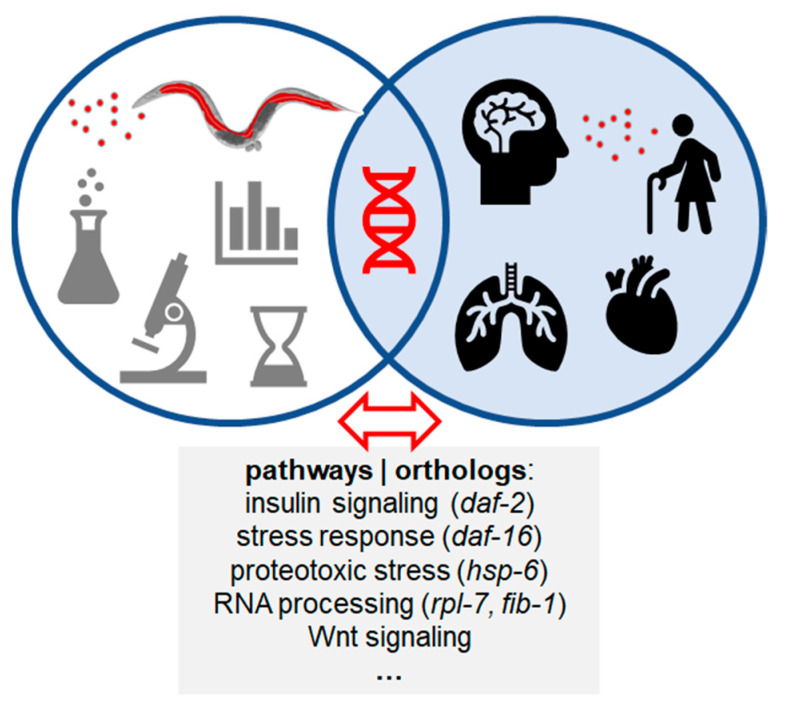
Due to its preferred habitats in the environment, the free-living nematode has become a realistic target organism for pollutants, including manufactured nanoparticles. In the laboratory, the invertebrate animal model represents a cost-effective tool to investigate the molecular mechanisms of the biological response to nanomaterials. With an estimated number of 22,000 coding genes and short life span of 2-3 weeks, the small worm is a giant when it comes to characterization of molecular pathways, long-term low dose pollutant effects and vulnerable age-groups. Here, we review (i) flows of manufactured nanomaterials and exposition of in the environment, (ii) the track record of in biomedical research, and (iii) its potential to contribute to the investigation of the exposome and bridge nanotoxicology between higher organisms, including humans. The role of in the one health concept is taken one step further by proposing methods to sample wild nematodes and their molecular characterization by single worm proteomics.
由于其在环境中的偏好栖息地,自由生活的线虫已成为污染物(包括制造的纳米颗粒)的现实目标生物。在实验室中,无脊椎动物动物模型是一种具有成本效益的工具,可以研究生物对纳米材料的反应的分子机制。估计有 22000 个编码基因,寿命短至 2-3 周,这种小蠕虫在分子途径的特征描述、长期低剂量污染物效应和脆弱的年龄组方面是一个巨大的挑战。在这里,我们回顾了(i)制造纳米材料的流动和在环境中的暴露,(ii)在生物医学研究中的记录,以及(iii)它在调查暴露组和在包括人类在内的高等生物之间架起纳米毒理学桥梁方面的潜力。通过提出采集野生线虫及其通过单虫蛋白质组学进行分子特征描述的方法,将线虫在一健康概念中的作用又向前推进了一步。