Mastraftsi Styliani, Vrioni Georgia, Bakakis Michail, Nicolaidou Electra, Rigopoulos Dimitrios, Stratigos Alexander J, Gregoriou Stamatios
1st Department of Dermatology and Venereology, Andreas Sygros Hospital for Skin and Venereal Diseases, Medical School, National and Kapodistrian University of Athens, 16121 Athens, Greece.
Department of Microbiology, Medical School, National and Kapodistrian University of Athens, 11527 Athens, Greece.
J Clin Med. 2022 Aug 9;11(16):4639. doi: 10.3390/jcm11164639.
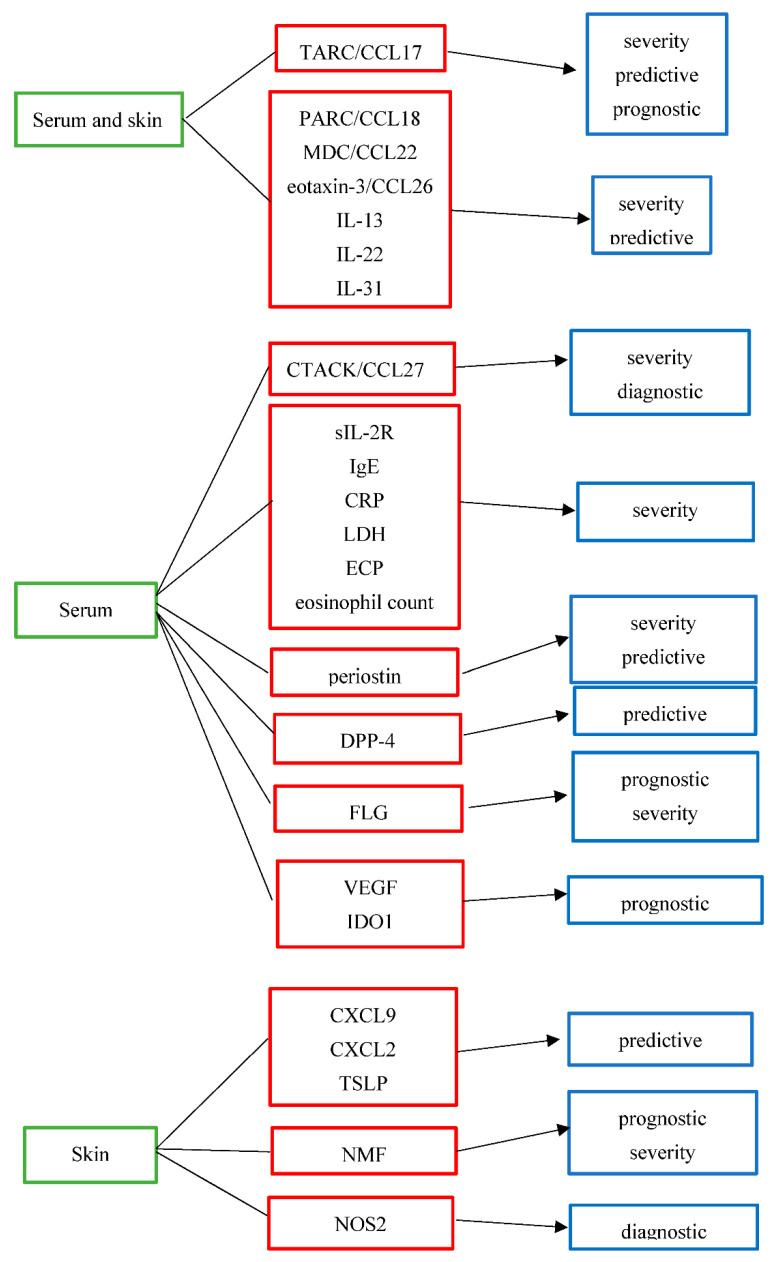
Atopic dermatitis (AD) is a highly heterogeneous inflammatory disease regarding both its pathophysiology and clinical manifestations. However, it is treated according to the "one-size-fits-all" approach, which may restrict response to treatment. Thus, there is an unmet need for the stratification of patients with AD into distinct endotypes and clinical phenotypes based on biomarkers that will contribute to the development of precision medicine in AD. The development of reliable biomarkers that may distinguish which patients with AD are most likely to benefit from specific targeted therapies is a complex procedure and to date none of the identified candidate biomarkers for AD has been validated for use in routine clinical practice. Reliable biomarkers in AD are expected to improve diagnosis, evaluate disease severity, predict the course of disease, the development of comorbidities, or the therapeutic response, resulting in effective and personalized treatment of AD. Among the studied AD potential biomarkers, thymus and activation-regulated chemokine/C-C motif ligand 17 (TARC/CCL17) has the greatest evidence-based support for becoming a reliable biomarker in AD correlated with disease severity in both children and adults. In this review, we present the most prominent candidate biomarkers in AD and their suggested use.
特应性皮炎(AD)在病理生理学和临床表现方面都是一种高度异质性的炎症性疾病。然而,它采用的是“一刀切”的治疗方法,这可能会限制治疗反应。因此,基于生物标志物将AD患者分层为不同的内型和临床表型的需求尚未得到满足,这将有助于AD精准医学的发展。开发能够区分哪些AD患者最有可能从特定靶向治疗中获益的可靠生物标志物是一个复杂的过程,迄今为止,已确定的AD候选生物标志物均未在常规临床实践中得到验证。AD中的可靠生物标志物有望改善诊断、评估疾病严重程度、预测疾病进程、合并症的发生或治疗反应,从而实现AD的有效和个性化治疗。在已研究的AD潜在生物标志物中,胸腺和活化调节趋化因子/C-C基序配体17(TARC/CCL17)在成为与儿童和成人疾病严重程度相关的AD可靠生物标志物方面有最充分的循证支持。在这篇综述中,我们介绍了AD中最突出的候选生物标志物及其建议用途。