Assmus Frauke, Driouich Jean-Sélim, Abdelnabi Rana, Vangeel Laura, Touret Franck, Adehin Ayorinde, Chotsiri Palang, Cochin Maxime, Foo Caroline S, Jochmans Dirk, Kim Seungtaek, Luciani Léa, Moureau Grégory, Park Soonju, Pétit Paul-Rémi, Shum David, Wattanakul Thanaporn, Weynand Birgit, Fraisse Laurent, Ioset Jean-Robert, Mowbray Charles E, Owen Andrew, Hoglund Richard M, Tarning Joel, Lamballerie Xavier de, Nougairède Antoine, Neyts Johan, Sjö Peter, Escudié Fanny, Scandale Ivan, Chatelain Eric
Mahidol Oxford Tropical Medicine Research Unit, Faculty of Tropical Medicine, Mahidol University, Bangkok 10400, Thailand.
Centre for Tropical Medicine and Global Health, Nuffield Department of Medicine, University of Oxford, Oxford OX3 7LG, UK.
Microorganisms. 2022 Aug 12;10(8):1639. doi: 10.3390/microorganisms10081639.
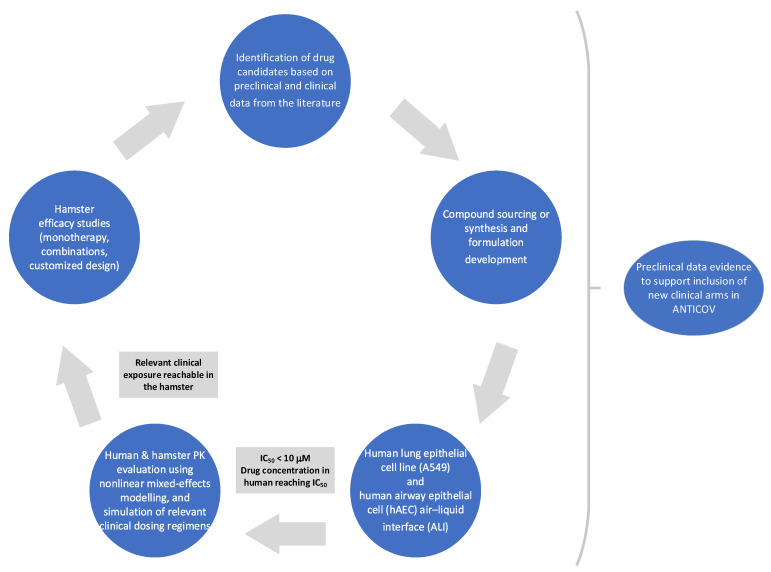
In the absence of drugs to treat or prevent COVID-19, drug repurposing can be a valuable strategy. Despite a substantial number of clinical trials, drug repurposing did not deliver on its promise. While success was observed with some repurposed drugs (e.g., remdesivir, dexamethasone, tocilizumab, baricitinib), others failed to show clinical efficacy. One reason is the lack of clear translational processes based on adequate preclinical profiling before clinical evaluation. Combined with limitations of existing in vitro and in vivo models, there is a need for a systematic approach to urgent antiviral drug development in the context of a global pandemic. We implemented a methodology to test repurposed and experimental drugs to generate robust preclinical evidence for further clinical development. This translational drug development platform comprises in vitro, ex vivo, and in vivo models of SARS-CoV-2, along with pharmacokinetic modeling and simulation approaches to evaluate exposure levels in plasma and target organs. Here, we provide examples of identified repurposed antiviral drugs tested within our multidisciplinary collaboration to highlight lessons learned in urgent antiviral drug development during the COVID-19 pandemic. Our data confirm the importance of assessing in vitro and in vivo potency in multiple assays to boost the translatability of pre-clinical data. The value of pharmacokinetic modeling and simulations for compound prioritization is also discussed. We advocate the need for a standardized translational drug development platform for mild-to-moderate COVID-19 to generate preclinical evidence in support of clinical trials. We propose clear prerequisites for progression of drug candidates for repurposing into clinical trials. Further research is needed to gain a deeper understanding of the scope and limitations of the presented translational drug development platform.
在缺乏治疗或预防新冠病毒病(COVID-19)的药物的情况下,药物重新利用可能是一种有价值的策略。尽管进行了大量临床试验,但药物重新利用并未达到预期效果。虽然一些重新利用的药物(如瑞德西韦、地塞米松、托珠单抗、巴瑞替尼)取得了成功,但其他药物未能显示出临床疗效。一个原因是在临床评估之前缺乏基于充分临床前分析的明确转化流程。再加上现有体外和体内模型的局限性,在全球大流行的背景下,需要一种系统的方法来进行紧急抗病毒药物研发。我们实施了一种方法来测试重新利用的药物和实验性药物,以生成有力的临床前证据用于进一步的临床开发。这个转化药物研发平台包括严重急性呼吸综合征冠状病毒2(SARS-CoV-2)的体外、离体和体内模型,以及药代动力学建模和模拟方法,以评估血浆和靶器官中的暴露水平。在此,我们提供在我们的多学科合作中测试的已确定的重新利用的抗病毒药物的实例,以突出在COVID-19大流行期间紧急抗病毒药物研发中吸取的经验教训。我们的数据证实了在多种试验中评估体外和体内效力对于提高临床前数据可转化性的重要性。还讨论了药代动力学建模和模拟在化合物优先级排序方面的价值。我们主张需要一个针对轻至中度COVID-19的标准化转化药物研发平台,以生成支持临床试验的临床前证据。我们提出了将重新利用的候选药物推进到临床试验的明确先决条件。需要进一步研究以更深入地了解所提出的转化药物研发平台的范围和局限性。