Springfield Nutraceuticals, Managing Director, Research & Development, Veldenstraat 23, 2220 Heist-op-den-Berg, Belgium.
Clinical Nutrition and Dietetics Unit, Fondazione IRCCS Policlinico San Matteo, 27100 Pavia, Italy.
Nutrients. 2022 Aug 10;14(16):3273. doi: 10.3390/nu14163273.
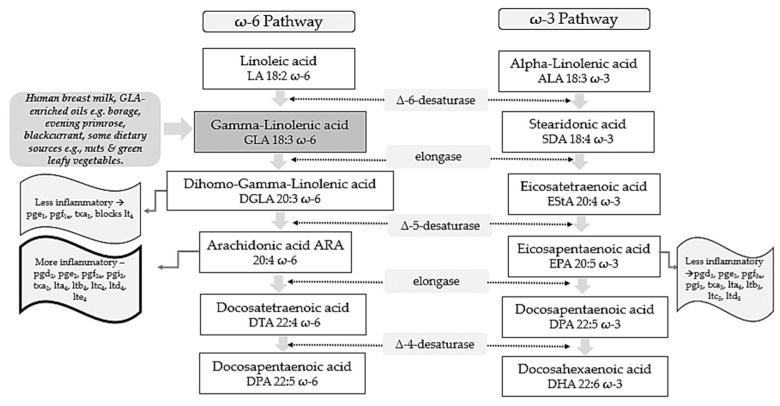
The use of polyunsaturated fatty acids in Attention-Deficit/Hyperactivity Disorder (ADHD) and developmental disorders has been gaining interest with preparations containing different dosages and combinations. Gamma-linolenic acid (GLA) is an ω-6 fatty acid of emerging interest with potential roles as an adjuvant anti-inflammatory agent that could be used with ω-3 PUFAs in the treatment of ADHD and associated symptoms. A narrative review was undertaken to examine the potential role(s) of the ω-6 fatty acid GLA. PubMed, Google Scholar, and Scopus were searched to examine the potential role(s) of the ω-6 fatty acid GLA as (1) an antioxidant and anti-inflammatory agent, (2) a synergistic nutrient when combined with ω-3 PUFAs, and (3) a potential etiological factor in ADHD and its treatment. The results show that GLA exerts anti-inflammatory effects by increasing dihomo-gamma-linolenic acid in immune cells. ω-3 PUFAs, such as EPA and DHA, are often co-administered with GLA because these ω-3 PUFAs may prevent the accumulation of serum arachidonic acid in response to GLA administration without limiting the storage of DGLA in immune cells. The administration of ω-3 PUFAs alone might not be sufficient to effectively treat patients with ADHD and developmental disorders. Overall studies point towards a combination of EPA and DHA with GLA in a 9:3:1 ratio appearing to be associated with ADHD symptom improvement. A combination of PUFAs may lead to better outcomes.
多不饱和脂肪酸在注意缺陷多动障碍(ADHD)和发育障碍中的应用引起了人们的兴趣,因为含有不同剂量和组合的制剂正在被研究。γ-亚麻酸(GLA)是一种新兴的ω-6 脂肪酸,具有作为辅助抗炎剂的潜在作用,可与 ω-3 PUFAs 一起用于治疗 ADHD 及相关症状。本文进行了叙述性综述,以研究 ω-6 脂肪酸 GLA 的潜在作用。通过检索 PubMed、Google Scholar 和 Scopus,研究了 ω-6 脂肪酸 GLA 的潜在作用:(1)作为抗氧化剂和抗炎剂;(2)与 ω-3 PUFAs 联合使用时的协同营养物质;(3)ADHD 及其治疗的潜在病因。结果表明,GLA 通过增加免疫细胞中的二同型-γ-亚麻酸发挥抗炎作用。EPA 和 DHA 等 ω-3 PUFAs 通常与 GLA 一起使用,因为这些 ω-3 PUFAs 可能会防止 GLA 给药时血清花生四烯酸的积累,而不会限制 DGLA 在免疫细胞中的储存。单独使用 ω-3 PUFAs 可能不足以有效治疗 ADHD 和发育障碍患者。总的来说,研究表明,EPA 和 DHA 与 GLA 以 9:3:1 的比例联合使用似乎与 ADHD 症状改善有关。多不饱和脂肪酸的组合可能会带来更好的结果。