Institute of Applied Health Sciences, University of Aberdeen, Polwarth Building, Foresterhill, Aberdeen AB25 2ZD, UK.
The Rowett Institute, University of Aberdeen, Ashgrove Road West, Aberdeen AB25 2ZD, UK.
Nutrients. 2022 Aug 16;14(16):3363. doi: 10.3390/nu14163363.
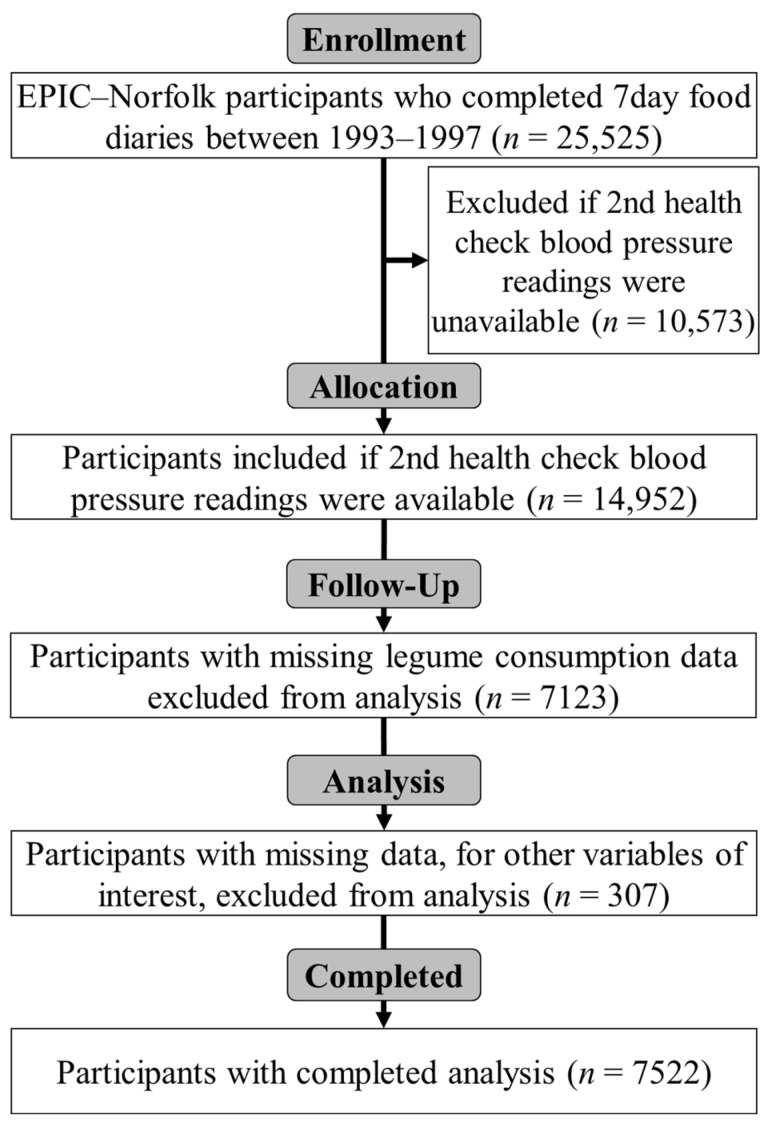
Hypertension is a significant and preventable cardiovascular disease risk factor. Growing evidence suggests legumes have blood-pressure (BP) lowering properties. However, there is little population-based research on legume intake and hypertension risk in Western populations. The objective was to investigate the relationship between legume intake and blood pressure by using data from the European Prospective Investigation into Cancer and Nutrition (EPIC) Norfolk cohort. Further, to identify any potential legume intake that confers benefits in relation to blood pressure. We included participants who completed both 7-day food diaries to assess legume intake and undertook a first (1993−1997) and second (1998−2000) health check from the EPIC-Norfolk prospective study. Legume consumption was categorized using percentile cut off values. We used multivariate logistic regression models to calculate the odds ratio of hypertension (defined as >140 mmHg systolic and/or >90 mmHg diastolic blood pressure) at the second health check, stratified by legume intake, adjusting for antihypertensive medication use and demographic, socioeconomic and lifestyle covariates. A total of 7522 participants were included with mean age (± SD) of 58.0 ± 8.9 years. The follow-up time was 3.7 years (range: 2.1−6.6 years). Mean legume consumption was 17.3 ± 16.3 g/day. Participants in the 97th percentile of legume intake had the lowest odds of subsequent hypertension (OR: 0.71; 95% CI: 0.52, 0.96). Legume consumption between 55−70 g/day was associated with reduced odds of hypertension (OR: 0.57; 95% CI: 0.37, 0.88); sex-specific values for men and women were 0.64 (0.38, 1.03) and 0.32 (0.12, 0.88), respectively. In this UK population, legume intake of 55−70 g/day was associated with a lower subsequent risk of hypertension. Given the low legume intake in the UK and Western countries, dietary guidance to increase intake above 55 g/day may lower the burden of hypertension and associated diseases.
高血压是一种重要且可预防的心血管疾病风险因素。越来越多的证据表明,豆类具有降血压的特性。然而,在西方人群中,关于豆类摄入量与高血压风险的人群研究较少。本研究旨在利用欧洲癌症与营养前瞻性调查(EPIC)诺福克队列的数据,调查豆类摄入量与血压之间的关系。此外,还确定了任何与血压相关的潜在豆类摄入量的益处。我们纳入了完成两次 7 天食物日记以评估豆类摄入量的参与者,以及来自 EPIC-Norfolk 前瞻性研究的第一次(1993-1997 年)和第二次(1998-2000 年)健康检查。豆类消费使用百分位截断值进行分类。我们使用多变量逻辑回归模型,计算第二次健康检查时高血压(定义为收缩压>140mmHg 和/或舒张压>90mmHg)的比值比,按豆类摄入量分层,调整降压药物使用以及人口统计学、社会经济和生活方式协变量。共纳入 7522 名参与者,平均年龄(±标准差)为 58.0±8.9 岁。随访时间为 3.7 年(范围:2.1-6.6 年)。平均豆类摄入量为 17.3±16.3g/天。豆类摄入量处于第 97 百分位数的参与者,随后发生高血压的可能性最低(比值比:0.71;95%置信区间:0.52,0.96)。每天摄入 55-70g 豆类与降低高血压的可能性相关(比值比:0.57;95%置信区间:0.37,0.88);男性和女性的具体值分别为 0.64(0.38,1.03)和 0.32(0.12,0.88)。在英国人群中,每天摄入 55-70g 豆类与随后发生高血压的风险较低相关。考虑到英国和西方国家豆类摄入量较低,建议增加摄入量超过 55g/天,可能会降低高血压及相关疾病的负担。