Department of Clinical Medicine and Surgery, Federico II University of Naples, 80131 Naples, Italy.
Epidemiology and Prevention Unit, Fondazione IRCCS Istituto Nazionale dei Tumori di Milano, 20121 Milan, Italy.
Nutrients. 2023 Jun 26;15(13):2895. doi: 10.3390/nu15132895.
Our aims were to evaluate the relationship of habitual legume consumption with blood pressure (BP) control in a large cohort of people with T2D and hypertension, and to investigate whether specific nutritional components of legumes or other foods may contribute to regulate BP levels.
We studied 1897 participants with T2D and hypertension. Dietary habits were assessed through a validated food frequency questionnaire. Sex-specific quartiles of legume consumption were created.
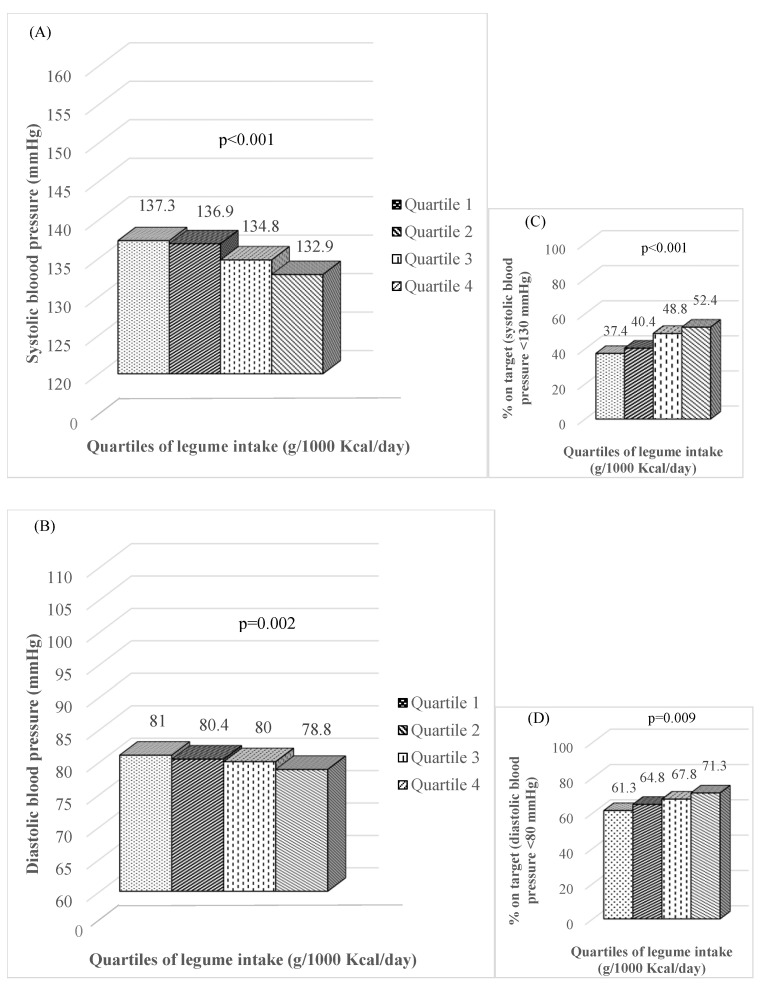
Higher legume consumption was associated with a lower intake of energy, carbohydrates, glycaemic load, alcohol, and sodium, and a significantly greater intake of proteins, fat, monounsaturated, polyunsaturated, fibre, potassium, and polyphenols. Significantly lower systolic and diastolic BP values were observed in the highest vs. lowest quartile of legume consumption (132.9 ± 6.7 vs. 137.3 ± 7.0 mmHg, < 0.001; 78.9 ± 4.1 vs. 81.0 ± 4.2 mmHg, = 0.002; respectively), as well as the proportion of people meeting the treatment targets (61.3% vs. 37.4% and 71.3% vs. 52.4%, respectively, < 0.01). This association was independent from other foods whose consumption is associated with the high legume intake.
In people with T2D and hypertension, three servings of legumes per week are associated with significantly better BP control. This gives further support to current dietary guidelines in recommending the frequent consumption of legumes, as a "ready-to-use" dietary strategy to achieve optimal BP control.
我们的目的是评估习惯性食用豆类与 2 型糖尿病和高血压患者血压控制之间的关系,并探讨豆类或其他食物中的特定营养成分是否有助于调节血压水平。
我们研究了 1897 名患有 2 型糖尿病和高血压的参与者。通过验证后的食物频率问卷评估饮食习惯。创建了豆类消费的性别特异性四分位数。
更高的豆类消费与更低的能量、碳水化合物、血糖负荷、酒精和钠摄入以及更高的蛋白质、脂肪、单不饱和脂肪、多不饱和脂肪、纤维、钾和多酚摄入相关。在最高与最低豆类消费四分位数之间观察到收缩压和舒张压均显著降低(132.9 ± 6.7 与 137.3 ± 7.0mmHg, <0.001;78.9 ± 4.1 与 81.0 ± 4.2mmHg, = 0.002;分别),以及达到治疗目标的人群比例也更高(61.3%与 37.4%和 71.3%与 52.4%,分别, <0.01)。这种关联独立于其他与高豆类摄入量相关的食物消费。
在患有 2 型糖尿病和高血压的人群中,每周食用三份豆类与血压控制显著改善相关。这进一步支持了当前的饮食指南,建议频繁食用豆类作为实现最佳血压控制的“现成”饮食策略。