Colomba Claudia, Guccione Cristoforo, Rubino Raffaella, Scalisi Michela, Condemi Anna, Bagarello Sara, Giordano Salvatore, Cascio Antonio
Department of Health Promotion, Maternal and Infant Care, Internal Medicine and Medical Specialties, University of Palermo, 90127 Palermo, Italy.
Division of Paediatric Infectious Diseases, "G. Di Cristina" Hospital, ARNAS Civico, 90134 Palermo, Italy.
Pathogens. 2022 Aug 14;11(8):913. doi: 10.3390/pathogens11080913.
In the currently ongoing coronavirus pandemic, coinfections with unrelated life-threatening febrile conditions may pose a particular challenge to clinicians. Leishmaniasis is a zoonosis that may present general symptoms, including fever, malaise, and arthralgia, rendering it indistinguishable from COVID-19.
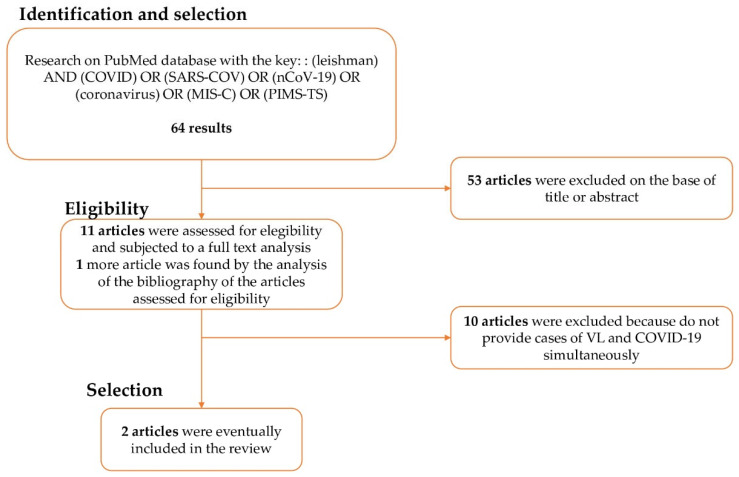
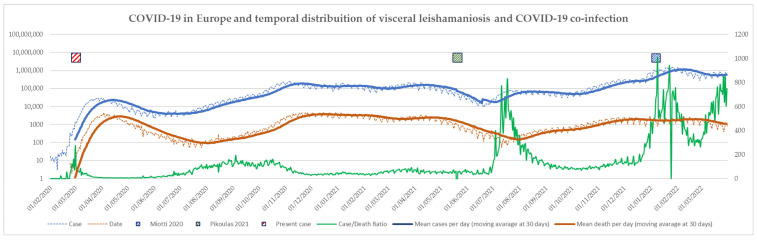
In this paper, we aim to draw attention to this issue and analyze the clinical characteristics of the coinfection SARS-CoV-2/Leishmania through a systematic review of the literature. We were motivated by the observation of the first case of visceral leishmaniasis and COVID-19 in a paediatric patient.
Our case is a reminder for healthcare providers to consider the diagnosis of visceral leishmaniasis in patients presenting with febrile syndrome in endemic regions during the COVID-19 pandemic.
在当前仍在肆虐的冠状病毒大流行中,合并感染其他危及生命的发热性疾病可能给临床医生带来特殊挑战。利什曼病是一种人畜共患病,可能出现包括发热、不适和关节痛在内的一般症状,这使得它与COVID-19难以区分。
在本文中,我们旨在引起对这一问题的关注,并通过对文献的系统回顾分析SARS-CoV-2/利什曼原虫合并感染的临床特征。我们受到一名儿科患者同时感染内脏利什曼病和COVID-19首例病例观察结果的启发。
我们的病例提醒医疗保健人员,在COVID-19大流行期间,对于流行地区出现发热综合征的患者,要考虑内脏利什曼病的诊断。