Mazloum Ali, Van Schalkwyk Antoinette, Chernyshev Roman, Shotin Andrey, Korennoy Fedor I, Igolkin Alexey, Sprygin Alexander
Reference Laboratory for African Swine Fever Virus, FGBI "Federal Centre for Animal Health" (FGBI "ARRIAH"), 600901 Vladimir, Russia.
Agricultural Research Council-Onderstepoort Veterinary Institute, 100 Old Soutpan Road, Onderstepoort 0110, South Africa.
Pathogens. 2022 Aug 15;11(8):919. doi: 10.3390/pathogens11080919.
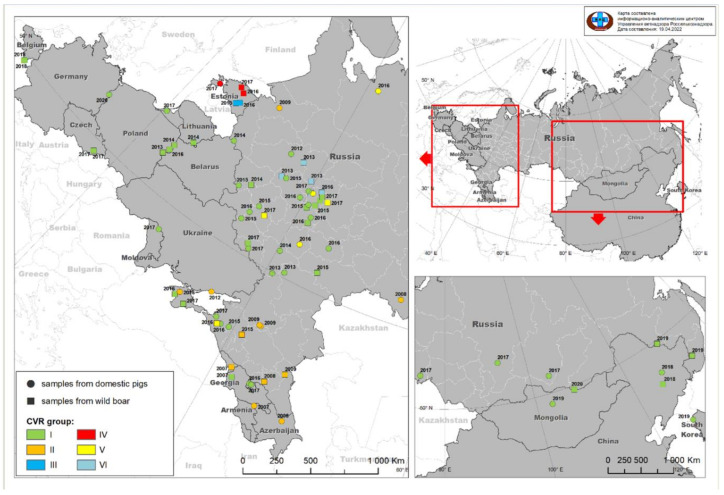
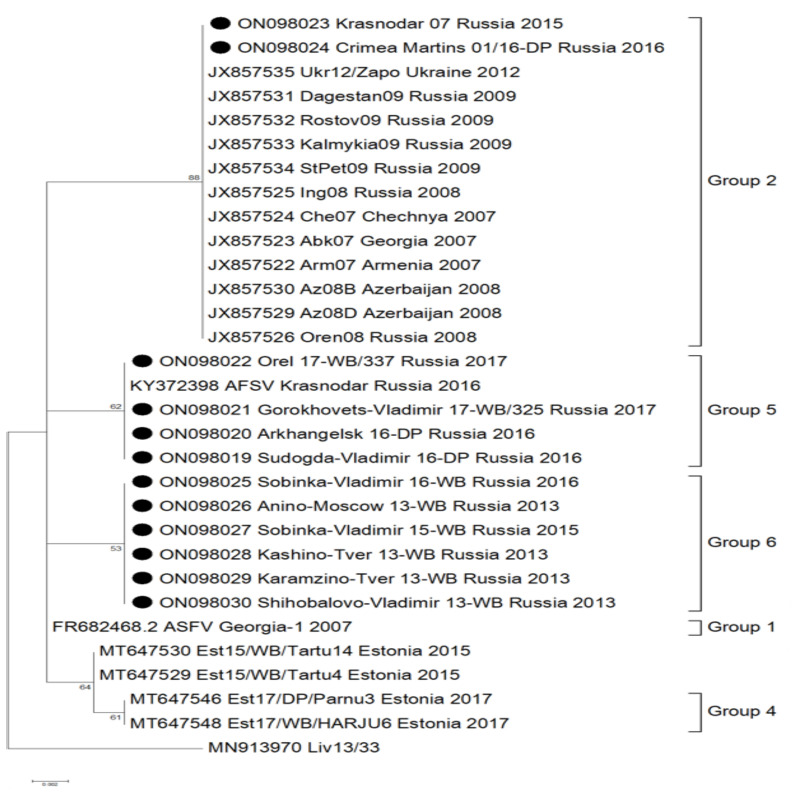
African swine fever virus (ASFV), classified as genotype II, was introduced into Georgia in 2007, and from there, it spread quickly and extensively across the Caucasus to Russia, Europe and Asia. The molecular epidemiology and evolution of these isolates are predominantly investigated by means of phylogenetic analysis based on complete genome sequences. Since this is a costly and time-consuming endeavor, short genomic regions containing informative polymorphisms are pursued and utilized instead. In this study, sequences of the central variable region (CVR) located within the B602L gene were determined for 55 ASFV isolates submitted from 526 active African swine fever (ASF) outbreaks occurring in 23 different regions across the Russian Federation (RF) between 2013 and 2017. The new sequences were compared to previously published data available from Genbank, representing isolates from Europe and Asia. The sequences clustered into six distinct groups. Isolates from Estonia clustered into groups 3 and 4, whilst sequences from the RF were divided into the remaining four groups. Two of these groups (5 and 6) exclusively contained isolates from the RF, while group 2 included isolates from Russia as well as Chechnya, Georgia, Armenia, Azerbaijan and Ukraine. In contrast, group 1 was the largest, containing sequences from the RF, Europe and Asia, and was represented by the sequence from the first isolate in Georgia in 2007. Based on these results, it is recommended that the CVR sequences contain significant informative polymorphisms to be used as a marker for investigating the epidemiology and spread of genotype II ASFVs circulating in the RF, Europe and Asia.
非洲猪瘟病毒(ASFV)被归类为基因型II,于2007年传入格鲁吉亚,此后迅速广泛传播至高加索地区、俄罗斯、欧洲和亚洲。这些分离株的分子流行病学和进化主要通过基于完整基因组序列的系统发育分析进行研究。由于这是一项成本高昂且耗时的工作,因此转而寻求并利用包含信息多态性的短基因组区域。在本研究中,测定了2013年至2017年间俄罗斯联邦(RF)23个不同地区526起活跃的非洲猪瘟(ASF)疫情中提交的55株ASFV分离株位于B602L基因内的中央可变区(CVR)序列。将这些新序列与Genbank中先前公布的代表欧洲和亚洲分离株的数据进行了比较。这些序列聚为六个不同的组。爱沙尼亚的分离株聚为第3组和第4组,而RF的序列则分为其余四组。其中两组(第5组和第6组)仅包含RF的分离株,而第2组包括来自俄罗斯以及车臣、格鲁吉亚、亚美尼亚、阿塞拜疆和乌克兰的分离株。相比之下,第1组最大,包含来自RF、欧洲和亚洲的序列,并以2007年格鲁吉亚首例分离株的序列为代表。基于这些结果,建议CVR序列包含显著的信息多态性,可作为调查在RF、欧洲和亚洲传播的基因型II ASFVs的流行病学和传播情况的标记。