Groupe de Recherche Biotechnologies Appliquées & Bioprocédés environnementaux (GRBA-BE), École Supérieure Polytechnique (ESP)-Université Cheikh Anta Diop, Dakar-Fann, Dakar 5085, Senegal.
Laboratoire Bactériologie Virologie, Centre Hospitalier Régional de Saint-Louis, Saint-Louis, Senegal.
Viruses. 2022 Aug 9;14(8):1742. doi: 10.3390/v14081742.
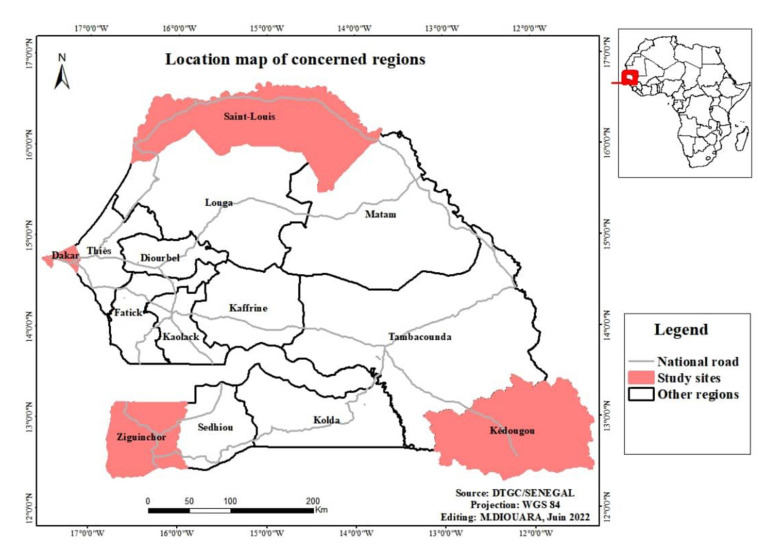
In West Africa, research on the hepatitis E virus (HEV) is barely covered, despite the recorded outbreaks. The low level of access to safe water and adequate sanitation is still one of the main factors of HEV spread in developing countries. HEV infection induces acute or sub-clinical liver diseases with a mortality rate ranging from 0.5 to 4%. The mortality rate is more alarming (15 to 25%) among pregnant women, especially in the last trimester of pregnancy. Herein, we conducted a multicentric socio-demographic and seroepidemiological survey of HEV in Senegal among pregnant women. A consecutive and non-redundant recruitment of participants was carried out over the period of 5 months, from March to July 2021. A total of 1227 consenting participants attending antenatal clinics responded to a standard questionnaire. Plasma samples were collected and tested for anti-HEV IgM and IgG by using the WANTAI HEV-IgM and IgG ELISA assay. The overall HEV seroprevalence was 7.8% (n = 96), with 0.5% (n = 6) and 7.4% (n = 91) for HEV IgM and HEV IgG, respectively. One of the participant samples was IgM/IgG-positive, while four were declared indeterminate to anti-HEV IgM as per the manufacturer’s instructions. From one locality to another, the seroprevalence of HEV antibodies varied from 0 to 1% for HEV IgM and from 1.5 to 10.5% for HEV IgG. The data also showed that seroprevalence varied significantly by marital status (p < 0.0001), by the regularity of income (p = 0.0043), and by access to sanitation services (p = 0.0006). These data could serve as a basis to setup national prevention strategies focused on socio-cultural, environmental, and behavioral aspects for a better management of HEV infection in Senegal.
在西非,尽管有记录的疫情爆发,但对戊型肝炎病毒(HEV)的研究几乎没有涉及。在发展中国家,获得安全用水和适当卫生设施的机会有限仍然是 HEV 传播的主要因素之一。HEV 感染可引起急性或亚临床肝病,死亡率在 0.5%至 4%之间。在孕妇中,死亡率更为惊人(15%至 25%),尤其是在妊娠的最后三个月。在此,我们对塞内加尔孕妇中的 HEV 进行了一项多中心社会人口学和血清流行病学调查。在 2021 年 3 月至 7 月的 5 个月期间,连续且无重复地招募了参与者。共有 1227 名参加产前检查的同意参与者回答了一份标准问卷。采集血浆样本,使用万泰 HEV-IgM 和 IgG ELISA 检测试剂盒检测抗 HEV IgM 和 IgG。总的 HEV 血清流行率为 7.8%(n = 96),HEV IgM 和 HEV IgG 分别为 0.5%(n = 6)和 7.4%(n = 91)。一名参与者的样本 IgM/IgG 均为阳性,而根据制造商的说明,有四个样本抗 HEV IgM 结果不确定。从一个地方到另一个地方,HEV 抗体的血清流行率在 0 至 1%之间变化,而 HEV IgG 在 1.5 至 10.5%之间变化。数据还表明,血清流行率在婚姻状况(p<0.0001)、收入规律(p=0.0043)和获得卫生服务情况(p=0.0006)方面有显著差异。这些数据可以为塞内加尔建立以社会文化、环境和行为方面为重点的国家预防策略提供依据,以更好地管理 HEV 感染。