Exotic Disease Group, National Institute of Animal Health (NIAH), National Agriculture and Food Research Organization (NARO), 6-20-1 Josuihoncho, Kodaira-shi, Tokyo 187-0022, Japan.
Viruses. 2022 Aug 16;14(8):1794. doi: 10.3390/v14081794.
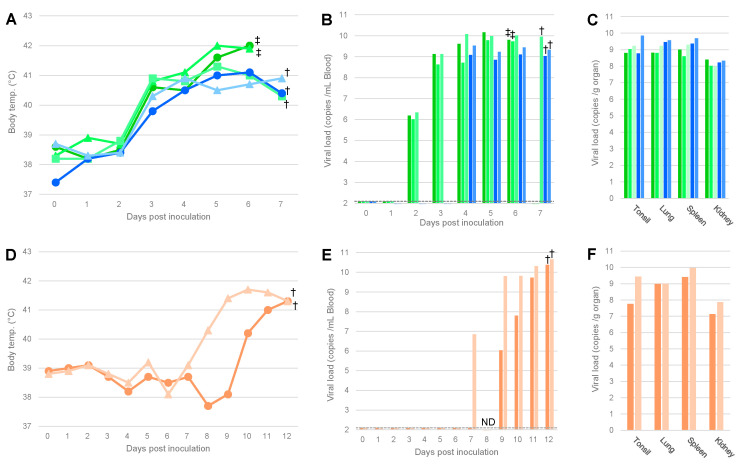
Immortalized porcine kidney macrophage (IPKM) cells are highly susceptible to major African swine fever virus (ASFV) isolates. To clarify the compatibility of this cell line for ASFV isolation from biomaterials, animal experiments and isolation were performed. Pork products seized at international airports were subjected to virus inoculation in pigs () and IPKM cell cultures () to examine the viability and virulence of the contaminating viruses. Moreover, the viruses isolated using IPKM cells were inoculated into pigs to assess the virulence shift from the original materials. All pigs that were inoculated with either homogenate samples of seized pork product or IPKM-isolated ASFVs developed typical symptoms of ASF and died (or were euthanized) within the term of the animal experiments. The success rate of virus isolation in IPKM cells was comparable to that observed in porcine primary alveolar macrophage (PAM) cells. The IPKM cell line would be an ideal tool for the isolation and propagation of live ASFVs with high efficiency and enhanced usability, such as immortal, proliferative, and adhesive properties. The isolated viruses retained biologically similar characteristics to those of the original ones during isolation .
永生化猪肾巨噬细胞(IPKM)细胞对主要的非洲猪瘟病毒(ASFV)分离株高度易感。为了阐明该细胞系用于从生物材料中分离 ASFV 的适用性,进行了动物实验和分离。对在国际机场查获的猪肉产品进行病毒接种,接种到猪()和 IPKM 细胞培养物()中,以检查污染病毒的生存力和毒力。此外,使用 IPKM 细胞分离的病毒接种到猪中,以评估从原始材料中发生的毒力转移。用查获猪肉产品的匀浆样品或从 IPKM 分离的 ASFVs 接种的所有猪都表现出典型的 ASF 症状,并在动物实验期限内死亡(或被安乐死)。在 IPKM 细胞中分离病毒的成功率与在猪原代肺泡巨噬细胞(PAM)细胞中观察到的成功率相当。该 IPKM 细胞系将是一种理想的工具,可用于高效且增强可用性地分离和增殖活 ASFVs,例如具有永生、增殖和黏附特性。在分离过程中,分离的病毒保留了与原始病毒相似的生物学特征。