Division of Gastroenterology, Hepatology and Nutrition, Department of Internal Medicine, The University of Chicago Medicine, 5841 S. Maryland Ave. MC 4076, Chicago, IL 60637, USA.
Viruses. 2022 Aug 19;14(8):1822. doi: 10.3390/v14081822.
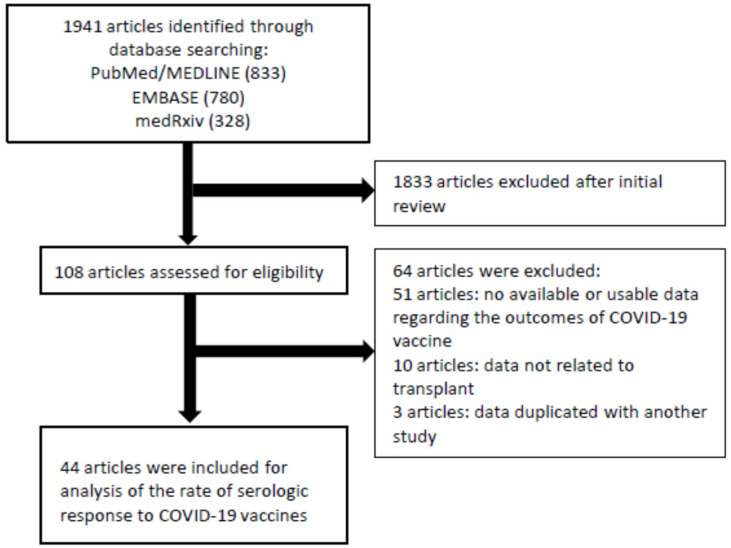
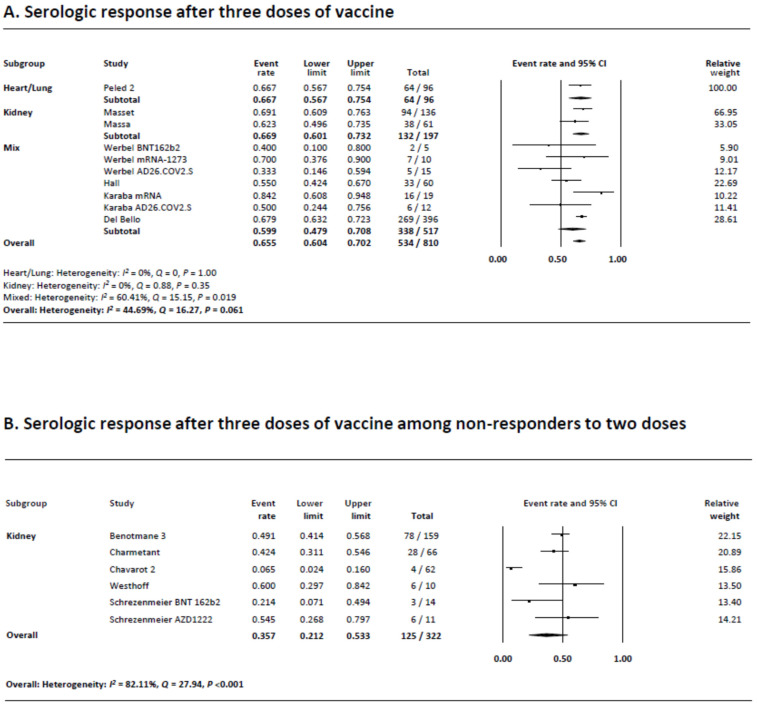
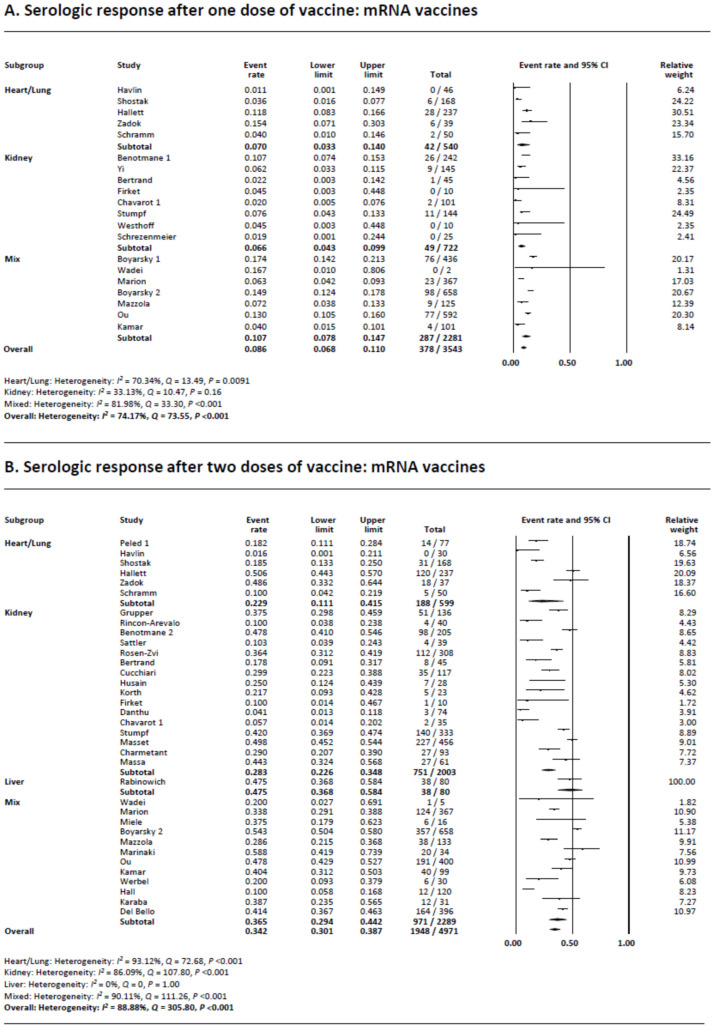
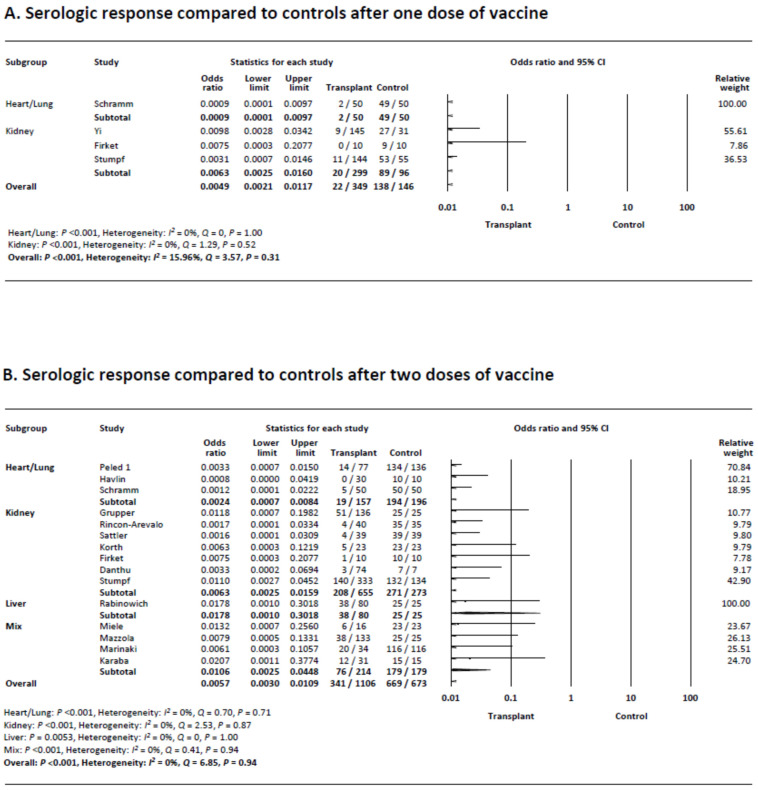
Solid organ transplant (SOT) recipients are at greater risk of coronavirus disease 2019 (COVID-19) and have attenuated response to vaccinations. In the present meta-analysis, we aimed to evaluate the serologic response to the COVID-19 vaccine in SOT recipients. A search of electronic databases was conducted to identify SOT studies that reported the serologic response to COVID-19 vaccination. We analyzed 44 observational studies including 6158 SOT recipients. Most studies were on mRNA vaccination (mRNA-1273 or BNT162b2). After a single and two doses of vaccine, serologic response rates were 8.6% (95% CI 6.8-11.0) and 34.2% (95% CI 30.1-38.7), respectively. Compared to controls, response rates were lower after a single and two doses of vaccine (OR 0.0049 [95% CI 0.0021-0.012] and 0.0057 [95% CI 0.0030-0.011], respectively). A third dose improved the rate to 65.6% (95% CI 60.4-70.2), but in a subset of patients who had not achieved a response after two doses, it remained low at 35.7% (95% CI 21.2-53.3). In summary, only a small proportion of SOT recipients achieved serologic response to the COVID-19 mRNA vaccine, and that even the third dose had an insufficient response. Alternative strategies for prophylaxis in SOT patients need to be developed. In this meta-analysis that included 6158 solid organ transplant recipients, the serologic response to the COVID-19 vaccine was extremely low after one (8.6%) and two doses (34.2%). The third dose of the vaccine improved the rate only to 66%, and in the subset of patients who had not achieved a response after two doses, it remained low at 36%. The results of our study suggest that a significant proportion of solid organ transplant recipients are unable to achieve a sufficient serologic response after completing not only the two series of vaccination but also the third booster dose. There is an urgent need to develop strategies for prophylaxis including modified vaccine schedules or the use of monoclonal antibodies in this vulnerable patient population.
器官移植受者感染 2019 冠状病毒病(COVID-19)的风险更高,且对疫苗的反应减弱。在本次荟萃分析中,我们旨在评估 COVID-19 疫苗在器官移植受者中的血清学反应。通过电子数据库检索,确定了报告 COVID-19 疫苗血清学反应的器官移植研究。我们分析了包括 6158 名器官移植受者在内的 44 项观察性研究。大多数研究是关于 mRNA 疫苗(mRNA-1273 或 BNT162b2)。接种一剂和两剂疫苗后,血清学反应率分别为 8.6%(95%CI 6.8-11.0)和 34.2%(95%CI 30.1-38.7)。与对照组相比,接种一剂和两剂疫苗后的反应率均较低(OR 0.0049 [95%CI 0.0021-0.012] 和 0.0057 [95%CI 0.0030-0.011])。接种第三剂可将该比率提高至 65.6%(95%CI 60.4-70.2),但在两剂后未产生应答的患者亚组中,该比率仍较低,为 35.7%(95%CI 21.2-53.3)。总之,只有一小部分器官移植受者对 COVID-19 mRNA 疫苗产生了血清学反应,甚至第三剂疫苗的反应也不充分。需要开发针对器官移植患者的预防策略。 在这项包括 6158 名实体器官移植受者的荟萃分析中,COVID-19 疫苗接种一剂(8.6%)和两剂(34.2%)后的血清学反应极低。疫苗的第三剂仅将该比率提高到 66%,而在两剂后未产生应答的患者亚组中,该比率仍较低,为 36%。我们的研究结果表明,在完成不仅两系列疫苗接种而且第三剂加强针接种后,相当一部分实体器官移植受者无法产生足够的血清学反应。迫切需要为包括改良疫苗接种时间表或使用单克隆抗体在内的这一脆弱患者群体制定预防策略。