Song Jiaxing, Yu Zhou, Wang Jian, Luo Xiaojun, Du Jie, Tian Zhengxuan, Yang Shunyu, Xie Weihua, Peng Yuqi, Mu Jinlin, Zi Wenjie, Huang Shuchun, Yang Mei
Department of Neurology, Xinqiao Hospital and The Second Affiliated Hospital, Army Medical University (Third Military Medical University), Chongqing, China.
Department of Neurology, The First People's Hospital of Liangshan Yi Autonomous Prefecture, Sichuan, China.
Front Neurol. 2022 Aug 9;13:931507. doi: 10.3389/fneur.2022.931507. eCollection 2022.
This study aimed to investigate the clinical outcomes of endovascular treatment (EVT) for distal basilar artery occlusion (BAO) and compare them with the outcomes of standard medical treatment (SMT) in daily clinical practice.
Patients with distal BAO enrolled in the BASILAR study from January 2014 to May 2019 were included. Differences in clinical outcomes were analyzed using Pearson's chi-square test and multivariable logistic regression. Clinical outcomes were evaluated using the modified Rankin Scale (mRS) score at 90 days, the mortality at 90 days, and the occurrence of symptomatic intracranial hemorrhage within 48 h.
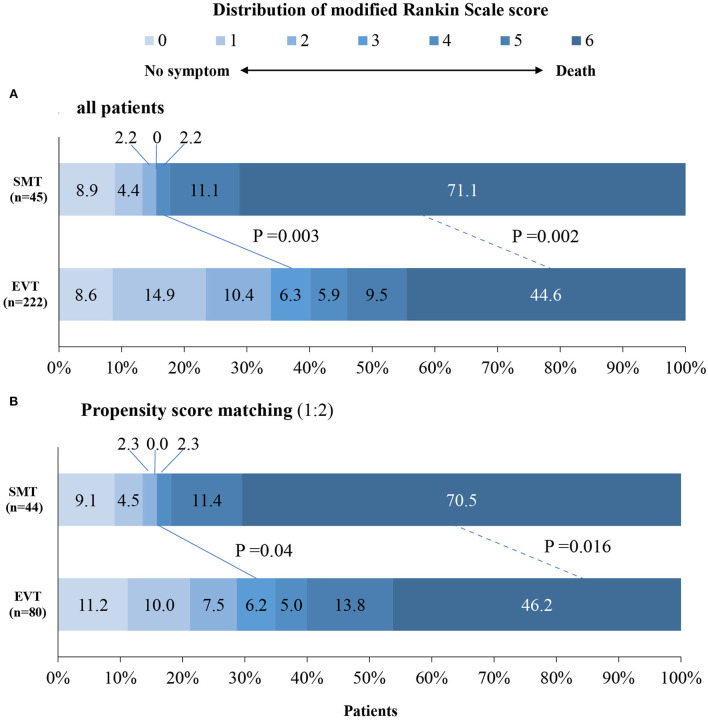
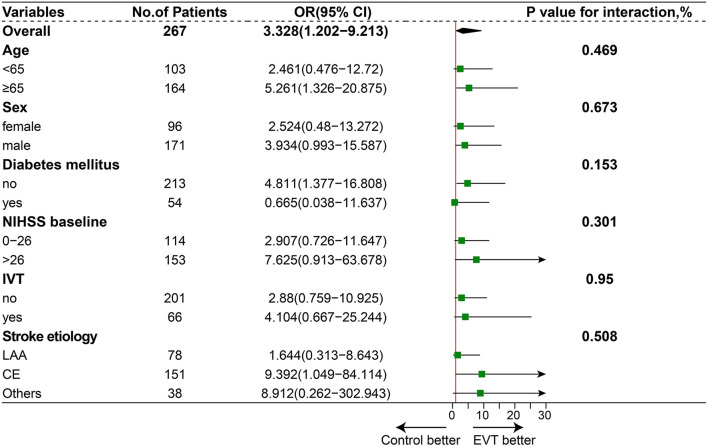
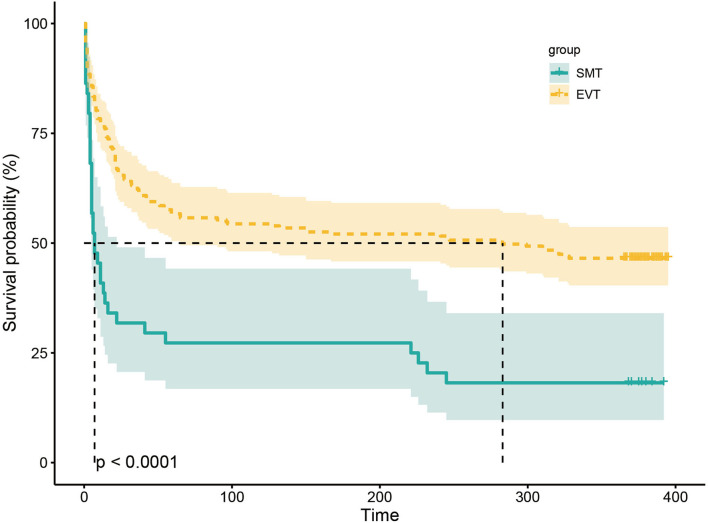
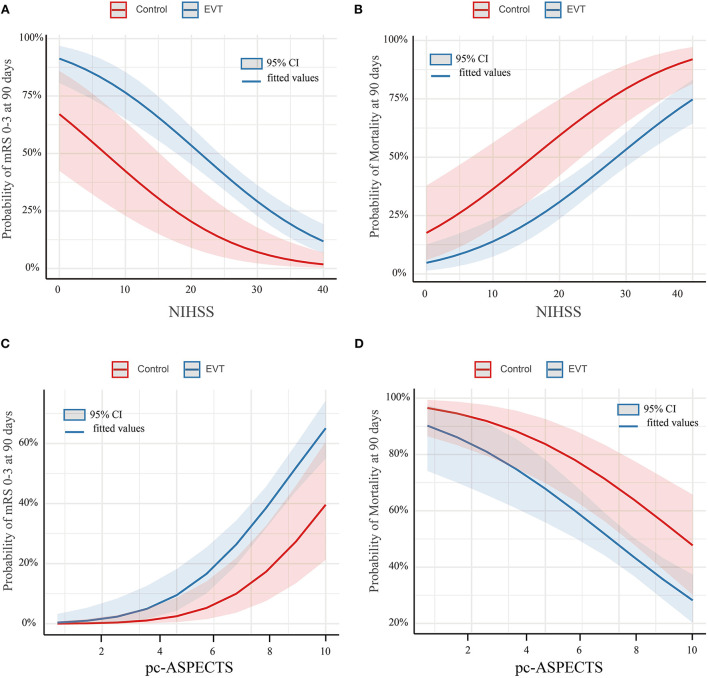
Among the 267 patients with distal BAO (222 patients in the EVT group and 45 patients in the SMT group), compared with the SMT group, the EVT group was associated with a favorable outcome (mRS 0-3; 40.1 vs. 15.6%; aOR 5.44; 95% CI, 1.68-17.66; = 0.005) and decreased mortality (44.6 vs. 71.1%, aOR 0.32, 95% CI, 0.13-0.77; = 0.012). In the EVT group, multivariable analysis showed that the initial National Institutes of Health Stroke Scale (NIHSS) score and posterior circulation-Alberta Stroke Program Early CT Score (pc-ASPECTS) were associated with favorable functional outcomes and mortality.
Our study suggests that, compared with SMT, EVT is technically feasible and safe for patients with distal BAO.
本研究旨在调查远端基底动脉闭塞(BAO)血管内治疗(EVT)的临床结局,并将其与日常临床实践中标准药物治疗(SMT)的结局进行比较。
纳入2014年1月至2019年5月参加BASILAR研究的远端BAO患者。使用Pearson卡方检验和多变量逻辑回归分析临床结局的差异。使用改良Rankin量表(mRS)评分评估90天时的临床结局、90天时的死亡率以及48小时内症状性颅内出血的发生情况。
在267例远端BAO患者中(EVT组222例,SMT组45例),与SMT组相比,EVT组的良好结局(mRS 0 - 3)发生率更高(40.1%对15.6%;调整后比值比[aOR] 5.44;95%置信区间[CI],1.68 - 17.66;P = 0.005),死亡率更低(44.6%对71.1%,aOR 0.32,95% CI,0.13 - 0.77;P = 0.012)。在EVT组中,多变量分析显示,初始美国国立卫生研究院卒中量表(NIHSS)评分和后循环 - 艾伯塔卒中项目早期CT评分(pc - ASPECTS)与良好的功能结局和死亡率相关。
我们的研究表明,与SMT相比,EVT对远端BAO患者在技术上是可行且安全的。